Culligan vs Aquasana
The cleanest illustration of this site's whole argument. Culligan has the mark and hides the media. Aquasana names the media and does not have the mark. You cannot have both in this category.
Disclosure — some links on this page go to Amazon, and we earn a commission if you buy through them. It costs you nothing extra and it does not change what we recommend or in what order. The full disclosure.
Culligan is tested and certified by IAPMO R&T to NSF/ANSI 177 and does not publish its media. Aquasana names copper-zinc KDF plus coconut shell carbon, claims over 90 percent chlorine reduction, and is tested to NSF/ANSI 177 rather than certified against it. Both run 10,000-gallon cartridges.
Quick picks
Ranked on what can be verified: a traceable certification first, then media matched to your disinfectant. Tap a row to jump to the full write-up.
| # | Product | Best for | Certification | Price |
|---|---|---|---|---|
| 1 |  Culligan HSH-C135One of the few units in this category with a certification you can trace to the body that issued it. Culligan states plainly that the HSH-C135 is tested and certified by IAPMO R&T, and it runs the same WHR-140 cartridge and the same 10,000-gallon interval as the rest of its filtered range.Not published | A certified handheld shower head | NSF/ANSI 177 | |
| 2 | 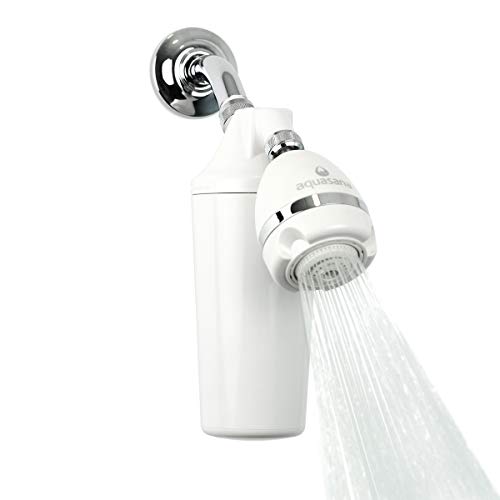 Aquasana AQ-4100One of the few units whose maker names the media outright — copper-zinc KDF plus coconut shell carbon — and one of the few that says anything at all about chloramine. Read its certification line carefully: it is tested to NSF/ANSI 177, not certified to it.Patented copper-zinc (KDF) plus coconut shel… | KDF plus carbon, with the media stated | None |
Every figure in this table links to the page it came from in the write-ups below. Units we claim to have tested: 0.
Culligan HSH-C135
A certified handheld shower head
One of the few units in this category with a certification you can trace to the body that issued it. Culligan states plainly that the HSH-C135 is tested and certified by IAPMO R&T, and it runs the same WHR-140 cartridge and the same 10,000-gallon interval as the rest of its filtered range.
Published specifications
- Filter media
- Not publishedCulligan states what the unit reduces, but not what media does the reducing.
- Stated flow rate
- 1.8 GPMSource: Culligan — HSH-C135 hand-held filtered showerhead (retrieved 2026-09-01)
- Rated cartridge life
- 10,000 gallons, or 6 monthsSource: Culligan — HSH-C135 hand-held filtered showerhead (retrieved 2026-09-01)
- Chloramine
- Not publishedCulligan publishes nothing about chloramine for this unit.
- Format
- Handheld shower head with integrated filter, supplied with a hose and wall bracketSource: Culligan — HSH-C135 hand-held filtered showerhead (retrieved 2026-09-01)
- Housing
- Plastic, chrome finishSource: Culligan HSH-C135 — listing on Amazon.com (retrieved 2026-09-01)
What it does well
- Explicitly "tested and certified by IAPMO R&T", with the certifying body named
- Published cartridge life of 10,000 gallons or 6 months
- Five spray settings and a published 1.8 GPM rating
- The WHR-140 cartridge is shared across several Culligan units, which keeps it easy to find
Where it falls short
- Culligan does not publish what is inside the cartridge
- No chloramine data
- Replaces the shower head rather than adding to it
What it does not do
- It does not soften water, and Culligan does not claim it does.
- It states nothing about chloramine.
- Culligan does not publish the filter media used in it.
Who it is for
Someone who wants a certified chlorine filter, and who wants a handheld on a hose rather than a fixed head or an inline unit.
Skip it if
You like your current shower head. This replaces it, and its 1.8 GPM is a fixed part of the deal.
#ad · how we are funded · price as of October 16, 2026
Aquasana AQ-4100
KDF plus carbon, with the media stated
One of the few units whose maker names the media outright — copper-zinc KDF plus coconut shell carbon — and one of the few that says anything at all about chloramine. Read its certification line carefully: it is tested to NSF/ANSI 177, not certified to it.
Published specifications
- Filter media
- Patented copper-zinc (KDF) plus coconut shell carbonSource: Aquasana — shower filter with shower head (retrieved 2026-09-01)
- Stated flow rate
- 2.5 GPMStated as the optimum flow rate.Source: Aquasana — shower filter with shower head (retrieved 2026-09-01)
- Rated cartridge life
- 10,000 gallons, or up to 6 monthsSource: Aquasana — shower filter with shower head (retrieved 2026-09-01)
- Chloramine
- Chloramines listed among contaminants reduced; no percentage publishedSource: Aquasana — shower filter with shower head (retrieved 2026-09-01)
- Format
- Filter body with shower head; a head-free version (AQ-4100NSH) also existsSource: Aquasana AQ-4100 — listing on Amazon.com (retrieved 2026-09-01)
- Housing
- Not publishedAquasana does not state a housing material.
What it does well
- Names its media: patented copper-zinc (KDF) and coconut shell carbon
- Published capacity of 10,000 gallons or up to 6 months
- Publishes a chlorine reduction figure of over 90%
- Sold with a head or as a filter-only unit for an existing head
Where it falls short
- Tested to NSF/ANSI 177 rather than certified to it
- Chloramine is listed but not quantified
- 2.5 GPM is above the 1.8 GPM cap some states apply to new fixtures
What it does not do
- It does not soften water, and Aquasana makes no softening claim.
- It is not certified by NSF; the wording is "independently tested to NSF/ANSI Standard 177".
- It lists chloramines among what it reduces without publishing a reduction percentage for them.
Who it is for
Someone who wants a stated media list and a published capacity, and who cares more about what is inside than about the finish.
Skip it if
You need a certification mark rather than a testing claim. "Independently tested to" is a weaker statement than "certified by", and the difference matters.
#ad · how we are funded · price as of October 16, 2026
Side by side
Every figure is the manufacturer's own published data, sourced on each product page. Neither unit appears in an independent bench test we could locate.
Tested to, versus certified by
Aquasana's wording is "independently tested to NSF/ANSI Standard 177". Culligan's is "tested and certified by IAPMO R & T". Those look similar and are not.
Tested to means a laboratory ran the protocol once, on data the manufacturer commissioned and controls. Certified by means an accredited body reviewed that data, audited the production line, listed the model publicly, and keeps auditing it. The first is a snapshot; the second is a continuing obligation to a third party. Only the second is something you can look up. How to check either in about two minutes.
What Aquasana gives you that Culligan will not
The contents. Aquasana names copper-zinc KDF and coconut shell carbon outright, which lets you reason about the product instead of trusting it. KDF handles free chlorine well at shower contact time. Carbon adds adsorption capacity. Knowing the pairing tells you roughly what to expect and, more usefully, what not to.
Culligan publishes what the unit reduces — chlorine, sulfur odor and scale — but not what does the reducing. That is an odd combination next to a real certification, and it is the single thing we would change about the product. A certified unit that named its media would be the strongest product in this category.
The chloramine line is worth reading carefully
Aquasana lists chloramines among the contaminants its filter reduces, and publishes no percentage for it. That is more than most of this category says — most says nothing at all — but a contaminant named in a list without a figure is not a performance claim you can check. If chloramine is your actual problem, the media classes with a real mechanism against it are vitamin C and catalytic carbon, and the NSF/ANSI 177 standard that Culligan holds explicitly does not evaluate it.
Flow, and the thing nobody mentions
Aquasana's 2.5 GPM against Culligan's 1.8 GPM is a real difference in feel, and it cuts both ways. 2.5 GPM is the federal cap and will feel stronger; 1.8 GPM is what several states now require on new fixtures, and it is the figure Culligan sells today. If you live somewhere with a 1.8 cap, that decides it for you. What filters do to pressure.
The verdict
- Buy Culligan if a certification you can trace to a named body is the thing you are buying, and you can accept not knowing what is in the cartridge.
- Buy Aquasana if you would rather know the media and reason about it yourself, and you treat "tested to" as what it is — a manufacturer-commissioned result rather than an audited mark.
- Buy Aquasana if you want the higher flow rate and your state allows it.
- Buy neither for hard water. Neither softens, and Culligan's "scale" claim is about deposits rather than hardness itself.
- If chloramine is your problem, neither is aimed at it. Aquasana at least names it; that is not the same as a figure.
What we would skip, and why
Questions people actually ask
+ Is the Aquasana AQ-4100 NSF certified?
No. Aquasana states it is independently tested to NSF/ANSI Standard 177, which means a lab ran the protocol. It does not name a certifying body and does not appear in a certifier's public listing. The Culligan does both.
+ Which is better, Culligan or Aquasana?
They trade different things. Culligan gives you an audited certification and withholds the media list; Aquasana gives you the media list and only a testing claim. If you rank verification first, Culligan. If you rank knowing the contents first, Aquasana.
+ Does either remove chloramine?
Aquasana lists chloramines among what it reduces but publishes no percentage. Culligan publishes nothing about chloramine. NSF/ANSI 177, the standard Culligan holds, explicitly excludes chloramine performance.
+ What is the flow rate difference?
Aquasana publishes 2.5 GPM, Culligan 1.8 GPM. 2.5 is the federal maximum; 1.8 is what several states now require on new fixtures.
Sources
Everything on this page traces to one of these. Where a source is brand-owned we say so, because a filter maker explaining filter chemistry has an interest and you are entitled to weigh it.
- Plumbing & Mechanical, "NSF/ANSI Standard 177: A Level Playing Field for Shower Filter Claims" (retrieved 2026-09-01)
- NSF — NSF/ANSI 177 shower filter certification program
- WaterFilterGuru, "The Best Shower Head Filter" — independent lab testing, credited to them (retrieved 2026-09-01)
- US EPA WaterSense — showerheads and the 2.5 gpm federal maximum