Aquasana AQ-4100 review
One of the few units that names its media and says something about chloramine. Its certification line is a testing claim, and the difference is the point.
Disclosure — some links on this page go to Amazon, and we earn a commission if you buy through them. It costs you nothing extra and it does not change what we recommend or in what order. The full disclosure.
Aquasana names its media — patented copper-zinc (KDF) and coconut shell carbon — publishes 2.5 GPM, 10,000 gallons or up to 6 months, and over 90 percent chlorine reduction. Its certification line reads "independently tested to NSF/ANSI Standard 177", which is a testing claim rather than a certification.
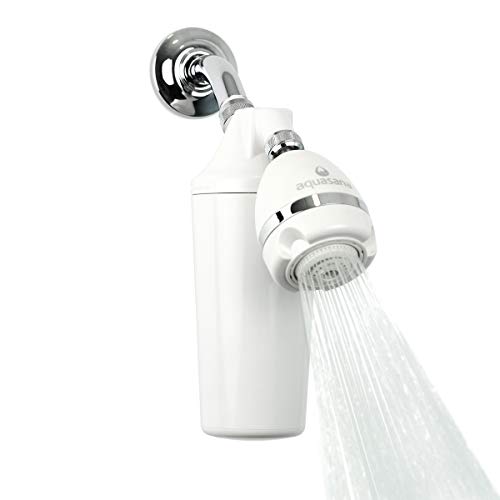
Aquasana AQ-4100
KDF plus carbon, with the media stated
One of the few units whose maker names the media outright — copper-zinc KDF plus coconut shell carbon — and one of the few that says anything at all about chloramine. Read its certification line carefully: it is tested to NSF/ANSI 177, not certified to it.
Published specifications
- Filter media
- Patented copper-zinc (KDF) plus coconut shell carbonSource: Aquasana — shower filter with shower head (retrieved 2026-09-01)
- Stated flow rate
- 2.5 GPMStated as the optimum flow rate.Source: Aquasana — shower filter with shower head (retrieved 2026-09-01)
- Rated cartridge life
- 10,000 gallons, or up to 6 monthsSource: Aquasana — shower filter with shower head (retrieved 2026-09-01)
- Chloramine
- Chloramines listed among contaminants reduced; no percentage publishedSource: Aquasana — shower filter with shower head (retrieved 2026-09-01)
- Format
- Filter body with shower head; a head-free version (AQ-4100NSH) also existsSource: Aquasana AQ-4100 — listing on Amazon.com (retrieved 2026-09-01)
- Housing
- Not publishedAquasana does not state a housing material.
What it does well
- Names its media: patented copper-zinc (KDF) and coconut shell carbon
- Published capacity of 10,000 gallons or up to 6 months
- Publishes a chlorine reduction figure of over 90%
- Sold with a head or as a filter-only unit for an existing head
Where it falls short
- Tested to NSF/ANSI 177 rather than certified to it
- Chloramine is listed but not quantified
- 2.5 GPM is above the 1.8 GPM cap some states apply to new fixtures
What it does not do
- It does not soften water, and Aquasana makes no softening claim.
- It is not certified by NSF; the wording is "independently tested to NSF/ANSI Standard 177".
- It lists chloramines among what it reduces without publishing a reduction percentage for them.
Who it is for
Someone who wants a stated media list and a published capacity, and who cares more about what is inside than about the finish.
Skip it if
You need a certification mark rather than a testing claim. "Independently tested to" is a weaker statement than "certified by", and the difference matters.
#ad · how we are funded · price as of October 16, 2026
Certifications and claims
Two tables, deliberately. A certification names a standard and the body that issued it, and you can look it up. A claim is the maker describing itself. Both belong here; conflating them does not.
No third-party certification is published for this product. That is not evidence of poor performance and it is not evidence of good performance — it means there is nothing independent to check.
“Independently tested to NSF/ANSI Standard 177”
Source: Aquasana — shower filter with shower head (retrieved 2026-09-01)“Reduces over 90% of chlorine”
Source: Aquasana — shower filter with shower head (retrieved 2026-09-01)
Tested to, versus certified by
This is a distinction we make on every page, and the AQ-4100 is the clearest illustration of it. "Independently tested to NSF/ANSI Standard 177" says a lab ran the standard's protocol against the product. "Tested and certified by IAPMO R&T" — which is what the Culligan says — means a certifying body issued a mark, maintains a listing, and audits it.
The first is likely true and is not checkable by you. The second is checkable in a public directory. Aquasana's wording is more transparent than the "surpassing NSF-177" construction that Jolie and eskiin use, because at least it identifies what was done. It is still not a certification, and this site does not treat it as one.
It says something about chloramine, which is rare
Aquasana lists chloramines among the contaminants reduced. It publishes no percentage for them, which is a real limitation — but naming chloramine at all puts it in a very small group. The vast majority of this category is silent on the disinfectant a fifth of American water systems use.
The media makes it plausible without proving it. Coconut shell carbon can act on chloramine given contact time, and KDF's redox chemistry does not. Without a published figure we cannot tell you how much of the chloramine in your water it will remove. If chloramine is your problem, the products that address it directly are the better-founded bet.
The 2.5 GPM question
Aquasana states 2.5 GPM as the optimum flow rate. That is the federal maximum for new shower heads and above the 1.8 GPM cap that applies in California and New York. It matters for two reasons: a higher flow rate means a stronger shower, and it means less contact time per unit of water passing through the media.
The contact-time consideration is the more interesting one. Every media in this category performs better at lower flow — that is why the standard specifies the flow rate its test runs at. A unit rated at 2.5 GPM is being asked to do the same chemistry in fewer milliseconds than one rated at 1.8.
Who it is for
- You want the media named rather than counted in stages.
- You want a large published capacity you can actually cost out.
- You want a unit that at least addresses chloramine in its claims, even without a figure.
- You want the choice of head-included or filter-only.
Who should skip it
- You want a certification mark rather than a testing claim. Culligan and Sprite both give you one.
- You live somewhere with a 1.8 GPM fixture cap and are buying the head version.
- Chloramine is your specific problem and you want a number. There is not one.
- You want hardness dealt with. Nothing here does.
Questions people actually ask
+ Is the Aquasana AQ-4100 NSF certified?
Its published wording is "independently tested to NSF/ANSI Standard 177". That is a testing claim rather than a certification issued by a certifying body.
+ What media does the AQ-4100 use?
Patented copper-zinc (KDF) plus coconut shell carbon, named on Aquasana's own product page.
+ Does the Aquasana filter remove chloramine?
Aquasana lists chloramines among the contaminants reduced but publishes no percentage. The carbon makes it plausible; without a figure we cannot tell you how much.
+ How long does the AQ-4100 cartridge last?
10,000 gallons or up to 6 months, whichever comes first.
+ Is 2.5 GPM allowed where I live?
It is the federal maximum, but California and New York cap new shower heads at 1.8 GPM. The filter-only AQ-4100NSH version avoids the question by keeping your existing head.
Sources
Everything on this page traces to one of these. Where a source is brand-owned we say so, because a filter maker explaining filter chemistry has an interest and you are entitled to weigh it.
- Plumbing & Mechanical, "NSF/ANSI Standard 177: A Level Playing Field for Shower Filter Claims" (retrieved 2026-09-01)
- NSF — NSF/ANSI 177 shower filter certification program
- US EPA WaterSense — showerheads and the 2.5 gpm federal maximum
- AquaEarth, "KDF vs vitamin C vs carbon shower filter" — brand-owned explainer, cited with that stated (retrieved 2026-09-01)