This is the cluster where the category makes its biggest promises. We went and read the studies, including the ones that did not find what the marketing says they found.
Disclosure — some links on this page go to Amazon, and we earn a commission if you buy through them. It costs you nothing extra and it does not change what we recommend or in what order. The full disclosure.
The short answer
Hard water measurably reduces hair tensile strength, so breakage is a real, evidenced problem. Chlorine oxidizes keratin, so reducing chlorine is a defensible benefit. But a shower filter removes no hardness, and nothing here treats androgenetic hair loss. Shedding, breakage and hair loss are three claims, and they need separating.
This is the promise the whole category is sold on, and it is where the reasoning gets loosest. So take the claims one at a time and ask what has actually been measured.
Hard water and hair: measured, and not fixed by a filter
Luqman and colleagues published a controlled comparison in the International Journal of Trichology in 2018. Three groups of hair — untreated control, deionized water, hard water — measured for tensile strength on a universal testing machine. Mean values were 255.49 for the control, 254.84 after deionized water, and 234.16 after hard water. The hard-water result was significant at P = 0.001; the deionized result was not significant at P = 0.609. Their conclusion was that hard water decreases the strength of hair and thus increases breakage.
That is a genuine finding, and it is the strongest evidence in the category. It is also a finding about hardness — which, as the hard water section sets out, no shower filter removes. If hardness is what is weakening your hair, the treatment is a softener, not a filter. That conclusion is inconvenient for a site funded by filter commissions, and it is what the evidence says.
Chlorine and keratin: plausible, and addressable
Chlorinated water is an oxidizing environment, and keratin's structure depends on disulfide bonds that oxidation degrades. This is the well-established mechanism behind the condition of competitive swimmers' hair, although the research on swimmers also points out that daily mechanical handling contributes as much as the chemistry. For a domestic shower the exposure is far lower, so expect a smaller effect — but this is the one stressor in the list that a filter genuinely removes, and the good ones remove nearly all of it.
Skin, eczema, and a trial worth knowing about
There is an observational association between living in a hard-water area and childhood eczema; a systematic review and meta-analysis of water hardness and atopic eczema found it. The obvious next question is whether removing the hardness helps, and that question has actually been tested. The Softened Water Eczema Trial randomized children with eczema to a domestic ion-exchange softener or to standard care, and found no significant difference in objective eczema severity.
That does not make a filter useless for skin. Chlorine is a known irritant, reducing it is a reasonable thing to do for skin that reacts, and plenty of people report the change. We are drawing a line between what people report and what has been demonstrated, and saying which is which.
Quick picks
Ranked on what can be verified: a traceable certification first, then media matched to your disinfectant. Tap a row to jump to the full write-up.
#
Product
Best for
Certification
Price
1
Weddell Duo Shower FilterThe only filter in this set whose maker publishes its NSF test dates and reduction ranges, and the one an independent lab measured at 100% chlorine removal. It also removed disinfection byproducts, which almost nothing else did.Dual cartridge: sediment filter plus activat…
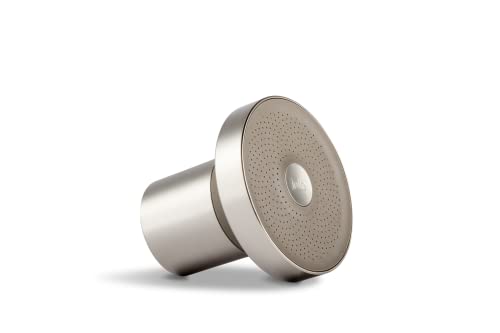
Jolie Filtered ShowerheadThe most searched shower filter in the United States, with a media pairing that makes sense and a certification line that does not. "Surpassing NSF-177 certifications" is a claim about exceeding a standard the product is not stated to hold.KDF-55 and calcium sulfite
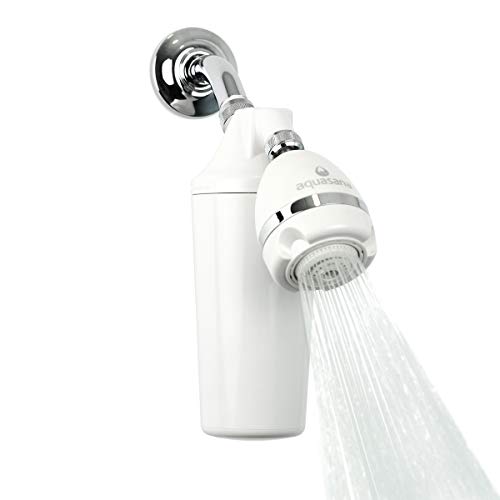
Aquasana AQ-4100One of the few units whose maker names the media outright — copper-zinc KDF plus coconut shell carbon — and one of the few that says anything at all about chloramine. Read its certification line carefully: it is tested to NSF/ANSI 177, not certified to it.Patented copper-zinc (KDF) plus coconut shel…
Canopy Filtered ShowerheadCanopy publishes almost nothing you can check — no media, no flow rate, no capacity, no certification. What saves it is somebody else's number: WaterFilterGuru measured 97% chlorine reduction, from 2.7 PPM down to 0.06.Not published
AquaBliss SF100 Daily RevitalizeThe one product here whose maker states outright that it reduces chloramine as well as chlorine, and then backs that up by routing chloramine customers away from its own cheaper model. That is an unusually honest piece of product literature.Three stages: sand filter, stainless mesh an…
Every figure in this table links to the page it came from in the write-ups below. Units we claim to have tested: 0.
Top pick
Weddell Duo Shower Filter
Chlorine and disinfection byproducts
The only filter in this set whose maker publishes its NSF test dates and reduction ranges, and the one an independent lab measured at 100% chlorine removal. It also removed disinfection byproducts, which almost nothing else did.
+Independently measured at 100% chlorine reduction and confirmed to remove disinfection byproducts
+2.8 GPM rating is the highest published flow in this set
+Clear cartridges let you see the sediment stage loading up
Where it falls short
−Publishes nothing about chloramine
−Two cartridges to replace instead of one
−Inline format adds length between the arm and the head
What it does not do
×It does not soften water. An independent lab measured hardness at 125.59 PPM after filtration — effectively unchanged.
×It publishes no chloramine performance data of any kind.
×It is an inline unit, so it does not replace or improve your shower head.
Who it is for
Anyone on chlorinated municipal water who wants the strongest published evidence rather than the strongest published adjectives.
Skip it if
Your utility uses chloramine. Weddell publishes nothing about chloramine performance, and an activated carbon block sized for shower flow is not the thing to bet on for it — see the chloramine guide.
The most searched shower filter in the United States, with a media pairing that makes sense and a certification line that does not. "Surpassing NSF-177 certifications" is a claim about exceeding a standard the product is not stated to hold.
Not publishedJolie lists finishes rather than a housing material.
What it does well
+Media named outright: KDF-55 and calcium sulfite
+1.8 GPM, compliant with California and New York flow limits
+90-day cartridge cadence on subscription, so replacement actually happens
+Replaces the shower head, so there is nothing extra hanging off the arm
Where it falls short
−"Surpassing NSF-177 certifications" is a claim, not a certification
−No gallon capacity published, so cost per gallon cannot be computed from its own data
−Nothing published about chloramine
What it does not do
×It does not soften water. KDF-55 and calcium sulfite do not remove calcium or magnesium.
×It does not hold a stated NSF/ANSI 177 certification; the published wording is that it surpasses NSF-177 certifications.
×It does not treat hair loss. Reduced shedding and reduced breakage are different claims from androgenetic hair loss — see the hair-loss evidence page.
Who it is for
A reader who wants the well-known unit, a 1.8 GPM head that meets state flow limits, and a subscription that removes the decision about when to change the cartridge.
Skip it if
You want a verifiable certification rather than a testing claim, or you want a published gallon capacity you can do arithmetic with.
One of the few units whose maker names the media outright — copper-zinc KDF plus coconut shell carbon — and one of the few that says anything at all about chloramine. Read its certification line carefully: it is tested to NSF/ANSI 177, not certified to it.
Not publishedAquasana does not state a housing material.
What it does well
+Names its media: patented copper-zinc (KDF) and coconut shell carbon
+Published capacity of 10,000 gallons or up to 6 months
+Publishes a chlorine reduction figure of over 90%
+Sold with a head or as a filter-only unit for an existing head
Where it falls short
−Tested to NSF/ANSI 177 rather than certified to it
−Chloramine is listed but not quantified
−2.5 GPM is above the 1.8 GPM cap some states apply to new fixtures
What it does not do
×It does not soften water, and Aquasana makes no softening claim.
×It is not certified by NSF; the wording is "independently tested to NSF/ANSI Standard 177".
×It lists chloramines among what it reduces without publishing a reduction percentage for them.
Who it is for
Someone who wants a stated media list and a published capacity, and who cares more about what is inside than about the finish.
Skip it if
You need a certification mark rather than a testing claim. "Independently tested to" is a weaker statement than "certified by", and the difference matters.
Canopy publishes almost nothing you can check — no media, no flow rate, no capacity, no certification. What saves it is somebody else's number: WaterFilterGuru measured 97% chlorine reduction, from 2.7 PPM down to 0.06.
Published specifications
Filter media
Not publishedCanopy's own product page states no filter media. We checked it on 2026-09-01.
Stated flow rate
Not publishedNo flow rate is published on Canopy's product page.
Rated cartridge life
Not publishedNo gallon capacity or replacement interval is published on the product page.
The one product here whose maker states outright that it reduces chloramine as well as chlorine, and then backs that up by routing chloramine customers away from its own cheaper model. That is an unusually honest piece of product literature.
Androgenetic hair loss is driven by hormones and follicle sensitivity. No filter addresses it. Reduced breakage is a real and different benefit, and honest brands say breakage.
Skip this
Any "dermatologist recommended" line with no dermatologist named
It is a marketing phrase, not a citation. Where a brand publishes a study, we link it and say who ran it. Where it does not, we say that instead.
The strongest trial found no benefit, and chlorine is still a real irritant. What to buy if you are buying anyway, with the evidence stated before the ranking.
It can reduce chlorine-driven damage and breakage. It does not treat androgenetic hair loss, and no filter has been shown to. The full evidence.
+ Can a shower filter help eczema?
Possibly by reducing chlorine, an irritant. But a randomized trial of whole-house softeners found no significant improvement in eczema severity, and a shower filter does less than a softener. The trial and what it means.
+ Is a shower filter good for hair?
For chlorine, yes, with a plausible mechanism. For hardness damage, no, because it removes no hardness. Which one matters to you depends on your water.
+ Can a shower filter cause hair loss?
We found no evidence that one does. The one indirect route worth mentioning is that some filters reduce flow, and heavier mechanical handling of hair does contribute to breakage.
+ Does a shower filter help with dry scalp?
It is the most plausible claim in this cluster, because both chlorine and hardness contribute to a dry, tight scalp and a filter removes one of them. The detail.
Sources
Everything on this page traces to one of these. Where a source is brand-owned we say so, because a filter maker explaining filter chemistry has an interest and you are entitled to weigh it.