Disclosure — some links on this page go to Amazon, and we earn a commission if you buy through them. It costs you nothing extra and it does not change what we recommend or in what order. The full disclosure.
The short answer
A shower filter reduces free chlorine, some disinfection byproducts, sediment and some dissolved metals. It does not remove hardness minerals, and standard KDF media does not neutralize chloramine. Which of those your water contains decides which filter is worth buying, and your utility publishes the answer annually.
Roughly one in five American water systems disinfects with chloramine rather than free chlorine, and the two behave completely differently in a filter. Free chlorine is reactive and comparatively easy to knock down: KDF-55 strips electrons from it in a redox reaction, activated carbon adsorbs it given contact time, and ascorbic acid neutralizes it chemically. Chloramine is chlorine bonded to ammonia, it is deliberately more stable so that it persists further down the distribution main, and that stability is exactly what makes it hard to remove at a shower head.
This is not a subtle difference in performance. It is the difference between a product working and a product not working, and yet not one of the roundups we surveyed asks the reader which disinfectant they have before recommending a single best filter to everybody. That is the gap this section exists to fill.
The certification does not help you here
NSF/ANSI 177 is the shower filter standard, and it is narrower than almost anyone assumes. A certified filter must reduce a 2.0 mg/L free available chlorine challenge by at least 50 percent across its rated life, hold structural integrity to 125 psi, use materials with no intentional lead, maintain at least 1 gpm at 80 psi, and publish specified literature. That is the entire scope. As the trade press put it when the standard was introduced, NSF/ANSI Standard 177 is not a health effects standard — and critically, it does not evaluate free available chlorine reduction performance in the presence of chloramines.
Matching media to disinfectant
What each media class actually does
Media
Free chlorine
Chloramine
Why
KDF-55 (copper-zinc)
Yes
Not on its own
Redox reaction; works fast, which suits shower flow, but chloramine is the stable bond it does not break
Activated carbon
Given contact time
Only catalytic carbon, and slowly
Adsorption. Needs 25 to 40 seconds of contact; a shower head gives about a tenth of a second
Calcium sulfite
Yes
Partial at best
Chemical reduction, faster than carbon adsorption at shower flow
Vitamin C (ascorbic acid)
Yes
Yes
Neutralizes chemically rather than adsorbing, so short contact time matters far less
Sediment and mesh stages
No
No
They catch particulates. Useful, and often counted as "stages"
Chemistry summarized from an explainer published by AquaEarth, a brand that sells filters — we are citing it with that stated. The full media comparison is at filter media compared.
Quick picks
Ranked on what can be verified: a traceable certification first, then media matched to your disinfectant. Tap a row to jump to the full write-up.
#
Product
Best for
Certification
Price
1
AquaBliss SF100 Daily RevitalizeThe one product here whose maker states outright that it reduces chloramine as well as chlorine, and then backs that up by routing chloramine customers away from its own cheaper model. That is an unusually honest piece of product literature.Three stages: sand filter, stainless mesh an…
Weddell Duo Shower FilterThe only filter in this set whose maker publishes its NSF test dates and reduction ranges, and the one an independent lab measured at 100% chlorine removal. It also removed disinfection byproducts, which almost nothing else did.Dual cartridge: sediment filter plus activat…
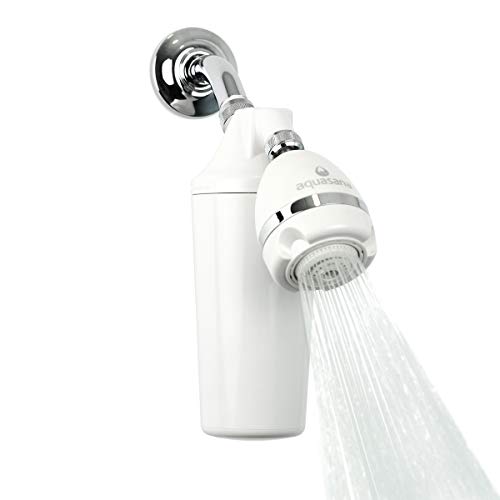
Aquasana AQ-4100One of the few units whose maker names the media outright — copper-zinc KDF plus coconut shell carbon — and one of the few that says anything at all about chloramine. Read its certification line carefully: it is tested to NSF/ANSI 177, not certified to it.Patented copper-zinc (KDF) plus coconut shel…
Miniwell L751 Vitamin C Shower HeadA vitamin C shower head sold on the media that actually has a mechanism against chloramine. Ascorbic acid neutralizes chlorine and chloramine chemically rather than by adsorption, which is why it does not need contact time the way carbon does.Vitamin C (ascorbic acid) shower head cartri…
Culligan ISH-100The inline sibling of the HSH-C135, aimed squarely at sulfur odor and scale rather than at hair. It uses KDF media, which is the right mechanism for iron and hydrogen sulfide nuisance rather than for hardness.Kinetic Degradation Fluxion (KDF) media
Every figure in this table links to the page it came from in the write-ups below. Units we claim to have tested: 0.
Top pick
AquaBliss SF100 Daily Revitalize
Chloramine, on the maker's own routing
The one product here whose maker states outright that it reduces chloramine as well as chlorine, and then backs that up by routing chloramine customers away from its own cheaper model. That is an unusually honest piece of product literature.
The only filter in this set whose maker publishes its NSF test dates and reduction ranges, and the one an independent lab measured at 100% chlorine removal. It also removed disinfection byproducts, which almost nothing else did.
+Independently measured at 100% chlorine reduction and confirmed to remove disinfection byproducts
+2.8 GPM rating is the highest published flow in this set
+Clear cartridges let you see the sediment stage loading up
Where it falls short
−Publishes nothing about chloramine
−Two cartridges to replace instead of one
−Inline format adds length between the arm and the head
What it does not do
×It does not soften water. An independent lab measured hardness at 125.59 PPM after filtration — effectively unchanged.
×It publishes no chloramine performance data of any kind.
×It is an inline unit, so it does not replace or improve your shower head.
Who it is for
Anyone on chlorinated municipal water who wants the strongest published evidence rather than the strongest published adjectives.
Skip it if
Your utility uses chloramine. Weddell publishes nothing about chloramine performance, and an activated carbon block sized for shower flow is not the thing to bet on for it — see the chloramine guide.
One of the few units whose maker names the media outright — copper-zinc KDF plus coconut shell carbon — and one of the few that says anything at all about chloramine. Read its certification line carefully: it is tested to NSF/ANSI 177, not certified to it.
Not publishedAquasana does not state a housing material.
What it does well
+Names its media: patented copper-zinc (KDF) and coconut shell carbon
+Published capacity of 10,000 gallons or up to 6 months
+Publishes a chlorine reduction figure of over 90%
+Sold with a head or as a filter-only unit for an existing head
Where it falls short
−Tested to NSF/ANSI 177 rather than certified to it
−Chloramine is listed but not quantified
−2.5 GPM is above the 1.8 GPM cap some states apply to new fixtures
What it does not do
×It does not soften water, and Aquasana makes no softening claim.
×It is not certified by NSF; the wording is "independently tested to NSF/ANSI Standard 177".
×It lists chloramines among what it reduces without publishing a reduction percentage for them.
Who it is for
Someone who wants a stated media list and a published capacity, and who cares more about what is inside than about the finish.
Skip it if
You need a certification mark rather than a testing claim. "Independently tested to" is a weaker statement than "certified by", and the difference matters.
A vitamin C shower head sold on the media that actually has a mechanism against chloramine. Ascorbic acid neutralizes chlorine and chloramine chemically rather than by adsorption, which is why it does not need contact time the way carbon does.
+Vitamin C is the primary media, which is the right chemistry for chloramine
+Neutralizes rather than adsorbs, so short shower contact time is much less of a problem
+Replacement cartridges are widely available
Where it falls short
−Marketed as a hard water softener, which it is not
−No published certification
−Cartridge life depends on your disinfectant dose, not on a fixed gallon count
What it does not do
×It does not soften water and it is marketed as a hard water softener anyway.
×It carries no published NSF/ANSI certification.
×It does not last like a carbon cartridge — the media is consumed by the reaction.
Who it is for
Readers on chloraminated water who want the media class that addresses it, and who accept that the cartridge is consumed rather than clogged.
Skip it if
You want a certification or a long interval. Vitamin C cartridges are used up by the chemistry itself, so they run out on a schedule set by your water, not by sediment.
The inline sibling of the HSH-C135, aimed squarely at sulfur odor and scale rather than at hair. It uses KDF media, which is the right mechanism for iron and hydrogen sulfide nuisance rather than for hardness.
+KDF media, which inhibits bacterial growth inside the cartridge itself
+Published capacity of 10,000 gallons or 6 months
+Keeps your existing shower head
+Shares the WHR-140 cartridge family with other Culligan units
Where it falls short
−Aimed at odor and scale, not at hair and skin outcomes
−No published chloramine performance
−A serious well iron problem needs treatment upstream of the bathroom
What it does not do
×It does not disinfect. Nothing at the shower head addresses coliform bacteria.
×It does not soften water or reduce hardness.
×It does not replace a whole-house iron or sediment system on a heavily loaded well.
Who it is for
Private-well readers whose complaint is rotten-egg odor and staining, and who want to keep their existing shower head.
Skip it if
Your well has a bacteriological or nitrate problem. A shower filter is the wrong tool for that entirely, and so is any other point-of-use device at the shower.
A shower filter has under a second of contact time and no certification covering anything but free chlorine. "Removes 99% of contaminants" is not a claim any standard in this category tests.
Skip this
A chlorine-only filter on chloraminated water
AquaBliss says this itself: it directs chloramine customers away from the SF220 and toward the SF100 or a whole-house unit. Take the manufacturer at its word.
Finding out what you have
Every community water system in the United States must publish a Consumer Confidence Report each year. It lists the disinfectant in use, the disinfection byproduct levels, and anything detected above its limit. It is free, it is specific to your address, and it takes about four minutes to read once you know which section to open. Private wells are not covered — nobody is required to test a well but its owner — which is its own set of decisions.
A physically impossible product with a high advertising bid behind it. The three reasons it cannot exist, and what to buy instead.
Questions people actually ask
+ What does a shower filter remove?
Free chlorine, some disinfection byproducts, sediment and some dissolved metals. Not hardness minerals, and not chloramine unless the media is specifically suited to it.
+ What shower filter removes chloramine?
Ones built on vitamin C or catalytic carbon rather than KDF alone. The chloramine guide covers the options and their limits.
+ How do I know if my water has chlorine or chloramine?
Your utility's annual Consumer Confidence Report says so directly, under disinfectants and disinfection byproducts. Here is how to find and read yours.
+ Do shower filters remove fluoride?
No meaningfully, and none is certified for it. The fluoride page explains why the contact time makes it implausible.
+ Does a shower filter remove lead?
Some media reduce dissolved metals, but no shower filter is certified for lead reduction under NSF/ANSI 177, because that standard does not cover it. Lead and heavy metals.
Sources
Everything on this page traces to one of these. Where a source is brand-owned we say so, because a filter maker explaining filter chemistry has an interest and you are entitled to weigh it.