The mechanism, the arithmetic and the standard. Once you know how little time the water spends inside the cartridge, most of the marketing stops being persuasive.
Disclosure — some links on this page go to Amazon, and we earn a commission if you buy through them. It costs you nothing extra and it does not change what we recommend or in what order. The full disclosure.
The short answer
A shower filter has about 0.10 to 0.14 seconds to act on the water passing through it. That single number decides everything: media that work by fast chemical reaction — KDF redox, calcium sulfite, vitamin C — can do something useful in that window. Media that work by adsorption, like plain activated carbon, need 25 to 40 seconds and cannot.
This is the arithmetic that the rest of the category skips. PICKI NIKI, a brand that sells filtered shower heads, publishes both figures on its own technical page: a residence time of 0.10 to 0.14 seconds inside the head at 7.5 liters a minute, and an empty-bed contact requirement of 25 to 40 seconds for standard carbon to reduce chlorine. Set those two numbers next to each other and a whole class of product claim stops being plausible.
The four mechanisms
KDF-55 is a copper-zinc alloy that works by oxidation-reduction. Chlorine passing over the alloy surface picks up electrons and converts to chloride, which is harmless and stays in solution. It is fast, which is exactly why it dominates this category, and it also inhibits bacterial growth inside the cartridge, which matters for a device that sits wet between uses. What it does not do is break the chlorine-ammonia bond in chloramine.
Calcium sulfite reduces free chlorine chemically and tolerates hot water better than carbon does. It is usually paired with KDF, and the pairing is what most premium heads in this category actually contain, whatever the stage count on the box says.
Activated carbon adsorbs — contaminants stick to an enormous internal surface area. In a kitchen filter with a slow flow it is superb, and it is the only media class with published disinfection-byproduct performance. In a shower head at 2 gallons a minute it is working far outside its comfortable regime, and heat makes that worse. This is why the units with genuine carbon-block DBP data are inline bodies with a lot more media volume than a shower head can hold.
Vitamin C, as ascorbic acid or sodium ascorbate, neutralizes chlorine and chloramine in a direct chemical reaction. Because it reacts rather than adsorbing, the contact-time problem largely goes away — which is why it is the media class that matters on chloraminated supplies. The trade-off is that the media is consumed by the reaction, so cartridge life tracks your utility's dose rather than a fixed gallon count.
The certification, and what it covers
NSF/ANSI 177 is the only standard written for this product category, and its scope is narrow enough that reading it changes how you shop. A certified filter must reduce a 2.0 mg/L free available chlorine challenge by at least 50 percent throughout its rated service life, withstand 125 psi, use materials with no intentional lead, maintain at least 1 gpm at 80 psi, and publish specified product literature. That is all of it. The standard is explicitly not a health effects standard, and it does not evaluate performance in the presence of chloramines.
Quick picks
Ranked on what can be verified: a traceable certification first, then media matched to your disinfectant. Tap a row to jump to the full write-up.
#
Product
Best for
Certification
Price
1
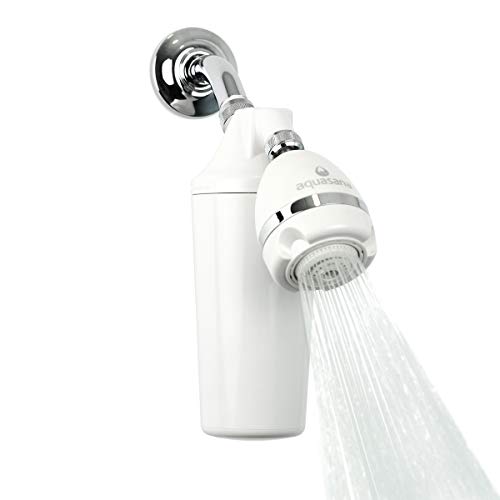
Aquasana AQ-4100One of the few units whose maker names the media outright — copper-zinc KDF plus coconut shell carbon — and one of the few that says anything at all about chloramine. Read its certification line carefully: it is tested to NSF/ANSI 177, not certified to it.Patented copper-zinc (KDF) plus coconut shel…
Weddell Duo Shower FilterThe only filter in this set whose maker publishes its NSF test dates and reduction ranges, and the one an independent lab measured at 100% chlorine removal. It also removed disinfection byproducts, which almost nothing else did.Dual cartridge: sediment filter plus activat…
Miniwell L751 Vitamin C Shower HeadA vitamin C shower head sold on the media that actually has a mechanism against chloramine. Ascorbic acid neutralizes chlorine and chloramine chemically rather than by adsorption, which is why it does not need contact time the way carbon does.Vitamin C (ascorbic acid) shower head cartri…
Philips AWP1775CHWorth owning and worth studying. Its listing says "NSF-Certified KDF", which certifies the material inside the cartridge, not the finished device. That is a real certification of a real thing, and it is not the same as the filter being certified.Three-stage filtration with double mesh and …
Sprite Slim-Line 2Certified to NSF/ANSI 177 by IAPMO, and the most instructive product in this set: when WaterFilterGuru measured it independently they got 42% chlorine reduction — a reminder that the certification floor is 50% of a controlled challenge, not a promise about your shower.KDF media with calcium sulfite, branded "Chl…
Every figure in this table links to the page it came from in the write-ups below. Units we claim to have tested: 0.
Top pick
Aquasana AQ-4100
KDF plus carbon, with the media stated
One of the few units whose maker names the media outright — copper-zinc KDF plus coconut shell carbon — and one of the few that says anything at all about chloramine. Read its certification line carefully: it is tested to NSF/ANSI 177, not certified to it.
Not publishedAquasana does not state a housing material.
What it does well
+Names its media: patented copper-zinc (KDF) and coconut shell carbon
+Published capacity of 10,000 gallons or up to 6 months
+Publishes a chlorine reduction figure of over 90%
+Sold with a head or as a filter-only unit for an existing head
Where it falls short
−Tested to NSF/ANSI 177 rather than certified to it
−Chloramine is listed but not quantified
−2.5 GPM is above the 1.8 GPM cap some states apply to new fixtures
What it does not do
×It does not soften water, and Aquasana makes no softening claim.
×It is not certified by NSF; the wording is "independently tested to NSF/ANSI Standard 177".
×It lists chloramines among what it reduces without publishing a reduction percentage for them.
Who it is for
Someone who wants a stated media list and a published capacity, and who cares more about what is inside than about the finish.
Skip it if
You need a certification mark rather than a testing claim. "Independently tested to" is a weaker statement than "certified by", and the difference matters.
The only filter in this set whose maker publishes its NSF test dates and reduction ranges, and the one an independent lab measured at 100% chlorine removal. It also removed disinfection byproducts, which almost nothing else did.
+Independently measured at 100% chlorine reduction and confirmed to remove disinfection byproducts
+2.8 GPM rating is the highest published flow in this set
+Clear cartridges let you see the sediment stage loading up
Where it falls short
−Publishes nothing about chloramine
−Two cartridges to replace instead of one
−Inline format adds length between the arm and the head
What it does not do
×It does not soften water. An independent lab measured hardness at 125.59 PPM after filtration — effectively unchanged.
×It publishes no chloramine performance data of any kind.
×It is an inline unit, so it does not replace or improve your shower head.
Who it is for
Anyone on chlorinated municipal water who wants the strongest published evidence rather than the strongest published adjectives.
Skip it if
Your utility uses chloramine. Weddell publishes nothing about chloramine performance, and an activated carbon block sized for shower flow is not the thing to bet on for it — see the chloramine guide.
A vitamin C shower head sold on the media that actually has a mechanism against chloramine. Ascorbic acid neutralizes chlorine and chloramine chemically rather than by adsorption, which is why it does not need contact time the way carbon does.
+Vitamin C is the primary media, which is the right chemistry for chloramine
+Neutralizes rather than adsorbs, so short shower contact time is much less of a problem
+Replacement cartridges are widely available
Where it falls short
−Marketed as a hard water softener, which it is not
−No published certification
−Cartridge life depends on your disinfectant dose, not on a fixed gallon count
What it does not do
×It does not soften water and it is marketed as a hard water softener anyway.
×It carries no published NSF/ANSI certification.
×It does not last like a carbon cartridge — the media is consumed by the reaction.
Who it is for
Readers on chloraminated water who want the media class that addresses it, and who accept that the cartridge is consumed rather than clogged.
Skip it if
You want a certification or a long interval. Vitamin C cartridges are used up by the chemistry itself, so they run out on a schedule set by your water, not by sediment.
Worth owning and worth studying. Its listing says "NSF-Certified KDF", which certifies the material inside the cartridge, not the finished device. That is a real certification of a real thing, and it is not the same as the filter being certified.
Certified to NSF/ANSI 177 by IAPMO, and the most instructive product in this set: when WaterFilterGuru measured it independently they got 42% chlorine reduction — a reminder that the certification floor is 50% of a controlled challenge, not a promise about your shower.
"15-stage", "20-stage", "33-stage" — a stage can be a mesh screen. It is a marketing unit with no standard behind it, and it is inversely correlated with how much a maker tells you about the actual media.
Skip this
Any filter whose media list is a mood board
Tourmaline, germanium, maifan stone and "negative ion balls" appear on a great many cartridges. None of them has published chlorine reduction data at shower flow. They are not dangerous; they are filler in a list that should be short.
Where to go next
Filter media compared — the full media table with chloramine, heat tolerance and lifespan.
KDF explained — the redox mechanism in detail, and its limits.
Filter media compared is the page to read if you only read one. It is the mechanism behind every recommendation on this site. If a filter's box is selling you a stage count instead of a media list, what a stage actually is unpacks that first.
A wall-mount rain arm takes any inline filter. A ceiling-mounted one usually takes none at all — check which you have before buying.
Questions people actually ask
+ How do shower filters work?
By fast chemistry, not by straining. KDF and calcium sulfite reduce chlorine in a redox reaction; vitamin C neutralizes it chemically; carbon adsorbs it if given contact time it rarely gets at shower flow.
+ What is KDF in a shower filter?
A copper-zinc alloy that converts free chlorine to chloride by electron transfer. Fast enough for shower flow, and ineffective against chloramine on its own. The detail.
+ Is a vitamin C shower filter better?
On chloraminated water, meaningfully so, because ascorbic acid neutralizes chloramine and KDF does not. On free chlorine the difference is much smaller. The detail.
+ What is the difference between a shower filter and a shower head filter?
An inline filter sits between the arm and your existing head; a shower head filter is a replacement head with the media inside it. The format comparison.
+ What does NSF/ANSI 177 certification actually mean?
That the unit reduced a 2.0 mg/L free chlorine challenge by at least 50 percent across its rated life, and passed material safety, structural and flow requirements. It is not a health effects standard and it says nothing about chloramine.
Sources
Everything on this page traces to one of these. Where a source is brand-owned we say so, because a filter maker explaining filter chemistry has an interest and you are entitled to weigh it.