The best shower filters, ranked on what can be verified
Nine filters, ranked by the things you can check: a traceable certification, a stated media list, a published flow rate and a cartridge cadence you can do arithmetic with. Everything else in this category is adjectives.
Disclosure — some links on this page go to Amazon, and we earn a commission if you buy through them. It costs you nothing extra and it does not change what we recommend or in what order. The full disclosure.
The best shower filter is the one whose media matches your utility's disinfectant. If your water report says free chlorine, a certified KDF or carbon unit is the right buy. If it says chloramine, you need vitamin C or catalytic carbon and most of this category will not help you. No filter here softens water, whatever the box says.
There are two ways to write a shower filter roundup. One is to test the products, which requires a lab, test kits and units you own. The other is to check what can be checked from published records: certification listings, manufacturer specification sheets, and third-party lab data published by people who did do the testing. We do the second, we say so, and we credit the labs by name.
That produces a different ranking from most of this SERP, because the things you can verify and the things brands advertise turn out to be almost disjoint. The cheapest product on this page is also one of the few with a certification you can trace to a certifying body. The two most searched brands in the category publish testing claims and no certification at all.
How we picked
Criteria first, products second. These are the things we ranked on, stated before anything is recommended.
- Certification first. A standard, issued by a named body, that we could trace. It is the only independent check this category offers, and only three products here have one.
- Media matched to your disinfectant. A KDF filter on chloraminated water is the wrong tool no matter how well it is made.
- Published flow rate. If a maker will not tell you how much water comes out, you cannot compare the product or check it against your state's limit.
- Cartridge cadence and capacity, because a filter you never re-cartridge stops being a filter around month eight.
- Independent measurement where one exists, credited to whoever ran it. We ran none of it.
- What the product does not do, stated for every pick. A pick without a stated limitation has not been thought about.
What we did not do: test any of these filters. We own none of them, we operate no lab, and nothing on this page is written as though we did. The full method.
Quick picks
Ranked on what can be verified: a traceable certification first, then media matched to your disinfectant. Tap a row to jump to the full write-up.
| # | Product | Best for | Certification | Price |
|---|---|---|---|---|
| 1 |  Weddell Duo Shower FilterThe only filter in this set whose maker publishes its NSF test dates and reduction ranges, and the one an independent lab measured at 100% chlorine removal. It also removed disinfection byproducts, which almost nothing else did.Dual cartridge: sediment filter plus activat… | Chlorine and disinfection byproducts | NSF/ANSI 177 +2 | |
| 2 |  Culligan HSH-C135One of the few units in this category with a certification you can trace to the body that issued it. Culligan states plainly that the HSH-C135 is tested and certified by IAPMO R&T, and it runs the same WHR-140 cartridge and the same 10,000-gallon interval as the rest of its filtered range.Not published | A certified handheld shower head | NSF/ANSI 177 | |
| 3 | 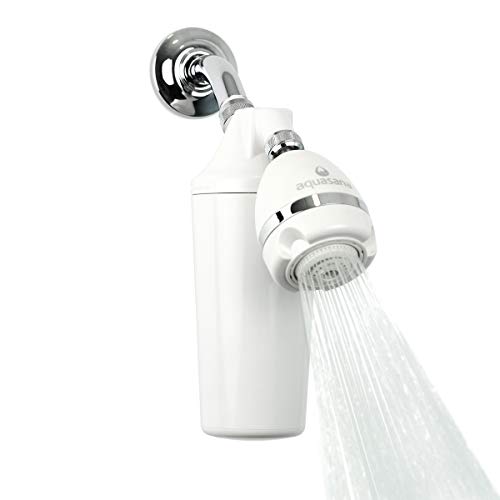 Aquasana AQ-4100One of the few units whose maker names the media outright — copper-zinc KDF plus coconut shell carbon — and one of the few that says anything at all about chloramine. Read its certification line carefully: it is tested to NSF/ANSI 177, not certified to it.Patented copper-zinc (KDF) plus coconut shel… | KDF plus carbon, with the media stated | None | |
| 4 |  AquaBliss SF100 Daily RevitalizeThe one product here whose maker states outright that it reduces chloramine as well as chlorine, and then backs that up by routing chloramine customers away from its own cheaper model. That is an unusually honest piece of product literature.Three stages: sand filter, stainless mesh an… | Chloramine, on the maker's own routing | None | |
| 5 |  Sprite Slim-Line 2Certified to NSF/ANSI 177 by IAPMO, and the most instructive product in this set: when WaterFilterGuru measured it independently they got 42% chlorine reduction — a reminder that the certification floor is 50% of a controlled challenge, not a promise about your shower.KDF media with calcium sulfite, branded "Chl… | Certified media, honestly benchmarked | NSF/ANSI 177 | |
| 6 | 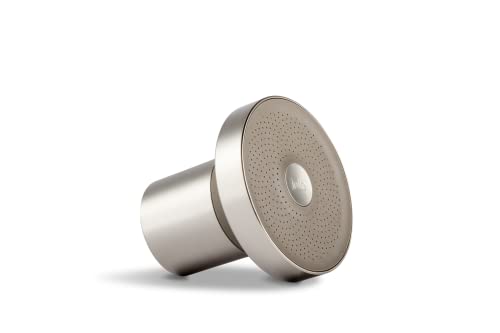 Jolie Filtered ShowerheadThe most searched shower filter in the United States, with a media pairing that makes sense and a certification line that does not. "Surpassing NSF-177 certifications" is a claim about exceeding a standard the product is not stated to hold.KDF-55 and calcium sulfite | The best-known name in the category | None | |
| 7 |  Philips AWP1775CHWorth owning and worth studying. Its listing says "NSF-Certified KDF", which certifies the material inside the cartridge, not the finished device. That is a real certification of a real thing, and it is not the same as the filter being certified.Three-stage filtration with double mesh and … | Reading a certification claim correctly | NSF certification of the KDF filtration material | |
| 8 |  Canopy Filtered ShowerheadCanopy publishes almost nothing you can check — no media, no flow rate, no capacity, no certification. What saves it is somebody else's number: WaterFilterGuru measured 97% chlorine reduction, from 2.7 PPM down to 0.06.Not published | Measured chlorine reduction | None | |
| 9 |  AquaBliss SF220 Daily EssentialThe cheap inline unit that tells you when not to buy it: AquaBliss states that chloramine customers should choose the SF100 or a whole-house filter instead. For plain free chlorine it publishes a full media list and asks very little.Sand filter, ultra-fine stainless steel mesh… | Free chlorine on a small budget | None |
Every figure in this table links to the page it came from in the write-ups below. Units we claim to have tested: 0.
Weddell Duo Shower Filter
Chlorine and disinfection byproducts
The only filter in this set whose maker publishes its NSF test dates and reduction ranges, and the one an independent lab measured at 100% chlorine removal. It also removed disinfection byproducts, which almost nothing else did.
Published specifications
- Filter media
- Dual cartridge: sediment filter plus activated carbonThe maker states "Material: Activated carbon" for the black cartridge and a sediment stage for the white one.Source: Weddell Water — Weddell Duo Shower Filter (retrieved 2026-09-01)
- Stated flow rate
- 2.8 GPMSource: Weddell Water — Weddell Duo Shower Filter (retrieved 2026-09-01)
- Rated cartridge life
- 8,000 gallons, or 5-6 monthsRated capacity 8,000 gallons; the maker also gives a 5-6 month calendar prompt.Source: Weddell Water — Weddell Duo Shower Filter (retrieved 2026-09-01)
- Chloramine
- Not publishedWeddell publishes no chloramine figure. Absence of a claim is not evidence of failure, but it is also not evidence of performance.
- Format
- Inline, fits between the arm and any shower headTool-free; the maker states it fits fixed, rain and handheld heads.Source: Weddell Water — Weddell Duo Shower Filter (retrieved 2026-09-01)
- Housing
- Not publishedWeddell does not state a housing material.
What it does well
- NSF/ANSI 177 chlorine reduction with the test date published
- Also carries NSF/ANSI 53 PFAS reduction and NSF/ANSI 42 particulate reduction
- Independently measured at 100% chlorine reduction and confirmed to remove disinfection byproducts
- 2.8 GPM rating is the highest published flow in this set
- Clear cartridges let you see the sediment stage loading up
Where it falls short
- Publishes nothing about chloramine
- Two cartridges to replace instead of one
- Inline format adds length between the arm and the head
What it does not do
- It does not soften water. An independent lab measured hardness at 125.59 PPM after filtration — effectively unchanged.
- It publishes no chloramine performance data of any kind.
- It is an inline unit, so it does not replace or improve your shower head.
Who it is for
Anyone on chlorinated municipal water who wants the strongest published evidence rather than the strongest published adjectives.
Skip it if
Your utility uses chloramine. Weddell publishes nothing about chloramine performance, and an activated carbon block sized for shower flow is not the thing to bet on for it — see the chloramine guide.
#ad · how we are funded · price as of October 16, 2026
Culligan HSH-C135
A certified handheld shower head
One of the few units in this category with a certification you can trace to the body that issued it. Culligan states plainly that the HSH-C135 is tested and certified by IAPMO R&T, and it runs the same WHR-140 cartridge and the same 10,000-gallon interval as the rest of its filtered range.
Published specifications
- Filter media
- Not publishedCulligan states what the unit reduces, but not what media does the reducing.
- Stated flow rate
- 1.8 GPMSource: Culligan — HSH-C135 hand-held filtered showerhead (retrieved 2026-09-01)
- Rated cartridge life
- 10,000 gallons, or 6 monthsSource: Culligan — HSH-C135 hand-held filtered showerhead (retrieved 2026-09-01)
- Chloramine
- Not publishedCulligan publishes nothing about chloramine for this unit.
- Format
- Handheld shower head with integrated filter, supplied with a hose and wall bracketSource: Culligan — HSH-C135 hand-held filtered showerhead (retrieved 2026-09-01)
- Housing
- Plastic, chrome finishSource: Culligan HSH-C135 — listing on Amazon.com (retrieved 2026-09-01)
What it does well
- Explicitly "tested and certified by IAPMO R&T", with the certifying body named
- Published cartridge life of 10,000 gallons or 6 months
- Five spray settings and a published 1.8 GPM rating
- The WHR-140 cartridge is shared across several Culligan units, which keeps it easy to find
Where it falls short
- Culligan does not publish what is inside the cartridge
- No chloramine data
- Replaces the shower head rather than adding to it
What it does not do
- It does not soften water, and Culligan does not claim it does.
- It states nothing about chloramine.
- Culligan does not publish the filter media used in it.
Who it is for
Someone who wants a certified chlorine filter, and who wants a handheld on a hose rather than a fixed head or an inline unit.
Skip it if
You like your current shower head. This replaces it, and its 1.8 GPM is a fixed part of the deal.
#ad · how we are funded · price as of October 16, 2026
Aquasana AQ-4100
KDF plus carbon, with the media stated
One of the few units whose maker names the media outright — copper-zinc KDF plus coconut shell carbon — and one of the few that says anything at all about chloramine. Read its certification line carefully: it is tested to NSF/ANSI 177, not certified to it.
Published specifications
- Filter media
- Patented copper-zinc (KDF) plus coconut shell carbonSource: Aquasana — shower filter with shower head (retrieved 2026-09-01)
- Stated flow rate
- 2.5 GPMStated as the optimum flow rate.Source: Aquasana — shower filter with shower head (retrieved 2026-09-01)
- Rated cartridge life
- 10,000 gallons, or up to 6 monthsSource: Aquasana — shower filter with shower head (retrieved 2026-09-01)
- Chloramine
- Chloramines listed among contaminants reduced; no percentage publishedSource: Aquasana — shower filter with shower head (retrieved 2026-09-01)
- Format
- Filter body with shower head; a head-free version (AQ-4100NSH) also existsSource: Aquasana AQ-4100 — listing on Amazon.com (retrieved 2026-09-01)
- Housing
- Not publishedAquasana does not state a housing material.
What it does well
- Names its media: patented copper-zinc (KDF) and coconut shell carbon
- Published capacity of 10,000 gallons or up to 6 months
- Publishes a chlorine reduction figure of over 90%
- Sold with a head or as a filter-only unit for an existing head
Where it falls short
- Tested to NSF/ANSI 177 rather than certified to it
- Chloramine is listed but not quantified
- 2.5 GPM is above the 1.8 GPM cap some states apply to new fixtures
What it does not do
- It does not soften water, and Aquasana makes no softening claim.
- It is not certified by NSF; the wording is "independently tested to NSF/ANSI Standard 177".
- It lists chloramines among what it reduces without publishing a reduction percentage for them.
Who it is for
Someone who wants a stated media list and a published capacity, and who cares more about what is inside than about the finish.
Skip it if
You need a certification mark rather than a testing claim. "Independently tested to" is a weaker statement than "certified by", and the difference matters.
#ad · how we are funded · price as of October 16, 2026
AquaBliss SF100 Daily Revitalize
Chloramine, on the maker's own routing
The one product here whose maker states outright that it reduces chloramine as well as chlorine, and then backs that up by routing chloramine customers away from its own cheaper model. That is an unusually honest piece of product literature.
Published specifications
- Filter media
- Three stages: sand filter, stainless mesh and PP cotton; then calcium sulfite, redox media and activated carbon; then a PP cotton and mesh barrier. Cartridge infused with vitamin C, minerals and tourmaline.Source: AquaBliss — SF100 Daily Revitalize shower filter (retrieved 2026-09-01)
- Stated flow rate
- Not publishedAquaBliss publishes no flow rate for the SF100.
- Rated cartridge life
- Every 3-6 monthsAquaBliss adds "sooner if you're in a high-chlorine or high-sediment area" and publishes no gallon rating.Source: AquaBliss — SF100 Daily Revitalize shower filter (retrieved 2026-09-01)
- Chloramine
- Stated to reduce chloramine as well as chlorine and sedimentAquaBliss routes chloramine customers to this model rather than to its cheaper SF220, which is a claim it makes against its own interest.Source: AquaBliss — SF100 Daily Revitalize shower filter (retrieved 2026-09-01)
- Format
- Inline, standard half-inch connection, five finishesSource: AquaBliss — SF100 Daily Revitalize shower filter (retrieved 2026-09-01)
- Housing
- Not publishedFinish options are listed; the underlying material is not.
What it does well
- States chloramine reduction explicitly, which almost nothing else in this set does
- Full three-stage media list published, including calcium sulfite, redox media and activated carbon
- Vitamin C infusion in the cartridge, which is the media class that actually addresses chloramine
- Inline body fits fixed, rain and handheld heads on a standard half-inch connection
Where it falls short
- No published NSF/ANSI certification
- No published flow rate and no gallon capacity
- Cartridge cadence given only as a 3-6 month range
What it does not do
- It does not soften water; AquaBliss makes no softening claim for it.
- It carries no NSF/ANSI certification that AquaBliss publishes.
- It publishes no flow rate and no gallon capacity, so you cannot compute cost per gallon from its own data.
Who it is for
Readers whose water report says chloramine rather than free chlorine, and who want a stated media list at the low end of the price range.
Skip it if
You want a certification. AquaBliss publishes no NSF/ANSI certification for this unit, and a stated media list is not the same as a verified result.
#ad · how we are funded · price as of October 16, 2026
Sprite Slim-Line 2
Certified media, honestly benchmarked
Certified to NSF/ANSI 177 by IAPMO, and the most instructive product in this set: when WaterFilterGuru measured it independently they got 42% chlorine reduction — a reminder that the certification floor is 50% of a controlled challenge, not a promise about your shower.
Published specifications
- Filter media
- KDF media with calcium sulfite, branded "Chlorgon"Source: WaterFilterGuru, "Sprite Slim-Line 2 Shower Filter: A Data-Driven Review" (retrieved 2026-09-01)
- Stated flow rate
- 1.8 GPM claimed; 1.65 GPM measured independentlyThe measured figure is WaterFilterGuru's, not ours.Source: WaterFilterGuru, "Sprite Slim-Line 2 Shower Filter: A Data-Driven Review" (retrieved 2026-09-01)
- Rated cartridge life
- 10,000 gallons, or 6 monthsSource: WaterFilterGuru, "Sprite Slim-Line 2 Shower Filter: A Data-Driven Review" (retrieved 2026-09-01)
- Chloramine
- Not publishedNo chloramine performance is published for this unit.
- Format
- Inline, fits between the arm and any shower headSource: Sprite Slim-Line 2 — listing on Amazon.com (retrieved 2026-09-01)
- Housing
- PlasticDescribed in the independent review as feeling flimsier than most of the filters tested alongside it.Source: WaterFilterGuru, "Sprite Slim-Line 2 Shower Filter: A Data-Driven Review" (retrieved 2026-09-01)
What it does well
- NSF/ANSI 177 certification from IAPMO, per the independent review that checked it
- KDF plus calcium sulfite, a media pairing with a real mechanism behind it
- 10,000 gallon / 6 month cartridge
- Low-profile inline body, roughly an inch and a half tall
Where it falls short
- Independently measured at 42% chlorine reduction, well below the marketing
- Plastic housing described by that reviewer as flimsier than most
- Measured flow of 1.65 GPM against a claimed 1.8
What it does not do
- It does not soften water. Independent measurement found hardness effectively unchanged at 128.19 PPM going in.
- It publishes no chloramine performance.
- Its certification does not mean 100% chlorine removal in your shower.
Who it is for
A reader who wants the certification and the caveat together, and who values a low-profile inline unit that does not change their shower head.
Skip it if
You want the highest measured chlorine reduction available. On the one independent measurement we could find, this was not it.
#ad · how we are funded · price as of October 16, 2026
Jolie Filtered Showerhead
The best-known name in the category
The most searched shower filter in the United States, with a media pairing that makes sense and a certification line that does not. "Surpassing NSF-177 certifications" is a claim about exceeding a standard the product is not stated to hold.
Published specifications
- Filter media
- KDF-55 and calcium sulfiteSource: Jolie — The Jolie Filtered Showerhead (retrieved 2026-09-01)
- Stated flow rate
- 1.8 GPMStated as compliant with California and New York water consumption standards.Source: Jolie — The Jolie Filtered Showerhead (retrieved 2026-09-01)
- Rated cartridge life
- Every 90 days on subscriptionNo gallon capacity is published.Source: Jolie — The Jolie Filtered Showerhead (retrieved 2026-09-01)
- Chloramine
- Not publishedJolie publishes no chloramine performance data.
- Format
- Replacement shower head with integrated filterSource: Jolie Filtered Showerhead — listing on Amazon.com (retrieved 2026-09-01)
- Housing
- Not publishedJolie lists finishes rather than a housing material.
What it does well
- Media named outright: KDF-55 and calcium sulfite
- 1.8 GPM, compliant with California and New York flow limits
- 90-day cartridge cadence on subscription, so replacement actually happens
- Replaces the shower head, so there is nothing extra hanging off the arm
Where it falls short
- "Surpassing NSF-177 certifications" is a claim, not a certification
- No gallon capacity published, so cost per gallon cannot be computed from its own data
- Nothing published about chloramine
What it does not do
- It does not soften water. KDF-55 and calcium sulfite do not remove calcium or magnesium.
- It does not hold a stated NSF/ANSI 177 certification; the published wording is that it surpasses NSF-177 certifications.
- It does not treat hair loss. Reduced shedding and reduced breakage are different claims from androgenetic hair loss — see the hair-loss evidence page.
Who it is for
A reader who wants the well-known unit, a 1.8 GPM head that meets state flow limits, and a subscription that removes the decision about when to change the cartridge.
Skip it if
You want a verifiable certification rather than a testing claim, or you want a published gallon capacity you can do arithmetic with.
#ad · how we are funded · price as of October 16, 2026
Philips AWP1775CH
Reading a certification claim correctly
Worth owning and worth studying. Its listing says "NSF-Certified KDF", which certifies the material inside the cartridge, not the finished device. That is a real certification of a real thing, and it is not the same as the filter being certified.
Published specifications
- Filter media
- Three-stage filtration with double mesh and NSF-certified KDF materialSource: Philips AWP1775CH/37 shower filter — listing on Amazon.com (retrieved 2026-09-01)
- Stated flow rate
- Not publishedNo flow rate is published on the US listing.
- Rated cartridge life
- Up to 50,000 L (about 13,208 gallons), replaced every 4-6 monthsPublished for the AWP1775 line; the figure is the manufacturer's, for the international model.Source: Philips AWP1775 in-line shower filter listing on Amazon.com (retrieved 2026-09-01)
- Chloramine
- Not publishedNot stated.
- Format
- Inline, fits handheld, rainfall or fixed headsSource: Philips AWP1775CH/37 shower filter — listing on Amazon.com (retrieved 2026-09-01)
- Housing
- Anti-scald material, chrome finishSource: Philips AWP1775CH/37 shower filter — listing on Amazon.com (retrieved 2026-09-01)
What it does well
- Three-stage filtration with double mesh and NSF-certified KDF material
- Large published capacity — the international version states up to 50,000 L, about 13,208 gallons
- Anti-scald housing rated for hot and cold
- Fits handheld, rainfall and fixed heads, tool-free
Where it falls short
- The certification applies to the media, not the device
- US listing publishes no flow rate
- Cartridge availability varies between the US and international model numbers
What it does not do
- It does not soften water.
- It is not stated to be a device certified to NSF/ANSI 177; the KDF material is what carries the NSF certification.
- It publishes no chloramine performance.
Who it is for
A reader who wants a large-capacity inline unit from a manufacturer with a plumbing division behind it.
Skip it if
You read "NSF-Certified" as meaning the unit passed NSF/ANSI 177. It does not say that.
#ad · how we are funded · price as of October 16, 2026
Canopy Filtered Showerhead
Measured chlorine reduction
Canopy publishes almost nothing you can check — no media, no flow rate, no capacity, no certification. What saves it is somebody else's number: WaterFilterGuru measured 97% chlorine reduction, from 2.7 PPM down to 0.06.
Published specifications
- Filter media
- Not publishedCanopy's own product page states no filter media. We checked it on 2026-09-01.
- Stated flow rate
- Not publishedNo flow rate is published on Canopy's product page.
- Rated cartridge life
- Not publishedNo gallon capacity or replacement interval is published on the product page.
- Chloramine
- Not publishedNot stated.
- Format
- Replacement shower head with integrated filter, three spray settingsSource: Canopy — Filtered Showerhead (retrieved 2026-09-01)
- Housing
- Not publishedNot stated.
What it does well
- Independently measured at 97% chlorine reduction, 2.7 PPM down to 0.06 PPM
- Three spray settings on a design-led head
- Widely stocked, so cartridges are easy to find
Where it falls short
- Publishes no media list, no flow rate, no capacity and no certification
- Was not one of the units shown to remove disinfection byproducts in that test
- Nothing published about chloramine
What it does not do
- It does not soften water. No filter in the independent test set reduced hardness, including this one.
- It publishes no filter media, flow rate, cartridge capacity or certification on its own product page.
- It removed chlorine in that test but was not among the two units that removed disinfection byproducts.
Who it is for
A reader who trusts an independent measurement more than a spec sheet, and who wants a design-led head rather than an inline puck.
Skip it if
You want to compare it on paper. There is no paper. Every figure we have for this product came from someone else's lab.
#ad · how we are funded · price as of October 16, 2026
AquaBliss SF220 Daily Essential
Free chlorine on a small budget
The cheap inline unit that tells you when not to buy it: AquaBliss states that chloramine customers should choose the SF100 or a whole-house filter instead. For plain free chlorine it publishes a full media list and asks very little.
Published specifications
- Filter media
- Sand filter, ultra-fine stainless steel mesh, micro-porous PP cotton, calcium sulfite, redox media, activated carbonSource: AquaBliss — SF220 Daily Essential shower filter (retrieved 2026-09-01)
- Stated flow rate
- Not publishedAquaBliss publishes no flow rate for the SF220; it states only that the design maintains pressure.
- Rated cartridge life
- Every 3-6 months, depending on water qualityNo gallon rating is published.Source: AquaBliss — SF220 Daily Essential shower filter (retrieved 2026-09-01)
- Chloramine
- Not suitable — the maker directs chloramine customers to the SF100 or a whole-house filterSource: AquaBliss — SF220 Daily Essential shower filter (retrieved 2026-09-01)
- Format
- Inline, 3.31 x 3.31 x 4.65 in, standard half-inch connectionSource: AquaBliss — SF220 Daily Essential shower filter (retrieved 2026-09-01)
- Housing
- Chrome finish, 5.6 ozSource: AquaBliss — SF220 Daily Essential shower filter (retrieved 2026-09-01)
What it does well
- Full media list published, down to the PP cotton and stainless mesh stages
- The maker states its own limit on chloramine instead of hiding it
- Compact inline body, about 3.3 by 3.3 by 4.7 inches
- Standard half-inch fitting works with fixed, rain and handheld heads
Where it falls short
- No published NSF/ANSI certification
- No published flow rate or gallon capacity
- Explicitly not the right choice on chloraminated water
What it does not do
- It does not soften water, and no hardness claim is made for it.
- It is designed to reduce chlorine only — AquaBliss directs chloramine customers elsewhere.
- It carries no published NSF/ANSI certification.
Who it is for
A reader on free-chlorine municipal water who wants the media named and the price low, and who does not need a certification mark.
Skip it if
Your utility uses chloramine. The maker says so itself.
#ad · how we are funded · price as of October 16, 2026
The certification ledger
This is the table the rest of the category does not publish. A certification names a standard and the body that issued it, and you can look it up. A claim is the manufacturer describing itself. Both belong on a page like this; conflating them does not. If a verifiable certification is the only thing you are shopping on, the certified shower filters that actually hold a listing is the shorter list.
Standards, certifying bodies and manufacturer claims
5 of 29 carry a certification we could trace to a certifying body.
What the makers claim about themselves
These are manufacturer statements, reported as manufacturer statements. A claim is not a certification, and separating the two is the whole point of this section.
Certification listings and manufacturer wording checked on 2026-09-01. What NSF/ANSI 177 actually covers.
Watch for one construction in particular. "Surpassing NSF-177 certifications" and "proven to far exceed NSF-177 certifications" both appear on premium products in this set. Read literally, they describe exceeding a benchmark the product does not hold. That is not necessarily untrue — a manufacturer may well have lab data showing exactly that — but it is a claim about performance, not a certification, and a reader deserves to be told which one they are looking at.
What NSF/ANSI 177 actually requires
It is worth knowing precisely, because it is narrower than most people assume. A certified shower filter must reduce a 2.0 mg/L free available chlorine challenge by at least 50 percent throughout its rated service life, withstand 125 psi or its maximum working pressure, contain no lead as an intentional ingredient, maintain at least 1 gpm at 80 psi of initial dynamic pressure, and publish specified literature. That is the whole scope. As the trade press reported when the standard was introduced, it is explicitly not a health effects standard, and it does not evaluate chlorine reduction in the presence of chloramines.
Flow rate, where anyone publishes one
Published flow rate
10 of 29 publish this figure. Every number below links to where it came from.
Compiled from the manufacturers’ own published material on 2026-09-01. We have measured none of it ourselves — see how we rank. Found an error? Tell us and we will correct it.
Federal law caps new shower heads at 2.5 gallons per minute; California and New York cap them at 1.8. Every filtered shower head sold into those states has to comply, which is why 1.8 GPM appears so often above. If a maker publishes no flow rate at all — and several do not — you cannot check the claim or predict the shower.
Cartridge cadence, and the arithmetic
Published cartridge life
24 of 29 publish this figure. Every number below links to where it came from.
Compiled from the manufacturers’ own published material on 2026-09-01. We have measured none of it ourselves — see how we rank. Found an error? Tell us and we will correct it.
Six months or 10,000 gallons is the category convention for KDF and carbon units. Vitamin C is the exception and honestly so: the media is consumed by the reaction rather than clogged by sediment, so its life depends on your utility's dose. The recurring cost this implies is the number nobody in this SERP computes, and we compute it here.
What we would skip, and why
Anything sold on a stage count
The iSpring SF2S advertises 33 stages and 18 media types, and names two of them. There is no standard defining a stage. A mesh screen is a stage.
Anything sold as a shower water softener
The Kitsch filter uses that phrase in its own listing title while containing KDF-55 and calcium sulfite, neither of which removes hardness. Here is why that cannot work.
A vitamin C unit bought for hardness rather than for chloramine
Vitamin C is the best media class in this category for chloramine and does nothing whatever for hardness, despite how these units are usually marketed.
Which of these to buy
- Municipal free chlorine, want the strongest evidence — the Weddell Duo. It publishes NSF test dates for three standards and was independently measured at 100 percent chlorine reduction, one of only two units in that test to remove disinfection byproducts.
- Want a certification and a new shower head — the Culligan HSH-C135, tested and certified by IAPMO R&T, 10,000 gallons or six months.
- Chloraminated supply — the AquaBliss SF100, which states chloramine reduction and routes chloramine customers away from its own cheaper model, or a dedicated vitamin C unit.
- Want the media named and a big published capacity — the Aquasana AQ-4100, reading its "tested to" wording as the claim it is.
- Hardness is the real complaint — none of the above. Read shower filter vs water softener first.
- You have already decided you want a replacement shower head rather than an inline filter — the filtered shower head ranking covers that format on its own, where the certification picture is thinner.
If you do not know which disinfectant your utility uses, that is the first job and it takes about four minutes: find your water report. Every recommendation on this page changes depending on the answer, which is exactly why we ask before ranking.
Questions people actually ask
+ What is the best shower head filter?
It depends on your disinfectant. For free chlorine with the strongest published evidence, the Weddell Duo. For the lowest-cost traceable certification, the Sprite Slim-Line 2; for one on a shower head rather than an inline body, the Culligan HSH-C135. For chloramine, a vitamin C unit or the AquaBliss SF100.
+ Do shower filters actually work?
For free chlorine, yes, and independent measurement backs that up. For hardness, no. For chloramine, only with the right media. The full answer.
+ Are expensive shower filters better?
Not on the evidence we could find. The cheapest filter in this set is a certified one, and the most expensive carry testing claims rather than certifications.
+ What shower filter removes the most contaminants?
That question has no answer this category can support, because NSF/ANSI 177 tests only free chlorine and nothing else is certified. The Weddell Duo publishes the widest set of test data, including PFAS under NSF/ANSI 53.
+ Do I need a shower filter?
If your water is chlorinated and your hair or skin reacts, there is a reasonable mechanism and a real benefit. If your complaint is scale and lather, you need a softener, not a filter.
+ Which shower filters are NSF certified?
In this set, the Culligan HSH-C135 (IAPMO R&T) and the Sprite Slim-Line 2 (IAPMO). The Weddell Duo publishes NSF/ANSI 177, 53 and 42 test dates. Everything else here carries claims rather than certifications.
Sources
Everything on this page traces to one of these. Where a source is brand-owned we say so, because a filter maker explaining filter chemistry has an interest and you are entitled to weigh it.
- Plumbing & Mechanical, "NSF/ANSI Standard 177: A Level Playing Field for Shower Filter Claims" (retrieved 2026-09-01)
- WaterFilterGuru, "The Best Shower Head Filter" — independent lab testing, credited to them (retrieved 2026-09-01)
- WaterFilterGuru, "Sprite Slim-Line 2 Shower Filter: A Data-Driven Review" (retrieved 2026-09-01)
- PICKI NIKI, "Filtered shower head technology explained" — brand-owned, cited for its published contact-time figures (retrieved 2026-09-01)
- US EPA — Consumer Confidence Reports (CCR) for drinking water