Disclosure — some links on this page go to Amazon, and we earn a commission if you buy through them. It costs you nothing extra and it does not change what we recommend or in what order. The full disclosure.
The short answer
Most shower filter cartridges are rated for 6 months or around 10,000 gallons, whichever comes first, and hard or heavily chlorinated water shortens both. Expect a small, real pressure drop when the cartridge is new and a larger one as it loads with sediment — a sudden drop usually means the cartridge is finished, not faulty.
Almost every page in this category ends at the purchase. That is where the commission is, so that is where the writing stops. But the cartridge is where the money actually goes over a year of ownership, and it is the single largest determinant of whether the filter is still working in month eight. So this section is about the part that comes after.
The cadence, from the makers' own published figures
Published cartridge life across the category
10 of 15 publish this figure. Every number below links to where it came from.
No gallon capacity is published; vitamin C cartridge life tracks the disinfectant dose in your supply.
Compiled from the manufacturers’ own published material on 2026-09-01. We have measured none of it ourselves — see how we rank. Found an error? Tell us and we will correct it.
Note how the figures divide. The units built around carbon and KDF publish gallon ratings — 8,000 or 10,000 gallons, six months — because a fixed media volume has a fixed capacity. The vitamin C units publish a time range or nothing at all, and that is honest rather than evasive: ascorbic acid is consumed by the reaction, so its life depends on how much disinfectant your utility puts in the water. Two households on the same product will get genuinely different service lives.
The arithmetic nobody publishes
Every roundup in this category lists a purchase price. Not one of the pages we surveyed computes what the filter costs over twelve months including cartridges, despite cartridge life being a published specification on most of them. The arithmetic is not hard: purchase price, plus the number of cartridges a year implied by the cadence, times the cartridge price, divided by twelve.
Twelve-month cost of ownership
Purchase price + (cartridges per year x cartridge price). Cadence comes from published specifications; the money comes from the live price layer or is left blank.
No live prices right now, so no figures are shown. A remembered price is not a price. Cartridge prices are not included in the year-one figure above because they are a separate purchase with a separate live price. The full method.
You may be looking at a table with the dollar columns empty. That is deliberate and it is the correct output right now. This site renders prices only from a live retailer feed, and when that feed has no current figure it shows none — because a remembered price is not a price. The cadence column is populated because cadence is a published specification, and the arithmetic runs the moment the price layer has numbers to run it on.
Pressure, and what a drop actually means
An inline filter adds resistance. That is unavoidable — you are putting media in the path of the water. A new cartridge on a correctly sized unit costs you a little; the noticeable losses come later, as the sediment stage does its job and loads up. This is why "my shower filter killed my water pressure" and "my shower filter needs changing" are usually the same sentence.
Worth knowing before you blame the filter: federal law caps new shower heads at 2.5 GPM, and California and New York cap them lower still at 1.8. If you have just swapped a fifteen-year-old head for a filtered one, some of what you are feeling is regulation, not filtration.
Quick picks
Ranked on what can be verified: a traceable certification first, then media matched to your disinfectant. Tap a row to jump to the full write-up.
#
Product
Best for
Certification
Price
1
CulliganNo photo
Culligan WSH-C125The cheapest way to get a genuine third-party certification on your wall. Culligan states plainly that the WSH-C125 is tested and certified by IAPMO R&T, which is more than most of this category can say.Not published
Weddell Duo Shower FilterThe only filter in this set whose maker publishes its NSF test dates and reduction ranges, and the one an independent lab measured at 100% chlorine removal. It also removed disinfection byproducts, which almost nothing else did.Dual cartridge: sediment filter plus activat…
Sprite Slim-Line 2Certified to NSF/ANSI 177 by IAPMO, and the most instructive product in this set: when WaterFilterGuru measured it independently they got 42% chlorine reduction — a reminder that the certification floor is 50% of a controlled challenge, not a promise about your shower.KDF media with calcium sulfite, branded "Chl…
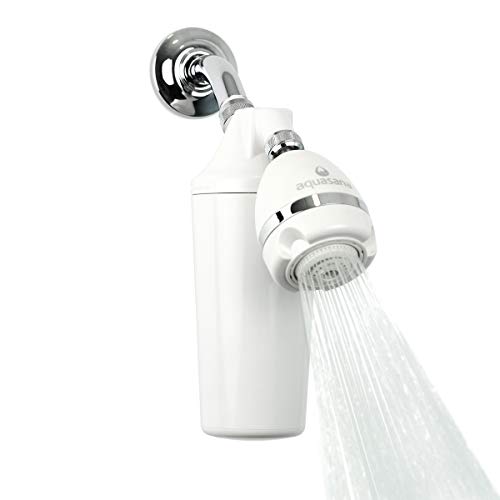
Aquasana AQ-4100One of the few units whose maker names the media outright — copper-zinc KDF plus coconut shell carbon — and one of the few that says anything at all about chloramine. Read its certification line carefully: it is tested to NSF/ANSI 177, not certified to it.Patented copper-zinc (KDF) plus coconut shel…
Philips AWP1775CHWorth owning and worth studying. Its listing says "NSF-Certified KDF", which certifies the material inside the cartridge, not the finished device. That is a real certification of a real thing, and it is not the same as the filter being certified.Three-stage filtration with double mesh and …
Every figure in this table links to the page it came from in the write-ups below. Units we claim to have tested: 0.
CulliganNo photo
Top pick
Culligan WSH-C125
A certified replacement shower head
The cheapest way to get a genuine third-party certification on your wall. Culligan states plainly that the WSH-C125 is tested and certified by IAPMO R&T, which is more than most of this category can say.
Published specifications
Filter media
Not publishedCulligan states what the unit reduces, but not what media does the reducing.
The only filter in this set whose maker publishes its NSF test dates and reduction ranges, and the one an independent lab measured at 100% chlorine removal. It also removed disinfection byproducts, which almost nothing else did.
+Independently measured at 100% chlorine reduction and confirmed to remove disinfection byproducts
+2.8 GPM rating is the highest published flow in this set
+Clear cartridges let you see the sediment stage loading up
Where it falls short
−Publishes nothing about chloramine
−Two cartridges to replace instead of one
−Inline format adds length between the arm and the head
What it does not do
×It does not soften water. An independent lab measured hardness at 125.59 PPM after filtration — effectively unchanged.
×It publishes no chloramine performance data of any kind.
×It is an inline unit, so it does not replace or improve your shower head.
Who it is for
Anyone on chlorinated municipal water who wants the strongest published evidence rather than the strongest published adjectives.
Skip it if
Your utility uses chloramine. Weddell publishes nothing about chloramine performance, and an activated carbon block sized for shower flow is not the thing to bet on for it — see the chloramine guide.
Certified to NSF/ANSI 177 by IAPMO, and the most instructive product in this set: when WaterFilterGuru measured it independently they got 42% chlorine reduction — a reminder that the certification floor is 50% of a controlled challenge, not a promise about your shower.
One of the few units whose maker names the media outright — copper-zinc KDF plus coconut shell carbon — and one of the few that says anything at all about chloramine. Read its certification line carefully: it is tested to NSF/ANSI 177, not certified to it.
Not publishedAquasana does not state a housing material.
What it does well
+Names its media: patented copper-zinc (KDF) and coconut shell carbon
+Published capacity of 10,000 gallons or up to 6 months
+Publishes a chlorine reduction figure of over 90%
+Sold with a head or as a filter-only unit for an existing head
Where it falls short
−Tested to NSF/ANSI 177 rather than certified to it
−Chloramine is listed but not quantified
−2.5 GPM is above the 1.8 GPM cap some states apply to new fixtures
What it does not do
×It does not soften water, and Aquasana makes no softening claim.
×It is not certified by NSF; the wording is "independently tested to NSF/ANSI Standard 177".
×It lists chloramines among what it reduces without publishing a reduction percentage for them.
Who it is for
Someone who wants a stated media list and a published capacity, and who cares more about what is inside than about the finish.
Skip it if
You need a certification mark rather than a testing claim. "Independently tested to" is a weaker statement than "certified by", and the difference matters.
Worth owning and worth studying. Its listing says "NSF-Certified KDF", which certifies the material inside the cartridge, not the finished device. That is a real certification of a real thing, and it is not the same as the filter being certified.
Any cartridge subscription you have not done the arithmetic on
A ninety-day cadence at premium cartridge prices can cost more per year than the filter did. That is not automatically bad — it is just a number you should have seen before agreeing to it.
Skip this
Third-party cartridges with no published media
The marketplace is full of compatible cartridges that name no media at all. You are then buying a shape, not a filter.
The arithmetic no competitor publishes, the cadence data behind it, and why our dollar columns only fill from live prices.
Questions people actually ask
+ How often should you change a shower filter?
Most makers publish six months or about 10,000 gallons, whichever comes first. Hard water, heavy chlorination and a large household all shorten it. The table by media type.
+ Do shower filters reduce water pressure?
A little when new, more as the cartridge loads with sediment. A sudden noticeable drop is usually the cartridge telling you it is finished. The detail.
+ Can you put a filter on your shower head?
Yes — an inline filter goes between the shower arm and your existing head on a standard half-inch thread, tool-free in most cases. How to install one.
+ How much does a shower filter cost to run per month?
It is purchase price plus cartridges per year times cartridge price, divided by twelve. We show the arithmetic and populate it from live prices rather than remembered ones. The method.
+ What happens if you never change the cartridge?
Chlorine reduction falls away as the media is exhausted, and flow keeps dropping as sediment accumulates. You end up with a restrictor that no longer filters.
Sources
Everything on this page traces to one of these. Where a source is brand-owned we say so, because a filter maker explaining filter chemistry has an interest and you are entitled to weigh it.