Chloramine, and the filters that actually address it
About one in five American water systems uses chloramine, the certification does not cover it, and most of this category is the wrong tool for it. Here is what is not.
Disclosure — some links on this page go to Amazon, and we earn a commission if you buy through them. It costs you nothing extra and it does not change what we recommend or in what order. The full disclosure.
Vitamin C (ascorbic acid) neutralizes chloramine chemically and is the best-suited media for shower flow. Catalytic carbon can break it down but needs contact time a shower head struggles to provide. KDF-55 alone does not. And NSF/ANSI 177 does not test for chloramine at all, so certification tells you nothing here.
What chloramine is, and why it is deliberately harder
Chloramine is chlorine bonded to ammonia — monochloramine, in the form used for drinking water. Utilities switch to it because it is more stable than free chlorine: it persists further along the distribution network, so the far end of the system still has a disinfectant residual, and it forms fewer regulated disinfection byproducts along the way. Those are good reasons and it is a sound engineering choice.
The stability that makes it good for a distribution main is exactly what makes it hard to remove at your shower. Free chlorine is reactive; that is why KDF's redox reaction strips it so readily. Chloramine's chlorine-nitrogen bond does not yield to the same electron transfer, which is why a media that handles chlorine at 90-plus percent can leave chloramine substantially intact.
The certification will not tell you
This is the part that catches people out. NSF/ANSI 177 is the shower filter standard, and its scope is a 50 percent reduction of a 2.0 mg/L free available chlorine challenge, plus material safety, structural integrity, flow rate and literature requirements. The trade press reporting on the standard when it was introduced stated it plainly: it does not evaluate free available chlorine reduction performance in the presence of chloramines.
The media that do work
Chemistry summarized from explainers published by AquaEarth and Second Shower, both of which sell filters — we cite them with that stated, because they are the clearest published accounts we could find and their commercial interest is relevant to how you weigh them.
Quick picks
Ranked on what can be verified: a traceable certification first, then media matched to your disinfectant. Tap a row to jump to the full write-up.
| # | Product | Best for | Certification | Price |
|---|---|---|---|---|
| 1 |  AquaBliss SF100 Daily RevitalizeThe one product here whose maker states outright that it reduces chloramine as well as chlorine, and then backs that up by routing chloramine customers away from its own cheaper model. That is an unusually honest piece of product literature.Three stages: sand filter, stainless mesh an… | Chloramine, on the maker's own routing | None | |
| 2 | AquaYouth Vitamin C Handheld Shower HeadThe vitamin C head we could still buy. Ascorbic acid neutralizes chlorine and chloramine chemically rather than adsorbing them, which is why it does not need the contact time carbon does. The catch here is unusually explicit: the cartridge is refillable with loose vitamin C powder, and the maker says that refill comes round every two to four weeks.Vitamin C powder (ascorbic acid) with antimi… | Vitamin C as the primary media | None | |
| 3 | 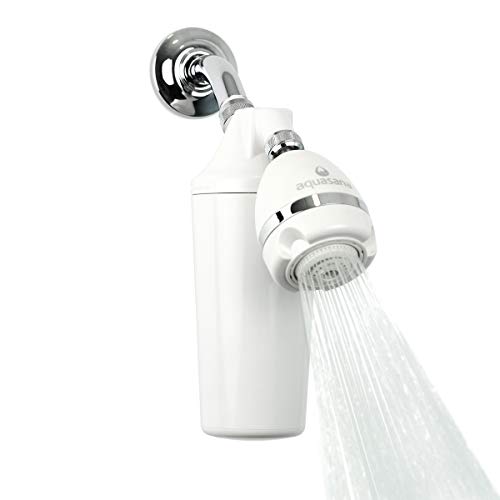 Aquasana AQ-4100One of the few units whose maker names the media outright — copper-zinc KDF plus coconut shell carbon — and one of the few that says anything at all about chloramine. Read its certification line carefully: it is tested to NSF/ANSI 177, not certified to it.Patented copper-zinc (KDF) plus coconut shel… | KDF plus carbon, with the media stated | None | |
| 4 |  Weddell Duo Shower FilterThe only filter in this set whose maker publishes its NSF test dates and reduction ranges, and the one an independent lab measured at 100% chlorine removal. It also removed disinfection byproducts, which almost nothing else did.Dual cartridge: sediment filter plus activat… | Chlorine and disinfection byproducts | NSF/ANSI 177 +2 |
Every figure in this table links to the page it came from in the write-ups below. Units we claim to have tested: 0.
AquaBliss SF100 Daily Revitalize
Chloramine, on the maker's own routing
The one product here whose maker states outright that it reduces chloramine as well as chlorine, and then backs that up by routing chloramine customers away from its own cheaper model. That is an unusually honest piece of product literature.
Published specifications
- Filter media
- Three stages: sand filter, stainless mesh and PP cotton; then calcium sulfite, redox media and activated carbon; then a PP cotton and mesh barrier. Cartridge infused with vitamin C, minerals and tourmaline.Source: AquaBliss — SF100 Daily Revitalize shower filter (retrieved 2026-09-01)
- Stated flow rate
- Not publishedAquaBliss publishes no flow rate for the SF100.
- Rated cartridge life
- Every 3-6 monthsAquaBliss adds "sooner if you're in a high-chlorine or high-sediment area" and publishes no gallon rating.Source: AquaBliss — SF100 Daily Revitalize shower filter (retrieved 2026-09-01)
- Chloramine
- Stated to reduce chloramine as well as chlorine and sedimentAquaBliss routes chloramine customers to this model rather than to its cheaper SF220, which is a claim it makes against its own interest.Source: AquaBliss — SF100 Daily Revitalize shower filter (retrieved 2026-09-01)
- Format
- Inline, standard half-inch connection, five finishesSource: AquaBliss — SF100 Daily Revitalize shower filter (retrieved 2026-09-01)
- Housing
- Not publishedFinish options are listed; the underlying material is not.
What it does well
- States chloramine reduction explicitly, which almost nothing else in this set does
- Full three-stage media list published, including calcium sulfite, redox media and activated carbon
- Vitamin C infusion in the cartridge, which is the media class that actually addresses chloramine
- Inline body fits fixed, rain and handheld heads on a standard half-inch connection
Where it falls short
- No published NSF/ANSI certification
- No published flow rate and no gallon capacity
- Cartridge cadence given only as a 3-6 month range
What it does not do
- It does not soften water; AquaBliss makes no softening claim for it.
- It carries no NSF/ANSI certification that AquaBliss publishes.
- It publishes no flow rate and no gallon capacity, so you cannot compute cost per gallon from its own data.
Who it is for
Readers whose water report says chloramine rather than free chlorine, and who want a stated media list at the low end of the price range.
Skip it if
You want a certification. AquaBliss publishes no NSF/ANSI certification for this unit, and a stated media list is not the same as a verified result.
#ad · how we are funded · price as of October 16, 2026
AquaYouth Vitamin C Handheld Shower Head
Vitamin C as the primary media
The vitamin C head we could still buy. Ascorbic acid neutralizes chlorine and chloramine chemically rather than adsorbing them, which is why it does not need the contact time carbon does. The catch here is unusually explicit: the cartridge is refillable with loose vitamin C powder, and the maker says that refill comes round every two to four weeks.
Published specifications
- Filter media
- Vitamin C powder (ascorbic acid) with antimicrobial ceramic ballsThe ceramic balls are stated to inhibit bacterial growth inside the filter, not to treat the water.Source: AquaYouth — Vitamin C Shower Head (retrieved 2026-09-01)
- Stated flow rate
- Not publishedAquaYouth publishes no flow rate for this head.
- Rated cartridge life
- Refillable; the maker states the vitamin C powder typically needs refilling every 2 to 4 weeksShort by the standards of this category, and a direct consequence of the chemistry: ascorbic acid is consumed by the reaction rather than loaded up like carbon.Source: AquaYouth — Vitamin C Shower Head (retrieved 2026-09-01)
- Chloramine
- Stated to neutralize chloramine as well as free chlorineNo reduction percentage is published. The mechanism is general to ascorbic acid rather than specific to this product.Source: AquaYouth — Vitamin C Shower Head (retrieved 2026-09-01)
- Format
- Handheld shower head with a refillable vitamin C cartridgeSource: AquaYouth vitamin C handheld shower head — listing on Amazon.com (retrieved 2026-09-01)
- Housing
- Not publishedAquaYouth does not state a housing material.
What it does well
- Vitamin C is the primary media rather than one name in a long stage count
- Neutralizes rather than adsorbs, so a tenth-of-a-second contact time is much less of a problem
- The cartridge is refillable with plain ascorbic acid, which is cheap and widely sold
- The maker states the chloramine mechanism plainly instead of implying it
Where it falls short
- A two-to-four-week refill interval is short, and it is the maker's own figure
- No published flow rate at all
- No certification on this model, while a sibling product in the same range does carry one
- No published reduction percentage to check the claim against
What it does not do
- It does not soften water. No shower filter does.
- It carries no published NSF/ANSI certification of its own. AquaYouth publishes an NSF/ANSI 177 and 372 certification for a DIFFERENT product in its range, the 2.0 Carbon filter — that certification does not transfer to this head.
- It publishes no flow rate, so you cannot check it against a state fixture cap.
- It publishes no reduction percentage for either chlorine or chloramine.
Who it is for
Readers on chloraminated water who want the media class that has a mechanism against it, and who would rather top up a cartridge than replace one.
Skip it if
You want a certification, a published flow rate, or a cartridge you can forget about for six months. This unit offers none of the three.
#ad · how we are funded · price as of October 16, 2026
Aquasana AQ-4100
KDF plus carbon, with the media stated
One of the few units whose maker names the media outright — copper-zinc KDF plus coconut shell carbon — and one of the few that says anything at all about chloramine. Read its certification line carefully: it is tested to NSF/ANSI 177, not certified to it.
Published specifications
- Filter media
- Patented copper-zinc (KDF) plus coconut shell carbonSource: Aquasana — shower filter with shower head (retrieved 2026-09-01)
- Stated flow rate
- 2.5 GPMStated as the optimum flow rate.Source: Aquasana — shower filter with shower head (retrieved 2026-09-01)
- Rated cartridge life
- 10,000 gallons, or up to 6 monthsSource: Aquasana — shower filter with shower head (retrieved 2026-09-01)
- Chloramine
- Chloramines listed among contaminants reduced; no percentage publishedSource: Aquasana — shower filter with shower head (retrieved 2026-09-01)
- Format
- Filter body with shower head; a head-free version (AQ-4100NSH) also existsSource: Aquasana AQ-4100 — listing on Amazon.com (retrieved 2026-09-01)
- Housing
- Not publishedAquasana does not state a housing material.
What it does well
- Names its media: patented copper-zinc (KDF) and coconut shell carbon
- Published capacity of 10,000 gallons or up to 6 months
- Publishes a chlorine reduction figure of over 90%
- Sold with a head or as a filter-only unit for an existing head
Where it falls short
- Tested to NSF/ANSI 177 rather than certified to it
- Chloramine is listed but not quantified
- 2.5 GPM is above the 1.8 GPM cap some states apply to new fixtures
What it does not do
- It does not soften water, and Aquasana makes no softening claim.
- It is not certified by NSF; the wording is "independently tested to NSF/ANSI Standard 177".
- It lists chloramines among what it reduces without publishing a reduction percentage for them.
Who it is for
Someone who wants a stated media list and a published capacity, and who cares more about what is inside than about the finish.
Skip it if
You need a certification mark rather than a testing claim. "Independently tested to" is a weaker statement than "certified by", and the difference matters.
#ad · how we are funded · price as of October 16, 2026
Weddell Duo Shower Filter
Chlorine and disinfection byproducts
The only filter in this set whose maker publishes its NSF test dates and reduction ranges, and the one an independent lab measured at 100% chlorine removal. It also removed disinfection byproducts, which almost nothing else did.
Published specifications
- Filter media
- Dual cartridge: sediment filter plus activated carbonThe maker states "Material: Activated carbon" for the black cartridge and a sediment stage for the white one.Source: Weddell Water — Weddell Duo Shower Filter (retrieved 2026-09-01)
- Stated flow rate
- 2.8 GPMSource: Weddell Water — Weddell Duo Shower Filter (retrieved 2026-09-01)
- Rated cartridge life
- 8,000 gallons, or 5-6 monthsRated capacity 8,000 gallons; the maker also gives a 5-6 month calendar prompt.Source: Weddell Water — Weddell Duo Shower Filter (retrieved 2026-09-01)
- Chloramine
- Not publishedWeddell publishes no chloramine figure. Absence of a claim is not evidence of failure, but it is also not evidence of performance.
- Format
- Inline, fits between the arm and any shower headTool-free; the maker states it fits fixed, rain and handheld heads.Source: Weddell Water — Weddell Duo Shower Filter (retrieved 2026-09-01)
- Housing
- Not publishedWeddell does not state a housing material.
What it does well
- NSF/ANSI 177 chlorine reduction with the test date published
- Also carries NSF/ANSI 53 PFAS reduction and NSF/ANSI 42 particulate reduction
- Independently measured at 100% chlorine reduction and confirmed to remove disinfection byproducts
- 2.8 GPM rating is the highest published flow in this set
- Clear cartridges let you see the sediment stage loading up
Where it falls short
- Publishes nothing about chloramine
- Two cartridges to replace instead of one
- Inline format adds length between the arm and the head
What it does not do
- It does not soften water. An independent lab measured hardness at 125.59 PPM after filtration — effectively unchanged.
- It publishes no chloramine performance data of any kind.
- It is an inline unit, so it does not replace or improve your shower head.
Who it is for
Anyone on chlorinated municipal water who wants the strongest published evidence rather than the strongest published adjectives.
Skip it if
Your utility uses chloramine. Weddell publishes nothing about chloramine performance, and an activated carbon block sized for shower flow is not the thing to bet on for it — see the chloramine guide.
#ad · how we are funded · price as of October 16, 2026
What we would skip, and why
The AquaBliss SF220 — and the maker says so
AquaBliss's own product page tells chloramine customers to buy the SF100 or a whole-house unit instead. When a manufacturer talks you out of its cheaper product, believe it.
The honest limitation of a vitamin C shower filter
Vitamin C is the right media class and it comes with a real trade-off that its sellers rarely lead with. Because the ascorbic acid is consumed in the reaction rather than trapping something, cartridge life is a function of how much disinfectant passes through it. Two households on the same product, in different supply zones, will get genuinely different service lives, and neither will match a printed number.
That is why the vitamin C units in our registry publish a time range or nothing at all where the carbon units publish a gallon rating. It is not evasiveness. It is the chemistry being honest about itself. Plan on replacing sooner than you would a KDF cartridge, and treat any specific gallon claim on a vitamin C product with more suspicion than you would on a carbon one.
One product that behaves well here
Worth naming, because it is rare: AquaBliss publishes that its SF100 reduces chloramine along with chlorine, and then on the product page for its cheaper SF220 explicitly directs chloramine customers away from that model and toward the SF100 or a whole-house filter. A manufacturer telling a customer not to buy its cheaper product is the kind of behavior that should be noticed.
That is a claim, not a certification, and we have marked it as such in the review. But a claim that costs the maker a sale is worth more than one that does not.
What we cannot tell you
- A reduction percentage for any specific product on chloramine. No manufacturer in our registry publishes one and no independent lab we found has measured it. The category is silent on the number.
- Whether a vitamin C unit will fully neutralize your supply's residual. That depends on your utility's dose and your flow rate, neither of which we know.
- Whether the difference is perceptible. Chloramine has a fainter smell than free chlorine, which is one reason people on chloraminated supply often report less obvious change.
Questions people actually ask
+ What shower filter removes chloramine?
Ones built on vitamin C or catalytic carbon. KDF-55 alone does not break the chlorine-ammonia bond, and standard activated carbon adsorbs chloramine poorly at shower contact times.
+ Does KDF remove chloramine?
Not on its own. KDF's redox reaction works on free chlorine; chloramine is deliberately more stable and does not yield to it.
+ Is my water chloraminated?
Your utility's annual report says so, in the disinfection section. Roughly one in five US systems uses chloramine. How to check.
+ Does NSF certification cover chloramine?
No. NSF/ANSI 177 covers free available chlorine reduction and explicitly does not evaluate performance in the presence of chloramines.
+ Do vitamin C shower filters really work on chloramine?
The mechanism is sound — ascorbic acid neutralizes both chlorine and chloramine chemically. No manufacturer in our registry publishes a reduction percentage for it, so we cannot give you a number.
+ Why does chloramine matter more than chlorine?
Not because it is worse, but because most of this category is built for free chlorine. On chloraminated supply the usual recommendations are the wrong tool.
Sources
Everything on this page traces to one of these. Where a source is brand-owned we say so, because a filter maker explaining filter chemistry has an interest and you are entitled to weigh it.
- Plumbing & Mechanical, "NSF/ANSI Standard 177: A Level Playing Field for Shower Filter Claims" (retrieved 2026-09-01)
- AquaEarth, "KDF vs vitamin C vs carbon shower filter" — brand-owned explainer, cited with that stated (retrieved 2026-09-01)
- Second Shower, "Vitamin C shower filter chlorine science" — brand-owned explainer, cited with that stated (retrieved 2026-09-01)
- PICKI NIKI, "Filtered shower head technology explained" — brand-owned, cited for its published contact-time figures (retrieved 2026-09-01)
- US EPA — Consumer Confidence Reports (CCR) for drinking water