How to clean a scaled shower head
On hard water this is the single highest-return maintenance job there is — and unlike everything else on this site, it costs nothing.
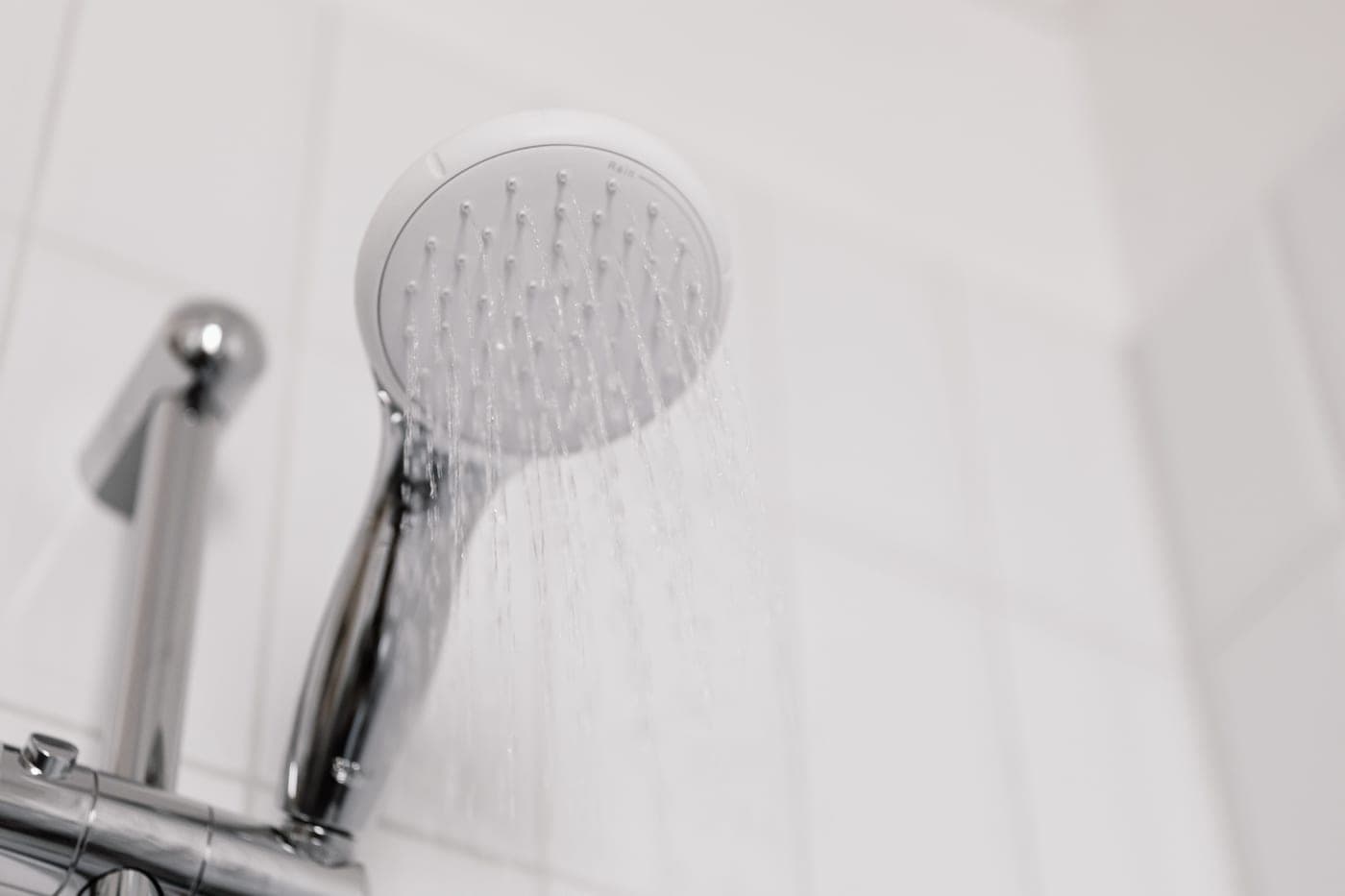
Soak the head in white vinegar — a few hours for light scale, overnight for heavy — then scrub the nozzles with an old toothbrush and flush on full flow for a minute. On hard water this recovers more flow than any filter purchase will, because a filter does not prevent scale and never did.
This page exists because of something we keep having to say elsewhere on this site. No shower filter reduces hardness, so scale keeps forming on the nozzles regardless of what you fit — and a scaled head is the most common cause of the weak, spitting shower that people then blame on the filter. Descaling is the actual fix, and it is free.
Which method to use
The method, step by step
- Use plain white vinegar, undiluted. There is no advantage to warming it and a real risk of splashing acid; room temperature works, it just takes longer.
- Submerge or bag the head so every nozzle is under liquid. A sandwich bag and a rubber band handles a fixed head; loop the band around the arm, not the finish.
- Leave it. Two to four hours clears light spotting; heavy crust wants overnight. There is no benefit to going beyond about twelve hours, and there is a finish risk.
- Scrub the nozzles with an old toothbrush. The soak softens the deposit; the brush is what removes it. On rubber nozzles, rub each one with a thumb — they are designed to flex so the scale cracks off.
- Clear the inlet screen. Most heads have a small mesh filter where they meet the arm. It catches grit and is very often the actual restriction. Pick it out, rinse it, refit it.
- Refit and flush on full flow for a minute, hot, to clear loosened debris before you next use it properly.
What not to do
- Do not soak brass, nickel, bronze or coated finishes for long periods. Vinegar attacks these. Thirty minutes and a scrub, repeated, is safer than an overnight soak on anything that is not chrome or plastic.
- Do not use bleach. It does nothing to mineral scale, which is not organic, and it degrades rubber nozzles and seals.
- Do not use a descaler and a filter cartridge at the same time. See the callout above.
- Do not poke nozzles with a needle on rubber-tipped heads. You will perforate them and the spray pattern never recovers.
- Do not bother with proprietary shower-head cleaners unless the finish rules out vinegar. Scale is calcium carbonate and a weak acid dissolves it; that is the entire mechanism.
Descaling the filter housing, which is a different job
The head is not the only thing scaling up. On an inline unit the filter body sits upstream of the head, full of water at shower temperature, and its inlet screen and internal surfaces accumulate the same deposit. People descale the head, get some flow back, and never touch the housing.
Do this at a cartridge change, with the cartridge out. Wipe the interior and the threads with a vinegar-dampened cloth, rinse thoroughly, and let it dry before the new cartridge goes in. Never soak an assembled housing with a cartridge inside it, for the reason in the callout above — you would be running acid through the media you just paid for.
The threads matter as much as the interior. Scale on a shower arm's threads is the second most common cause of a leak after tape wrapped the wrong way, because deposit prevents new tape seating into the thread profile. Cleaning them while you have the unit apart removes a future problem for free — the leak diagnosis.
If vinegar is wrong for your finish
Citric acid is the alternative worth knowing. It is a weak acid like vinegar so the descaling chemistry is the same, it is sold as a food-grade powder, and it is gentler on plated finishes than acetic acid at the same soak time. Dissolve it in warm water to a strong solution, then treat it exactly as you would vinegar — same soak times, same scrub, same flush.
It also has no smell, which sounds trivial until you have left an overnight vinegar bag on a shower head in a small bathroom. Whichever you use, the rules are unchanged: never on a cartridge, shorter soaks on brass, nickel and bronze, and a full-flow flush before you use the shower properly.
What scale is actually costing you
Worth putting in context, because it explains why this job outranks most purchases. New shower heads are capped by law at 2.5 gallons per minute federally and 1.8 in California and New York, so the entire designed flow of a modern head sits in a narrow band. Scale does not remove a percentage evenly across that band — it progressively blocks individual nozzles, which is why a scaled head sprays unevenly and spits before it feels globally weak.
That is a different failure mode from a loaded filter cartridge, which restricts more uniformly. Uneven, spitting jets point at the head. A general, even weakening points at the cartridge or upstream. The four causes of a weak shower separates them properly.
How often
It depends entirely on your hardness. Above roughly 7 grains per gallon — the threshold where water is classed as hard — every three months is realistic. Below that, twice a year. If you do not know your number, four ways to find it, two of which cost nothing.
A useful habit: do it at the same time as your cartridge change. Both are on a similar cadence, the head is already off, and pairing them means the job that has no reminder attached inherits one from the job that does. The cartridge procedure.
Why this matters more than the filter you buy
Because of where the restriction actually is. A new filter cartridge costs you a small, roughly constant amount of pressure. A scaled head progressively blocks the nozzles themselves, and on hard water that loss is far larger and keeps growing. People routinely buy a filter to fix a weak shower, notice no improvement, and conclude filters are useless — when the head was the problem the whole time.
It also sets a fair expectation for what a filter is for. Descaling fixes flow. A filter reduces chlorine. Those are different jobs, and the honest version of this category keeps them apart — what actually causes a weak shower, and why no filter stops the scale.
Questions people actually ask
+ How do you clean a shower head with vinegar?
Submerge it in undiluted white vinegar, or tie a bag of vinegar over it if it does not come off. Two to four hours for light scale, overnight for heavy, then scrub the nozzles and flush.
+ How often should you descale a shower head?
About every three months above roughly 7 grains per gallon hardness, twice a year below that. Pairing it with your cartridge change is the easiest way to remember.
+ Can I soak a filtered shower head in vinegar?
Not whole. Acid running through the cartridge strips KDF and consumes calcium sulfite and vitamin C. Bag the faceplate only, or remove the cartridge first.
+ Will a shower filter stop limescale on my shower head?
No. Scale forms from the calcium and magnesium a filter leaves in the water, so it keeps forming — on the filter housing as well as the head.
+ Does vinegar damage a shower head?
Chrome and plastic tolerate it well. Brass, nickel, bronze and coated finishes should get short soaks with scrubbing rather than an overnight immersion.
+ What if descaling does not restore the flow?
Check the inlet screen where the head meets the arm, then the filter cartridge, then whether the head is simply rated at 1.8 GPM. The four causes.
Sources
Everything on this page traces to one of these. Where a source is brand-owned we say so, because a filter maker explaining filter chemistry has an interest and you are entitled to weigh it.
- US EPA WaterSense — showerheads and the 2.5 gpm federal maximum
- WaterFilterGuru, "The Best Shower Head Filter" — independent lab testing, credited to them (retrieved 2026-09-01)
- PICKI NIKI, "Filtered shower head technology explained" — brand-owned, cited for its published contact-time figures (retrieved 2026-09-01)