Aquasana AQ-4100 vs AquaBliss SF100
One is tested to a standard it does not hold. The other makes the one claim almost nothing in this category makes, and asks a great deal less money. Your utility's disinfectant decides it.
Disclosure — some links on this page go to Amazon, and we earn a commission if you buy through them. It costs you nothing extra and it does not change what we recommend or in what order. The full disclosure.
Aquasana names copper-zinc KDF plus coconut shell carbon, publishes 2.5 GPM and 10,000 gallons, and says it is tested to NSF/ANSI 177. AquaBliss SF100 adds vitamin C and states outright that it reduces chloramine, on a 3-6 month cartridge with no flow rate published — at a fraction of the price. Neither is certified.
Quick picks
Ranked on what can be verified: a traceable certification first, then media matched to your disinfectant. Tap a row to jump to the full write-up.
| # | Product | Best for | Certification | Price |
|---|---|---|---|---|
| 1 |  AquaBliss SF100 Daily RevitalizeThe one product here whose maker states outright that it reduces chloramine as well as chlorine, and then backs that up by routing chloramine customers away from its own cheaper model. That is an unusually honest piece of product literature.Three stages: sand filter, stainless mesh an… | Chloramine, on the maker's own routing | None | |
| 2 | 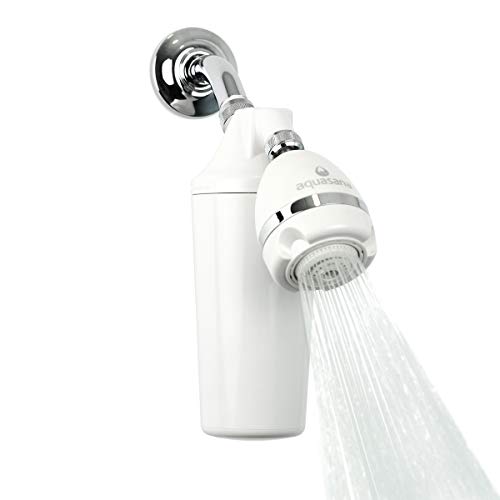 Aquasana AQ-4100One of the few units whose maker names the media outright — copper-zinc KDF plus coconut shell carbon — and one of the few that says anything at all about chloramine. Read its certification line carefully: it is tested to NSF/ANSI 177, not certified to it.Patented copper-zinc (KDF) plus coconut shel… | KDF plus carbon, with the media stated | None |
Every figure in this table links to the page it came from in the write-ups below. Units we claim to have tested: 0.
AquaBliss SF100 Daily Revitalize
Chloramine, on the maker's own routing
The one product here whose maker states outright that it reduces chloramine as well as chlorine, and then backs that up by routing chloramine customers away from its own cheaper model. That is an unusually honest piece of product literature.
Published specifications
- Filter media
- Three stages: sand filter, stainless mesh and PP cotton; then calcium sulfite, redox media and activated carbon; then a PP cotton and mesh barrier. Cartridge infused with vitamin C, minerals and tourmaline.Source: AquaBliss — SF100 Daily Revitalize shower filter (retrieved 2026-09-01)
- Stated flow rate
- Not publishedAquaBliss publishes no flow rate for the SF100.
- Rated cartridge life
- Every 3-6 monthsAquaBliss adds "sooner if you're in a high-chlorine or high-sediment area" and publishes no gallon rating.Source: AquaBliss — SF100 Daily Revitalize shower filter (retrieved 2026-09-01)
- Chloramine
- Stated to reduce chloramine as well as chlorine and sedimentAquaBliss routes chloramine customers to this model rather than to its cheaper SF220, which is a claim it makes against its own interest.Source: AquaBliss — SF100 Daily Revitalize shower filter (retrieved 2026-09-01)
- Format
- Inline, standard half-inch connection, five finishesSource: AquaBliss — SF100 Daily Revitalize shower filter (retrieved 2026-09-01)
- Housing
- Not publishedFinish options are listed; the underlying material is not.
What it does well
- States chloramine reduction explicitly, which almost nothing else in this set does
- Full three-stage media list published, including calcium sulfite, redox media and activated carbon
- Vitamin C infusion in the cartridge, which is the media class that actually addresses chloramine
- Inline body fits fixed, rain and handheld heads on a standard half-inch connection
Where it falls short
- No published NSF/ANSI certification
- No published flow rate and no gallon capacity
- Cartridge cadence given only as a 3-6 month range
What it does not do
- It does not soften water; AquaBliss makes no softening claim for it.
- It carries no NSF/ANSI certification that AquaBliss publishes.
- It publishes no flow rate and no gallon capacity, so you cannot compute cost per gallon from its own data.
Who it is for
Readers whose water report says chloramine rather than free chlorine, and who want a stated media list at the low end of the price range.
Skip it if
You want a certification. AquaBliss publishes no NSF/ANSI certification for this unit, and a stated media list is not the same as a verified result.
#ad · how we are funded · price as of October 16, 2026
Aquasana AQ-4100
KDF plus carbon, with the media stated
One of the few units whose maker names the media outright — copper-zinc KDF plus coconut shell carbon — and one of the few that says anything at all about chloramine. Read its certification line carefully: it is tested to NSF/ANSI 177, not certified to it.
Published specifications
- Filter media
- Patented copper-zinc (KDF) plus coconut shell carbonSource: Aquasana — shower filter with shower head (retrieved 2026-09-01)
- Stated flow rate
- 2.5 GPMStated as the optimum flow rate.Source: Aquasana — shower filter with shower head (retrieved 2026-09-01)
- Rated cartridge life
- 10,000 gallons, or up to 6 monthsSource: Aquasana — shower filter with shower head (retrieved 2026-09-01)
- Chloramine
- Chloramines listed among contaminants reduced; no percentage publishedSource: Aquasana — shower filter with shower head (retrieved 2026-09-01)
- Format
- Filter body with shower head; a head-free version (AQ-4100NSH) also existsSource: Aquasana AQ-4100 — listing on Amazon.com (retrieved 2026-09-01)
- Housing
- Not publishedAquasana does not state a housing material.
What it does well
- Names its media: patented copper-zinc (KDF) and coconut shell carbon
- Published capacity of 10,000 gallons or up to 6 months
- Publishes a chlorine reduction figure of over 90%
- Sold with a head or as a filter-only unit for an existing head
Where it falls short
- Tested to NSF/ANSI 177 rather than certified to it
- Chloramine is listed but not quantified
- 2.5 GPM is above the 1.8 GPM cap some states apply to new fixtures
What it does not do
- It does not soften water, and Aquasana makes no softening claim.
- It is not certified by NSF; the wording is "independently tested to NSF/ANSI Standard 177".
- It lists chloramines among what it reduces without publishing a reduction percentage for them.
Who it is for
Someone who wants a stated media list and a published capacity, and who cares more about what is inside than about the finish.
Skip it if
You need a certification mark rather than a testing claim. "Independently tested to" is a weaker statement than "certified by", and the difference matters.
#ad · how we are funded · price as of October 16, 2026
Side by side
All figures are the manufacturers' own published data. Neither unit appears in an independent bench test we could locate.
The deciding question is your disinfectant
About one in five US water systems disinfects with chloramine rather than free chlorine, and that single fact settles most of this comparison before any other spec matters.
Aquasana's stack is copper-zinc KDF with coconut shell carbon. KDF reduces free chlorine very effectively at shower contact time and does not break the chlorine-ammonia bond. Aquasana does list chloramines among the contaminants it reduces — more than most of the category says — but publishes no figure for it, and a contaminant named in a list without a number is not a performance claim you can check.
AquaBliss infuses vitamin C into the SF100's cartridge, which is one of only two media classes with a real mechanism against chloramine, and states plainly that the filter reduces it. It then does something rarer still: on its cheaper SF220 it tells chloramine customers to buy the SF100 instead. A maker routing you away from its own cheaper product is the strongest disclosure signal in this category. Which media handle chloramine, and find out which disinfectant you have.
Tested to, versus certified by — again
Aquasana's wording is "independently tested to NSF/ANSI Standard 177". A laboratory ran the protocol, on data Aquasana commissioned and controls. No accredited body is named, no listing exists, and no production line is audited. AquaBliss does not make a testing claim at all, which at least avoids the ambiguity.
Neither product holds a certification. If a traceable mark is what you are buying, the four that have one include an inline body cheaper than either of these.
What Aquasana gives you that AquaBliss does not
Numbers you can check. 2.5 GPM, which you can test against your state's fixture cap. 10,000 gallons or up to six months, which is a capacity you can do arithmetic with rather than a calendar range. And over 90 percent chlorine reduction, which is at least a figure with a unit attached.
AquaBliss publishes no flow rate and no gallon rating at all — its cadence is "every 3-6 months, sooner in a high-chlorine or high-sediment area". That is honest about the variability and useless for budgeting. The cost-of-ownership arithmetic needs a number, and only one of these two provides one.
And the price gap is large
Aquasana sits in the upper-middle of this category; the SF100 sits near the bottom. That is a substantial multiple for a product that publishes fewer numbers — but the cheaper one is also the one making the claim that matters on chloraminated water. Price and evidence point in opposite directions here, which is unusual and worth naming plainly rather than resolving with a shrug.
The verdict
- Buy the AquaBliss SF100 if your utility uses chloramine. It is the one making that claim, it has the right media class for it, and it costs far less.
- Buy the Aquasana AQ-4100 if your water is chlorinated and you want published numbers — a flow rate, a gallon capacity and a percentage — rather than a calendar range.
- Buy neither if you want a certification. Neither holds one, and Aquasana's testing claim is not a substitute.
- Buy neither for hard water. Neither softens, and neither claims to.
What we would skip, and why
Questions people actually ask
+ Which is better, Aquasana or AquaBliss?
It depends on your disinfectant. On chloraminated water the AquaBliss SF100 — it adds vitamin C and states chloramine reduction, and costs far less. On chlorinated water Aquasana publishes more checkable numbers: 2.5 GPM, 10,000 gallons and an over-90-percent chlorine claim.
+ Is the Aquasana AQ-4100 NSF certified?
No. It is described as independently tested to NSF/ANSI Standard 177, which means a lab ran the protocol. No certifying body is named and there is no listing to check.
+ Does the AquaBliss SF100 really remove chloramine?
AquaBliss states it does, and the cartridge is infused with vitamin C, which is one of two media classes with a real mechanism against chloramine. No percentage is published, so treat it as a credible manufacturer claim rather than a verified result.
+ Why is the cheaper one better for chloramine?
Because media class matters more than price here. Vitamin C addresses chloramine; copper-zinc KDF does not, however well made the unit around it is.
Sources
Everything on this page traces to one of these. Where a source is brand-owned we say so, because a filter maker explaining filter chemistry has an interest and you are entitled to weigh it.
- Plumbing & Mechanical, "NSF/ANSI Standard 177: A Level Playing Field for Shower Filter Claims" (retrieved 2026-09-01)
- NSF — NSF/ANSI 177 shower filter certification program
- AquaEarth, "KDF vs vitamin C vs carbon shower filter" — brand-owned explainer, cited with that stated (retrieved 2026-09-01)
- US EPA — Consumer Confidence Reports (CCR) for drinking water