Shower filters and dry scalp
Of all the hair and skin claims made for shower filters, this is the one with the least distance between the marketing and the mechanism.
Disclosure — some links on this page go to Amazon, and we earn a commission if you buy through them. It costs you nothing extra and it does not change what we recommend or in what order. The full disclosure.
This is the strongest of the skin claims, because two things are drying your scalp — chlorine and hard-water soap residue — and a filter removes one of them cleanly. It is still not a treatment for dandruff or seborrheic dermatitis, which have a different cause entirely.
Why this claim holds up better than the others
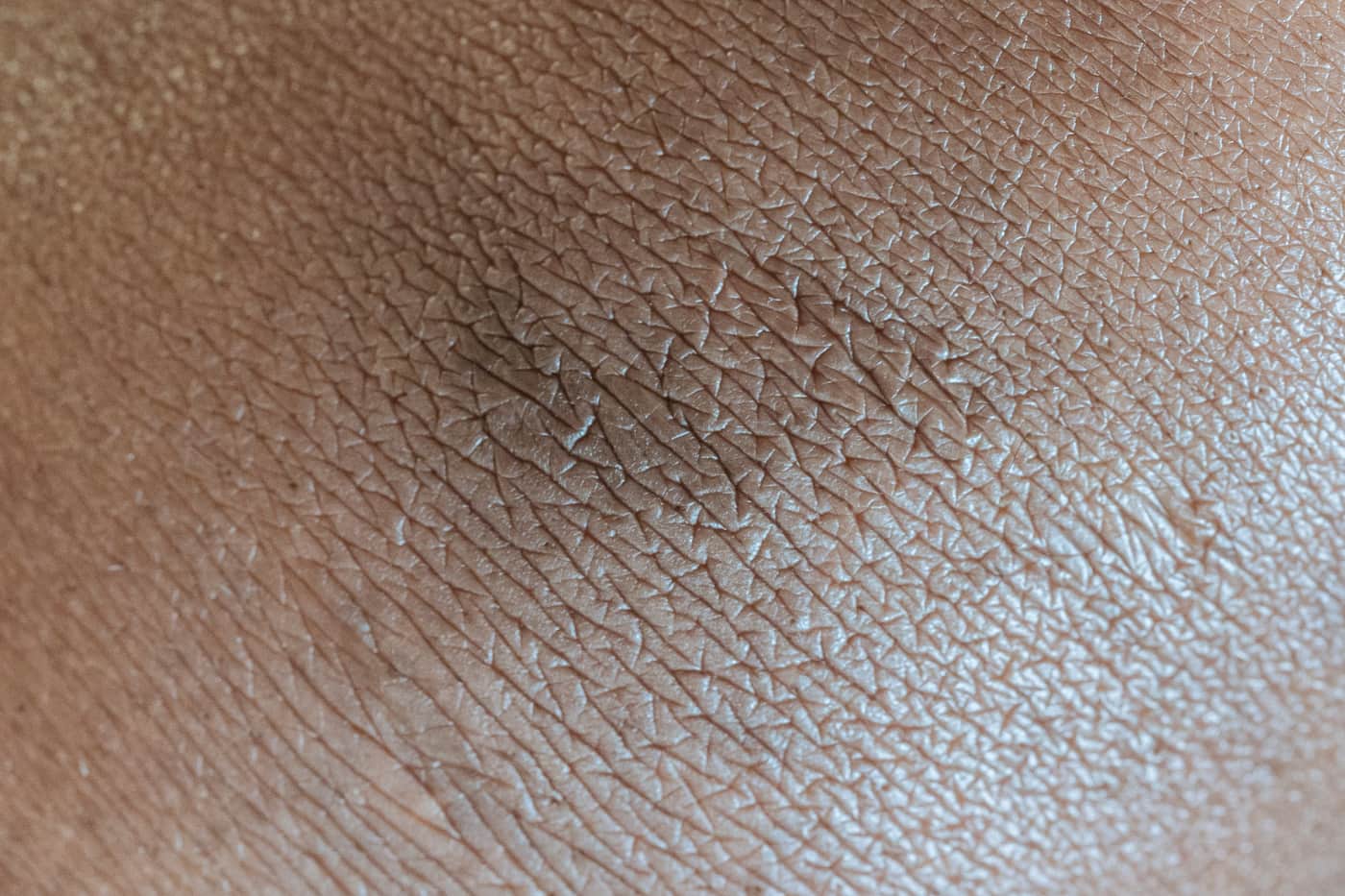
Dry scalp is a barrier problem: the stratum corneum has lost lipids and water faster than it can replace them. It does not require a disease process, and it responds to removing irritants in a way that eczema and acne do not. That makes the causal chain much shorter than in the eczema case, where a randomized trial of the obvious intervention came back negative.
Three things in a shower contribute. Water temperature, which strips lipids directly. Surfactant, which is doing the same job on purpose. And the disinfectant residual, which is oxidizing. A filter removes the third one — genuinely, measurably, and with a spread from 42 to 100 percent depending on the unit.
The hard-water contribution, and its limit
Hard water makes this worse in a way that is more behavioural than chemical. Calcium and magnesium react with the fatty acids in shampoo to form an insoluble scum, so lather collapses and people use more product and scrub harder. More surfactant, applied more vigorously, is straightforwardly worse for a dry scalp.
A filter does not fix that. The minerals stay in the water, the scum keeps forming, and the lather stays poor. If your scalp complaint tracks with a general no-lather, filmy-skin picture, the hardness page is the honest destination.
What this is not
- Not dandruff. Dandruff and seborrheic dermatitis involve Malassezia yeast and sebum, and no aspect of water hardness or chlorine is established in their pathophysiology. Antifungal shampoos exist for this reason.
- Not psoriasis. An immune-mediated condition, and not something a plumbing accessory addresses.
- Not a substitute for the free fixes. Cooler water and shorter showers do more for a dry scalp than any filter, cost nothing, and are the first thing any clinician would say.
Quick picks
Ranked on what can be verified: a traceable certification first, then media matched to your disinfectant. Tap a row to jump to the full write-up.
| # | Product | Best for | Certification | Price |
|---|---|---|---|---|
| 1 |  Weddell Duo Shower FilterThe only filter in this set whose maker publishes its NSF test dates and reduction ranges, and the one an independent lab measured at 100% chlorine removal. It also removed disinfection byproducts, which almost nothing else did.Dual cartridge: sediment filter plus activat… | Chlorine and disinfection byproducts | NSF/ANSI 177 +2 | |
| 2 |  AquaBliss SF100 Daily RevitalizeThe one product here whose maker states outright that it reduces chloramine as well as chlorine, and then backs that up by routing chloramine customers away from its own cheaper model. That is an unusually honest piece of product literature.Three stages: sand filter, stainless mesh an… | Chloramine, on the maker's own routing | None | |
| 3 | 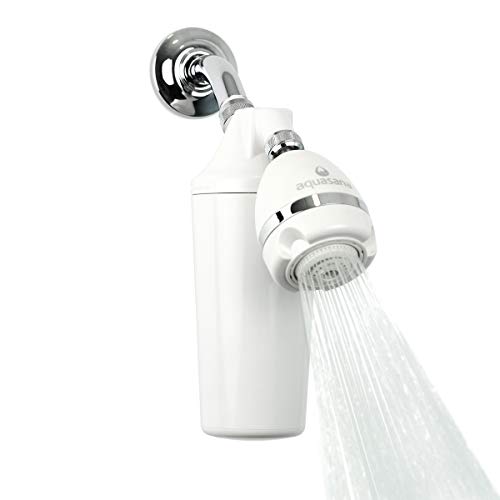 Aquasana AQ-4100One of the few units whose maker names the media outright — copper-zinc KDF plus coconut shell carbon — and one of the few that says anything at all about chloramine. Read its certification line carefully: it is tested to NSF/ANSI 177, not certified to it.Patented copper-zinc (KDF) plus coconut shel… | KDF plus carbon, with the media stated | None |
Every figure in this table links to the page it came from in the write-ups below. Units we claim to have tested: 0.
Weddell Duo Shower Filter
Chlorine and disinfection byproducts
The only filter in this set whose maker publishes its NSF test dates and reduction ranges, and the one an independent lab measured at 100% chlorine removal. It also removed disinfection byproducts, which almost nothing else did.
Published specifications
- Filter media
- Dual cartridge: sediment filter plus activated carbonThe maker states "Material: Activated carbon" for the black cartridge and a sediment stage for the white one.Source: Weddell Water — Weddell Duo Shower Filter (retrieved 2026-09-01)
- Stated flow rate
- 2.8 GPMSource: Weddell Water — Weddell Duo Shower Filter (retrieved 2026-09-01)
- Rated cartridge life
- 8,000 gallons, or 5-6 monthsRated capacity 8,000 gallons; the maker also gives a 5-6 month calendar prompt.Source: Weddell Water — Weddell Duo Shower Filter (retrieved 2026-09-01)
- Chloramine
- Not publishedWeddell publishes no chloramine figure. Absence of a claim is not evidence of failure, but it is also not evidence of performance.
- Format
- Inline, fits between the arm and any shower headTool-free; the maker states it fits fixed, rain and handheld heads.Source: Weddell Water — Weddell Duo Shower Filter (retrieved 2026-09-01)
- Housing
- Not publishedWeddell does not state a housing material.
What it does well
- NSF/ANSI 177 chlorine reduction with the test date published
- Also carries NSF/ANSI 53 PFAS reduction and NSF/ANSI 42 particulate reduction
- Independently measured at 100% chlorine reduction and confirmed to remove disinfection byproducts
- 2.8 GPM rating is the highest published flow in this set
- Clear cartridges let you see the sediment stage loading up
Where it falls short
- Publishes nothing about chloramine
- Two cartridges to replace instead of one
- Inline format adds length between the arm and the head
What it does not do
- It does not soften water. An independent lab measured hardness at 125.59 PPM after filtration — effectively unchanged.
- It publishes no chloramine performance data of any kind.
- It is an inline unit, so it does not replace or improve your shower head.
Who it is for
Anyone on chlorinated municipal water who wants the strongest published evidence rather than the strongest published adjectives.
Skip it if
Your utility uses chloramine. Weddell publishes nothing about chloramine performance, and an activated carbon block sized for shower flow is not the thing to bet on for it — see the chloramine guide.
#ad · how we are funded · price as of October 16, 2026
AquaBliss SF100 Daily Revitalize
Chloramine, on the maker's own routing
The one product here whose maker states outright that it reduces chloramine as well as chlorine, and then backs that up by routing chloramine customers away from its own cheaper model. That is an unusually honest piece of product literature.
Published specifications
- Filter media
- Three stages: sand filter, stainless mesh and PP cotton; then calcium sulfite, redox media and activated carbon; then a PP cotton and mesh barrier. Cartridge infused with vitamin C, minerals and tourmaline.Source: AquaBliss — SF100 Daily Revitalize shower filter (retrieved 2026-09-01)
- Stated flow rate
- Not publishedAquaBliss publishes no flow rate for the SF100.
- Rated cartridge life
- Every 3-6 monthsAquaBliss adds "sooner if you're in a high-chlorine or high-sediment area" and publishes no gallon rating.Source: AquaBliss — SF100 Daily Revitalize shower filter (retrieved 2026-09-01)
- Chloramine
- Stated to reduce chloramine as well as chlorine and sedimentAquaBliss routes chloramine customers to this model rather than to its cheaper SF220, which is a claim it makes against its own interest.Source: AquaBliss — SF100 Daily Revitalize shower filter (retrieved 2026-09-01)
- Format
- Inline, standard half-inch connection, five finishesSource: AquaBliss — SF100 Daily Revitalize shower filter (retrieved 2026-09-01)
- Housing
- Not publishedFinish options are listed; the underlying material is not.
What it does well
- States chloramine reduction explicitly, which almost nothing else in this set does
- Full three-stage media list published, including calcium sulfite, redox media and activated carbon
- Vitamin C infusion in the cartridge, which is the media class that actually addresses chloramine
- Inline body fits fixed, rain and handheld heads on a standard half-inch connection
Where it falls short
- No published NSF/ANSI certification
- No published flow rate and no gallon capacity
- Cartridge cadence given only as a 3-6 month range
What it does not do
- It does not soften water; AquaBliss makes no softening claim for it.
- It carries no NSF/ANSI certification that AquaBliss publishes.
- It publishes no flow rate and no gallon capacity, so you cannot compute cost per gallon from its own data.
Who it is for
Readers whose water report says chloramine rather than free chlorine, and who want a stated media list at the low end of the price range.
Skip it if
You want a certification. AquaBliss publishes no NSF/ANSI certification for this unit, and a stated media list is not the same as a verified result.
#ad · how we are funded · price as of October 16, 2026
Aquasana AQ-4100
KDF plus carbon, with the media stated
One of the few units whose maker names the media outright — copper-zinc KDF plus coconut shell carbon — and one of the few that says anything at all about chloramine. Read its certification line carefully: it is tested to NSF/ANSI 177, not certified to it.
Published specifications
- Filter media
- Patented copper-zinc (KDF) plus coconut shell carbonSource: Aquasana — shower filter with shower head (retrieved 2026-09-01)
- Stated flow rate
- 2.5 GPMStated as the optimum flow rate.Source: Aquasana — shower filter with shower head (retrieved 2026-09-01)
- Rated cartridge life
- 10,000 gallons, or up to 6 monthsSource: Aquasana — shower filter with shower head (retrieved 2026-09-01)
- Chloramine
- Chloramines listed among contaminants reduced; no percentage publishedSource: Aquasana — shower filter with shower head (retrieved 2026-09-01)
- Format
- Filter body with shower head; a head-free version (AQ-4100NSH) also existsSource: Aquasana AQ-4100 — listing on Amazon.com (retrieved 2026-09-01)
- Housing
- Not publishedAquasana does not state a housing material.
What it does well
- Names its media: patented copper-zinc (KDF) and coconut shell carbon
- Published capacity of 10,000 gallons or up to 6 months
- Publishes a chlorine reduction figure of over 90%
- Sold with a head or as a filter-only unit for an existing head
Where it falls short
- Tested to NSF/ANSI 177 rather than certified to it
- Chloramine is listed but not quantified
- 2.5 GPM is above the 1.8 GPM cap some states apply to new fixtures
What it does not do
- It does not soften water, and Aquasana makes no softening claim.
- It is not certified by NSF; the wording is "independently tested to NSF/ANSI Standard 177".
- It lists chloramines among what it reduces without publishing a reduction percentage for them.
Who it is for
Someone who wants a stated media list and a published capacity, and who cares more about what is inside than about the finish.
Skip it if
You need a certification mark rather than a testing claim. "Independently tested to" is a weaker statement than "certified by", and the difference matters.
#ad · how we are funded · price as of October 16, 2026
The order to try things in
- Turn the temperature down. This is the biggest single lever and it is free.
- Shorten the shower. Contact time works against your skin barrier the same way it works for a filter.
- Use less shampoo, less often, and rinse thoroughly. Residue left on the scalp is an irritant in its own right.
- Then consider a filter, if your water is chlorinated. Check what your utility uses so you buy the right media.
- See someone if there is flaking, redness or itch that persists. Dry scalp and scalp disease look similar and are treated completely differently.
Questions people actually ask
+ Does a shower filter help with dry scalp?
It removes chlorine, one of several irritants acting on a dry scalp. That is a reasonable mechanism. It does not address the hard-water residue, and no trial has tested the outcome.
+ Can a shower filter help with dandruff?
No established mechanism. Dandruff and seborrheic dermatitis involve Malassezia yeast and sebum, neither of which is affected by water hardness or chlorine.
+ Why is my scalp dry after showering?
Most often water temperature and surfactant. Chlorine and hard-water soap residue add to it. Temperature is the biggest lever and the free one.
+ Will a filter stop my scalp itching?
If the itch is irritant dryness on chlorinated water, plausibly. If it is a scalp condition, no — and it is worth having someone look at it.
Sources
Everything on this page traces to one of these. Where a source is brand-owned we say so, because a filter maker explaining filter chemistry has an interest and you are entitled to weigh it.
- Thomas KS et al. (2011). A multicentre randomized controlled trial and economic evaluation of ion-exchange water softeners for the treatment of eczema in children: the Softened Water Eczema Trial (SWET).
- Jabbar-Lopez ZK et al. (2021). The effect of water hardness on atopic eczema and skin barrier function: a systematic review and meta-analysis.
- WaterFilterGuru, "The Best Shower Head Filter" — independent lab testing, credited to them (retrieved 2026-09-01)
- Luqman MW et al. (2018). To evaluate and compare changes in baseline strength of hairs after treating them with deionized water and hard water and its role in hair breakage. International Journal of Trichology 10(3):113-117.