SparkPod filtered shower head review
The second stage-count product in this registry, and a more honest one than the first: SparkPod names what is in the cartridge. Then it tells you to replace it twice as often as most of the category.
Disclosure — some links on this page go to Amazon, and we earn a commission if you buy through them. It costs you nothing extra and it does not change what we recommend or in what order. The full disclosure.
SparkPod advertises 23-stage filtration and names the media — activated carbon, KDF and calcium sulfite — which most stage-counters do not. Its own cartridge page states 3 to 4 months of daily use, roughly twice the replacement rate of the six-month units here. It publishes no flow rate, no percentage and no certification.

SparkPod 23-Stage Filtered Shower Head
Stage counting, with the media actually named
Advertised as 23-stage, which is a marketing unit rather than an engineering one — but unlike most stage-counters SparkPod does name its media, and the list is a sensible one. The catch is the interval: its own cartridge page says three to four months, which is twice the replacement rate of the six-month units here.
Published specifications
- Filter media
- Multi-stage filtration with activated carbon, KDF and calcium sulfiteSparkPod's retail listing additionally lists vitamin C and ceramic among the 23 stages. The stage count is a layer count rather than a measure of filtration steps.Source: SparkPod — High Output Shower Filter Cartridge (retrieved 2026-09-01)
- Stated flow rate
- Not publishedSparkPod publishes no flow rate for the filtered head.
- Rated cartridge life
- Each cartridge lasts 3 to 4 months of daily useSparkPod's own cartridge page gives months rather than gallons. Retail copy elsewhere quotes a gallon figure; we use the maker's own wording.Source: SparkPod — High Output Shower Filter Cartridge (retrieved 2026-09-01)
- Chloramine
- Not publishedSparkPod makes no chloramine claim. Vitamin C appears in its stage list, which is the right media class, but no quantity or performance figure is published.
- Format
- Replacement shower head with a removable capsule filter, three spray settings, six-inch round faceSource: SparkPod filtered shower head, 23-stage, polished chrome — listing on Amazon.com (retrieved 2026-09-01)
- Housing
- Not publishedSparkPod states the finish and not the underlying material.
What it does well
- Names its media rather than hiding behind the stage count: activated carbon, KDF and calcium sulfite
- Vitamin C and ceramic are listed among the stages on its retail listing, which is a broader stack than most heads
- A complete replacement head with three spray settings, so one purchase replaces the fitting entirely
- Removable capsule filter makes the cartridge swap a visible, simple job
Where it falls short
- "23-stage" counts layers, not filtration steps — a mesh screen is a stage
- Three-to-four-month cartridge interval, roughly twice the replacement rate of the six-month units here
- No certification and no published reduction percentage
- No published flow rate, so you cannot check it against a state fixture cap
What it does not do
- It does not hold a certification, and SparkPod publishes none.
- It does not soften water, despite hard-water language in its retail listing. Nothing in this category does.
- It publishes no flow rate.
- It publishes no reduction percentage for anything it claims to remove.
Who it is for
Someone who wants a complete replacement head with the filter built in, three spray settings, and a media list they can actually read.
Skip it if
You dislike buying cartridges. A three-to-four-month interval is four changes a year at the short end, against two for most of this registry.
#ad · how we are funded · price as of October 16, 2026
Certifications and claims
Two tables, deliberately. A certification names a standard and the body that issued it, and you can look it up. A claim is the maker describing itself. Both belong here; conflating them does not.
No third-party certification is published for this product. That is not evidence of poor performance and it is not evidence of good performance — it means there is nothing independent to check.
“Reduces chlorine, heavy metals, pesticides and odors”
Source: SparkPod — High Output Shower Filter Cartridge (retrieved 2026-09-01)“23-stage filtration that reduces chlorine and heavy metals and helps improve hard water”
Source: SparkPod filtered shower head, 23-stage, polished chrome — listing on Amazon.com (retrieved 2026-09-01)
What a "stage" is, and is not
Twenty-three stages sounds like twenty-three filtration steps. It is not. A stage in this category is a layer in the cartridge, and a layer can be a mesh screen, a bed of ceramic balls, or a spacer. Counting them is a marketing unit rather than an engineering one, which is why the number climbs every year while the chemistry stays the same.
We have said this before about the iSpring SF2S, which advertises 33 stages and 18 media types and names two of them. Two products doing it makes it a category habit rather than one brand's quirk, and the useful response is the same either way: ignore the count and read the media list.
Where SparkPod does better than the pattern
It actually publishes the list. SparkPod's own cartridge page describes multi-stage filtration with activated carbon, KDF and calcium sulfite, and its retail listing adds vitamin C and ceramic among the stages. That is a coherent, conventional stack: KDF and calcium sulfite for free chlorine at shower contact time, carbon for organics and odor.
Compare that with iSpring, which names one medium out of eighteen, or with Canopy, which publishes no media at all. A named list is the thing that lets you reason about a product before you own it — most usefully, it tells you when not to buy. KDF and calcium sulfite do not treat chloramine, so if your utility uses it, SparkPod's own media list is the reason to look at vitamin C or catalytic carbon instead.
Vitamin C appearing among the 23 stages complicates that slightly, because vitamin C is the right chemistry for chloramine. But no quantity is published and no chloramine claim is made, and a trace of the right medium is not a performance claim. We record it as no chloramine statement.
The interval is the real cost
SparkPod's own cartridge page says each cartridge lasts 3 to 4 months of daily use. That is the number that decides what this filter costs you, and it is roughly twice the replacement rate of the six-month units in this registry — four changes a year at the short end against two.
It is also worth noting that retail copy elsewhere quotes a gallon figure for the same cartridge that does not appear on SparkPod's own page. Where those diverge we use the maker's wording, which here is months rather than gallons — and months are the weaker unit, because a two-person household and a family of five reach the end of a cartridge at very different times. The twelve-month arithmetic is where a short interval shows up, and it shows up hard.
A complete head, which is the actual selling point
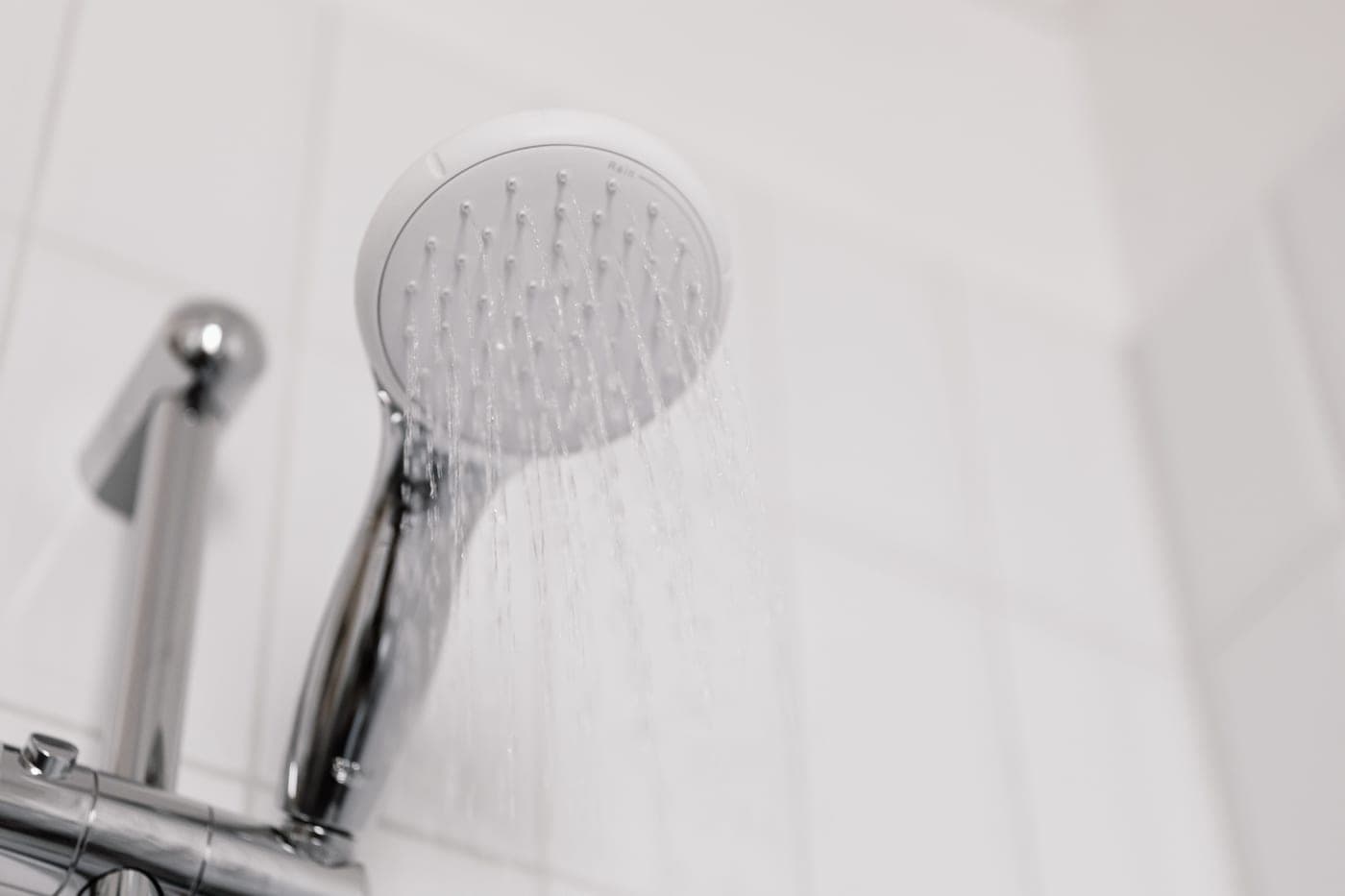
This is a replacement shower head with the filter built in — a six-inch round face, three spray settings, and a removable capsule that holds the cartridge. One purchase replaces the fitting entirely, and the capsule design makes the cartridge swap a visible job rather than a guessing game.
That is a different proposition from an inline filter, which keeps the head you already own and adds length at the arm. If your current head is unpleasant anyway, replacing it solves two problems at once; if you like it, the inline route leaves it alone. The full format comparison.
What it does not publish
No flow rate, which means you cannot check it against a state that caps shower fixtures at 1.8 GPM. No reduction percentage for chlorine or anything else. And no certification of any kind — SparkPod publishes none, and it does not use a testing formula either, which at least avoids the ambiguity several competitors create.
Its retail listing leans on hard-water language. It does not soften water; nothing in this category does, and independent bench testing of the category found no unit that reduced hardness at all. The mechanism, with the arithmetic.
What we would skip, and why
Questions people actually ask
+ What is actually in the SparkPod 23-stage filter?
SparkPod's own cartridge page names activated carbon, KDF and calcium sulfite; its retail listing adds vitamin C and ceramic among the stages. The "23 stages" are layers in the cartridge, not twenty-three filtration steps.
+ How often do you change the SparkPod filter?
SparkPod states each cartridge lasts 3 to 4 months of daily use. That is roughly twice the replacement rate of the six-month units we cover, and it is the number that determines the running cost.
+ Is the SparkPod shower head NSF certified?
No, and SparkPod publishes no certification. It also avoids the "tested to" formulations several competitors use, so at least there is no ambiguity to unpick.
+ Does the SparkPod filter remove chloramine?
SparkPod makes no chloramine claim. Its main media — KDF and calcium sulfite — do not break the chlorine-ammonia bond. Vitamin C appears among the listed stages, but no quantity or performance figure is published.
+ Does it help with hard water?
No. Its listing uses hard-water language, but no shower filter performs ion exchange and independent testing found none that reduced hardness.
Sources
Everything on this page traces to one of these. Where a source is brand-owned we say so, because a filter maker explaining filter chemistry has an interest and you are entitled to weigh it.
- WaterFilterGuru, "The Best Shower Head Filter" — independent lab testing, credited to them (retrieved 2026-09-01)
- Plumbing & Mechanical, "NSF/ANSI Standard 177: A Level Playing Field for Shower Filter Claims" (retrieved 2026-09-01)
- US EPA — Consumer Confidence Reports (CCR) for drinking water
- AquaEarth, "KDF vs vitamin C vs carbon shower filter" — brand-owned explainer, cited with that stated (retrieved 2026-09-01)