Multi-stage shower filters
A stage can be a mesh screen. Counts run from two to thirty-three and correlate with nothing — so we ranked these on the only disclosure that matters: how many of the advertised stages the maker will name.
Disclosure — some links on this page go to Amazon, and we earn a commission if you buy through them. It costs you nothing extra and it does not change what we recommend or in what order. The full disclosure.
A "stage" is a layer in the cartridge, not a filtration step — a mesh screen counts, so does a pad of PP cotton. Counts in this category run from two to thirty-three and do not track performance. Rank on how many stages the maker names: the best discloser here itemizes all seven, the worst advertises thirty-three and names one.
What a "stage" actually is
The clearest way to answer this is to read the stage list of a company that publishes one. AquaBliss itemizes all seven stages of its largest filter, and here they are in order: a sand filter, an ultra-fine stainless steel mesh, micro-porous PP cotton, calcium sulfite, redox media, activated carbon, and finally a PP cotton and mesh barrier.
Count the chemistry in that list. Stages four, five and six — calcium sulfite, redox media, carbon — are doing the actual work on chlorine. Stages one, two, three and seven are sediment handling and containment: catching grit on the way in, and stopping the media washing out on the way downstream. Four of the seven stages are plumbing, not filtration.
That is not a criticism of AquaBliss. Those layers are necessary and the company deserves credit for listing them. It is the proof of what the unit of measurement is: a stage is a layer, and layers are cheap to add. Once you know that, a jump from seven stages to thirty-three stops sounding like five times the filtration and starts sounding like a different counting convention.
How we ranked these
How we picked
Criteria first, products second. These are the things we ranked on, stated before anything is recommended.
- Stages named against stages advertised. The count is unverifiable; the media list is checkable. A maker who itemizes seven has told you more than one who advertises thirty-three and names one.
- Whether the named media match your water. Chloramine needs vitamin C or catalytic carbon. If the list does not contain one of those, no number of stages changes the answer.
- Published cartridge interval and capacity, because that is the recurring cost and stage counts say nothing about it.
- Certification where any exists — and we note plainly that the big-number units hold none.
- Explicitly NOT the stage number itself. We do not rank on it, and we would not have published a page that did.
What we did not do: test any of these filters. We own none of them, we operate no lab, and nothing on this page is written as though we did. The full method.
One consequence of that method is worth stating before the picks: the ranking runs roughly inverse to the stage count. The filter at the top advertises seven stages and the filter at the bottom advertises thirty-three. That is not contrarianism for its own sake — it falls straight out of ranking on disclosure instead of on the headline number.
Quick picks
Ranked on what can be verified: a traceable certification first, then media matched to your disinfectant. Tap a row to jump to the full write-up.
| # | Product | Best for | Certification | Price |
|---|---|---|---|---|
| 1 |  AquaBliss SF500 Daily Essential+The biggest filter AquaBliss makes, and the only unit in this registry that names all seven of its stages. What the extra media buys is capacity and sediment handling — not a chloramine mechanism, because this is the Essential line scaled up rather than a step toward the vitamin C model.Seven stages: sand filter, ultra-fine stainl… | More media, on water that fouls filters fast | None | |
| 2 | 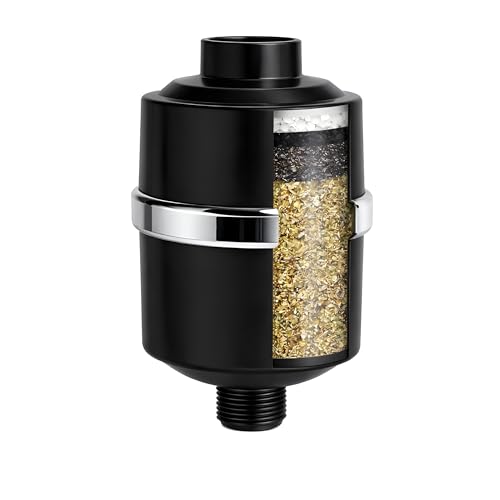 Crystal Quest Shower FilterA five-media cartridge including catalytic carbon — the class with a real mechanism against chloramine — at the budget end of the category, with a 10,000 to 15,000 gallon capacity that is among the longest here. Its certification line needs careful reading: IAPMO tested it, which is not the same as IAPMO certifying it.Five-stage multi-media: coconut shell GAC, c… | Catalytic carbon and a chloramine claim, cheaply | None | |
| 3 |  SparkPod 23-Stage Filtered Shower HeadAdvertised as 23-stage, which is a marketing unit rather than an engineering one — but unlike most stage-counters SparkPod does name its media, and the list is a sensible one. The catch is the interval: its own cartridge page says three to four months, which is twice the replacement rate of the six-month units here.Multi-stage filtration with activated carbon… | Stage counting, with the media actually named | None | |
| 4 |  AquaBliss SF100 Daily RevitalizeThe one product here whose maker states outright that it reduces chloramine as well as chlorine, and then backs that up by routing chloramine customers away from its own cheaper model. That is an unusually honest piece of product literature.Three stages: sand filter, stainless mesh an… | Chloramine, on the maker's own routing | None | |
| 5 |  AquaHomeGroup 20-Stage Shower FilterThe cheapest way into vitamin C in this registry, on a normal 10,000-gallon interval and a bundle that ships with five spare cartridges. It advertises twenty stages and names none of them, and its product page claims fluoride reduction — a claim the chemistry of a shower filter does not support at any price.Vitamin C and E infusion is stated; the rema… | Vitamin C cheaply, with nothing itemized | None | |
| 6 |  iSpring SF2SAdvertised as 33-stage with 18 types of media, and it names two of them. Stage counts are a marketing unit, not an engineering one — a stage can be a mesh screen. Judge it on the vitamin C and the long cartridge interval, not the number.Stated as 33-stage with 18 media types; only… | A case study in stage counting | None |
Every figure in this table links to the page it came from in the write-ups below. Units we claim to have tested: 0.
AquaBliss SF500 Daily Essential+
More media, on water that fouls filters fast
The biggest filter AquaBliss makes, and the only unit in this registry that names all seven of its stages. What the extra media buys is capacity and sediment handling — not a chloramine mechanism, because this is the Essential line scaled up rather than a step toward the vitamin C model.
Published specifications
- Filter media
- Seven stages: sand filter, ultra-fine stainless steel mesh, micro-porous PP cotton, calcium sulfite, redox media, activated carbon (coconut shell), then a PP cotton and mesh barrierCalcium sulfite and redox media are both free-chlorine chemistries. Neither vitamin C nor catalytic carbon — the two classes that address chloramine — appears in the stack.Source: AquaBliss — SF500 Daily Essential+ shower filter (retrieved 2026-10-03)
- Stated flow rate
- Not publishedAquaBliss publishes no flow rate for the SF500, as with the rest of the range.
- Rated cartridge life
- Every 3-6 months, depending on water qualityThe cartridge is the AB-SFC500, and the AB-SFC400 also fits. No gallon rating is published — so the 44% media increase comes with no stated increase in interval.Source: AquaBliss — SF500 Daily Essential+ shower filter (retrieved 2026-10-03)
- Chloramine
- Not publishedAquaBliss publishes nothing about chloramine for the SF500. That silence is consistent with the media list — unlike the SF100, this stack has no vitamin C — and AquaBliss elsewhere routes chloramine customers to the SF100 rather than to its larger filters.
- Format
- Inline, 3.31 x 3.31 x 4.76 in, 5.2 oz, standard half-inch connection with adapter; chrome, brushed nickel or oil rubbed bronzeSource: AquaBliss — SF500 Daily Essential+ shower filter (retrieved 2026-10-03)
- Housing
- Not publishedFinishes are listed; AquaBliss does not state the underlying housing material.
What it does well
- Names all seven stages, down to the mesh and PP cotton barriers — the fullest media disclosure in this registry
- States "44% more filtration media than a standard Aquabliss shower filter"
- Removable sediment guards, which nothing else here offers
- Shares a cartridge with the SF400, so the consumable is not model-locked
- Standard half-inch inline fitting, three finishes, no tools
Where it falls short
- No NSF/ANSI certification
- No published flow rate and no gallon capacity
- No published reduction percentage of any kind, for any contaminant
- 44% more media and the same 3-6 month interval as the cheaper models
- Not the AquaBliss to buy on chloraminated water, despite being the most expensive
What it does not do
- It does not address chloramine. Its seven stages contain neither of the two media classes with a real mechanism against it, and AquaBliss publishes no chloramine claim for this model.
- It does not soften water, and AquaBliss makes no softening claim for it.
- It publishes no flow rate and no gallon capacity, so cost per gallon cannot be computed from the maker's own data.
- It carries no NSF/ANSI certification, and AquaBliss does not claim one.
Who it is for
Someone on free-chlorine water with a visible sediment or particulate problem, who wants the largest cartridge in the AquaBliss platform and will keep their own shower head.
Skip it if
Your utility uses chloramine. More calcium sulfite and redox media is more of the wrong chemistry — the SF100 is the AquaBliss with vitamin C in it.
#ad · how we are funded · price as of October 16, 2026
Crystal Quest Shower Filter
Catalytic carbon and a chloramine claim, cheaply
A five-media cartridge including catalytic carbon — the class with a real mechanism against chloramine — at the budget end of the category, with a 10,000 to 15,000 gallon capacity that is among the longest here. Its certification line needs careful reading: IAPMO tested it, which is not the same as IAPMO certifying it.
Published specifications
- Filter media
- Five-stage multi-media: coconut shell GAC, catalytic carbon, ERA 6500, ERA 9500 and ceramic spherical mediaCatalytic carbon is the reason this unit can credibly mention chloramine at all — it is one of two media classes with a real mechanism against it.Source: Crystal Quest — Premium Shower Filter (retrieved 2026-09-01)
- Stated flow rate
- 2.0 GPMSource: Crystal Quest — Premium Shower Filter (retrieved 2026-09-01)
- Rated cartridge life
- 10,000 to 15,000 gallons, a 6 to 12 month lifespan depending on water quality and usageThe replacement cartridge is the CQE-RC-04045. The upper end of that range is the longest published capacity in this registry.Source: Crystal Quest — Premium Shower Filter (retrieved 2026-09-01)
- Chloramine
- Stated to reduce chloramines, alongside chlorine, VOCs and sulfurNo percentage is published for chloramine specifically. The catalytic carbon in the stack is the mechanism that makes the claim plausible.Source: Crystal Quest — Premium Shower Filter (retrieved 2026-09-01)
- Format
- Inline shower filter; a version bundled with a shower head is sold separatelySource: Crystal Quest shower filter — listing on Amazon.com (retrieved 2026-09-01)
- Housing
- Not publishedCrystal Quest does not state a housing material.
What it does well
- Names all five media: coconut shell GAC, catalytic carbon, ERA 6500, ERA 9500 and ceramic spherical media
- Catalytic carbon is one of only two media classes with a real mechanism against chloramine
- States chloramine, VOC and sulfur reduction explicitly, which very little of this category does
- 10,000 to 15,000 gallons and a 6 to 12 month lifespan — among the longest published capacities we cover
- Publishes a flow rate of 2.0 GPM
Where it falls short
- "Independently tested by IAPMO labs" is a testing claim, not a certification — and the body named is one that also certifies, which makes it easy to misread
- No plain reduction percentage on the maker's own page
- The retail listing's "99% Chlorine" headline is not matched by the maker's own wording
- No independent bench measurement of this unit that we could find
What it does not do
- It does not hold a certification. IAPMO ran the testing; Crystal Quest does not state that IAPMO certified the product or that it appears in any listing.
- It does not soften water, and Crystal Quest makes no softening claim.
- Its own site publishes no single clean reduction percentage — the figure is expressed as performance relative to the standard's requirement, which is harder to check than a plain number.
- The Amazon listing title advertises "99% Chlorine", a figure that does not appear in that form on Crystal Quest's own product page.
Who it is for
Someone on chloraminated water who wants catalytic carbon without paying the premium the certified catalytic-carbon unit asks, and who will read the testing claim for what it says.
Skip it if
You want a certification you can look up. "Independently tested by IAPMO labs in accordance to NSF/ANSI 177-2019" describes a test, not a listing.
#ad · how we are funded · price as of October 16, 2026
SparkPod 23-Stage Filtered Shower Head
Stage counting, with the media actually named
Advertised as 23-stage, which is a marketing unit rather than an engineering one — but unlike most stage-counters SparkPod does name its media, and the list is a sensible one. The catch is the interval: its own cartridge page says three to four months, which is twice the replacement rate of the six-month units here.
Published specifications
- Filter media
- Multi-stage filtration with activated carbon, KDF and calcium sulfiteSparkPod's retail listing additionally lists vitamin C and ceramic among the 23 stages. The stage count is a layer count rather than a measure of filtration steps.Source: SparkPod — High Output Shower Filter Cartridge (retrieved 2026-09-01)
- Stated flow rate
- Not publishedSparkPod publishes no flow rate for the filtered head.
- Rated cartridge life
- Each cartridge lasts 3 to 4 months of daily useSparkPod's own cartridge page gives months rather than gallons. Retail copy elsewhere quotes a gallon figure; we use the maker's own wording.Source: SparkPod — High Output Shower Filter Cartridge (retrieved 2026-09-01)
- Chloramine
- Not publishedSparkPod makes no chloramine claim. Vitamin C appears in its stage list, which is the right media class, but no quantity or performance figure is published.
- Format
- Replacement shower head with a removable capsule filter, three spray settings, six-inch round faceSource: SparkPod filtered shower head, 23-stage, polished chrome — listing on Amazon.com (retrieved 2026-09-01)
- Housing
- Not publishedSparkPod states the finish and not the underlying material.
What it does well
- Names its media rather than hiding behind the stage count: activated carbon, KDF and calcium sulfite
- Vitamin C and ceramic are listed among the stages on its retail listing, which is a broader stack than most heads
- A complete replacement head with three spray settings, so one purchase replaces the fitting entirely
- Removable capsule filter makes the cartridge swap a visible, simple job
Where it falls short
- "23-stage" counts layers, not filtration steps — a mesh screen is a stage
- Three-to-four-month cartridge interval, roughly twice the replacement rate of the six-month units here
- No certification and no published reduction percentage
- No published flow rate, so you cannot check it against a state fixture cap
What it does not do
- It does not hold a certification, and SparkPod publishes none.
- It does not soften water, despite hard-water language in its retail listing. Nothing in this category does.
- It publishes no flow rate.
- It publishes no reduction percentage for anything it claims to remove.
Who it is for
Someone who wants a complete replacement head with the filter built in, three spray settings, and a media list they can actually read.
Skip it if
You dislike buying cartridges. A three-to-four-month interval is four changes a year at the short end, against two for most of this registry.
#ad · how we are funded · price as of October 16, 2026
AquaBliss SF100 Daily Revitalize
Chloramine, on the maker's own routing
The one product here whose maker states outright that it reduces chloramine as well as chlorine, and then backs that up by routing chloramine customers away from its own cheaper model. That is an unusually honest piece of product literature.
Published specifications
- Filter media
- Three stages: sand filter, stainless mesh and PP cotton; then calcium sulfite, redox media and activated carbon; then a PP cotton and mesh barrier. Cartridge infused with vitamin C, minerals and tourmaline.Source: AquaBliss — SF100 Daily Revitalize shower filter (retrieved 2026-09-01)
- Stated flow rate
- Not publishedAquaBliss publishes no flow rate for the SF100.
- Rated cartridge life
- Every 3-6 monthsAquaBliss adds "sooner if you're in a high-chlorine or high-sediment area" and publishes no gallon rating.Source: AquaBliss — SF100 Daily Revitalize shower filter (retrieved 2026-09-01)
- Chloramine
- Stated to reduce chloramine as well as chlorine and sedimentAquaBliss routes chloramine customers to this model rather than to its cheaper SF220, which is a claim it makes against its own interest.Source: AquaBliss — SF100 Daily Revitalize shower filter (retrieved 2026-09-01)
- Format
- Inline, standard half-inch connection, five finishesSource: AquaBliss — SF100 Daily Revitalize shower filter (retrieved 2026-09-01)
- Housing
- Not publishedFinish options are listed; the underlying material is not.
What it does well
- States chloramine reduction explicitly, which almost nothing else in this set does
- Full three-stage media list published, including calcium sulfite, redox media and activated carbon
- Vitamin C infusion in the cartridge, which is the media class that actually addresses chloramine
- Inline body fits fixed, rain and handheld heads on a standard half-inch connection
Where it falls short
- No published NSF/ANSI certification
- No published flow rate and no gallon capacity
- Cartridge cadence given only as a 3-6 month range
What it does not do
- It does not soften water; AquaBliss makes no softening claim for it.
- It carries no NSF/ANSI certification that AquaBliss publishes.
- It publishes no flow rate and no gallon capacity, so you cannot compute cost per gallon from its own data.
Who it is for
Readers whose water report says chloramine rather than free chlorine, and who want a stated media list at the low end of the price range.
Skip it if
You want a certification. AquaBliss publishes no NSF/ANSI certification for this unit, and a stated media list is not the same as a verified result.
#ad · how we are funded · price as of October 16, 2026
AquaHomeGroup 20-Stage Shower Filter
Vitamin C cheaply, with nothing itemized
The cheapest way into vitamin C in this registry, on a normal 10,000-gallon interval and a bundle that ships with five spare cartridges. It advertises twenty stages and names none of them, and its product page claims fluoride reduction — a claim the chemistry of a shower filter does not support at any price.
Published specifications
- Filter media
- Vitamin C and E infusion is stated; the remaining stages are not itemizedAquaHomeGroup advertises "20-stages of MAXIMUM water filtration" and publishes no list of what those stages are. That is one fewer named medium than the iSpring SF2S, which names one of eighteen.Source: AquaHomeGroup — Premium 20-Stage Shower Filter with Vitamin C & E infusion (retrieved 2026-09-01)
- Stated flow rate
- Not publishedAquaHomeGroup publishes no flow rate. Its FAQ refers to a flow restrictor fitted in the ball joint, without stating the figure it restricts to.
- Rated cartridge life
- 10,000 gallons or about 6 months for the filter cartridgeThere is a second consumable on a different clock: AquaHomeGroup states the vitamin C and E cartridge should be replaced every 8 to 10 months. Both have to be tracked.Source: AquaHomeGroup — FAQs (retrieved 2026-09-01)
- Chloramine
- Not publishedAquaHomeGroup makes no chloramine claim. Vitamin C is in the stack and is the right media class for chloramine, but no quantity, percentage or claim is published for it.
- Format
- Inline filter; no shower head supplied, and it is stated to suit wall-mounted, handheld, rain and combo headsHand-tightened, no tools, with plumber's tape included.Source: AquaHomeGroup — Premium 20-Stage Shower Filter with Vitamin C & E infusion (retrieved 2026-09-01)
- Housing
- Not publishedFinishes are listed; the underlying material is not.
What it does well
- 10,000 gallons or about six months on the filter cartridge — the category convention, not a short one
- The bundle ships with five spare cartridges, which is roughly three years of filtration in one purchase
- Vitamin C and E infusion is stated, and vitamin C is the media class with a real mechanism against chloramine
- Inline body fits wall-mounted, handheld, rain and combo heads, so your existing head stays
- No tools to fit, and plumber's tape is supplied
Where it falls short
- Twenty stages advertised, zero of them named
- The product page claims fluoride reduction, which a shower filter cannot deliver
- Two consumables on two different clocks — the filter cartridge and the vitamin cartridge
- No published flow rate, no certification, and no independent measurement
What it does not do
- It does not remove fluoride in any meaningful quantity, despite the claim on its own product page. Fluoride needs reverse osmosis or activated alumina with far more contact time than a shower allows.
- It does not soften water, and no shower filter does.
- It carries no NSF/ANSI certification, and AquaHomeGroup publishes no third-party testing.
- It does not name a single one of the twenty stages it advertises.
Who it is for
Someone who wants vitamin C in the stack without the short refill cycle of a refillable unit, is buying at the budget end, and will read the stage count as marketing rather than engineering.
Skip it if
You want to know what is in the cartridge, or you are buying it for the fluoride claim. Neither survives contact with the product page.
#ad · how we are funded · price as of October 16, 2026
iSpring SF2S
A case study in stage counting
Advertised as 33-stage with 18 types of media, and it names two of them. Stage counts are a marketing unit, not an engineering one — a stage can be a mesh screen. Judge it on the vitamin C and the long cartridge interval, not the number.
Published specifications
- Filter media
- Stated as 33-stage with 18 media types; only vitamin C is named specificallyA stage count is a marketing unit. Sixteen of the eighteen media types are not identified anywhere on the product page.Source: iSpring — SF2S multi-stage shower head filter (retrieved 2026-09-01)
- Stated flow rate
- Not publishediSpring publishes no flow rate for the SF2S.
- Rated cartridge life
- 6 to 9 monthsNo gallon capacity is published.Source: iSpring — SF2S multi-stage shower head filter (retrieved 2026-09-01)
- Chloramine
- Not publishedChloramine is not addressed on the product page, which claims 99% chlorine removal.
- Format
- Shower head filter, 4.0 x 4.0 x 6.0 in, 3 lbSource: iSpring — SF2S multi-stage shower head filter (retrieved 2026-09-01)
- Housing
- Not publishedDimensions and weight are published; the material is not.
What it does well
- Vitamin C is named as one of the media, which is the right class for chloramine
- Published replacement interval of 6 to 9 months, the longest here
- Cheap cartridges, quoted by the maker at under ten cents a day
Where it falls short
- "33-Stage" and "18 types of media" with only two named
- Marketed as a water softener when no media listed can soften
- Locked to the maker's FSF2 cartridge
What it does not do
- It does not soften water, despite being marketed as a "water softener shower head filter".
- It publishes no NSF/ANSI certification for this model.
- It publishes no flow rate and no gallon capacity.
Who it is for
A reader who wants vitamin C in the cartridge and the longest published replacement interval in this set.
Skip it if
You want to know what is actually inside. Sixteen of the eighteen media types are never named.
#ad · how we are funded · price as of October 16, 2026
The disclosure table
Every figure is the manufacturer's own published description, taken from their product pages. Where a maker states a stage count but does not itemize it, the cell says so rather than estimating.
Two stages, certified. Thirty-three stages, not.
Read the bottom two rows of that table against the top six, because the pattern is the most useful thing on this page.
The highest stage count among every unit we cover that holds any certification at all is three. The WaterChef advertises two stages and is certified to NSF/ANSI 177 by IAPMO R&T — a mark with a named issuer and a scope you can read. The Philips advertises three, and carries an NSF certification on its KDF media rather than on the device, which is a weaker but still real and checkable claim.
Meanwhile every unit advertising twenty stages or more holds nothing. Not a device certification, not a media certification, not an independent measurement we could locate.
The causal story is not that stages cause uncertification. It is that a company with a certification leads with the certification, because it is the stronger claim and it cost real money to obtain. A company without one needs something to put on the box, and a stage count is free. The correlation runs through what the marketing department has available to say. How to check any certification yourself.
Why more stages cannot mean more filtration
There is a physical argument here, and it is short. A shower filter cartridge is a fixed volume — a cylinder of a few cubic inches that has to fit between your shower arm and your head without projecting a foot into the room. Whatever media it holds has to fit in that volume.
Adding stages does not enlarge the cylinder. It subdivides it. Thirty-three layers in the same housing means thinner layers, and a thinner bed of a given media does less than a thicker one, not more. The only ways to genuinely increase capacity are a bigger body or denser media — which is exactly what the SF500 claims with its "44% more filtration media", a claim about quantity rather than about count.
Nor does stage count buy contact time, which is the binding constraint on everything in this category. Water is inside a shower fitting for roughly a tenth of a second regardless of how many layers you divide that fitting into. Why that single number governs so much, and what each media class actually does with the time it gets.
What the stage count hides: chloramine
This is where treating the number as a quality score costs a buyer real money. Roughly one in five US water systems disinfects with chloramine rather than free chlorine, and only two media classes do anything useful about it: catalytic carbon and vitamin C.
So compare the two ends of our table on that one question. The Crystal Quest advertises five stages and names catalytic carbon among them — it has the mechanism, and it states a chloramine claim. The iSpring advertises thirty-three and names vitamin C, which is also a chloramine mechanism, so it has a case too. But a hypothetical twenty-stage filter built entirely on KDF and calcium sulfite would have thirty-three-stage marketing and no chloramine mechanism whatsoever, and nothing on the box would tell you.
That is the practical harm in an unitemized stage count. It is not that the number is a lie — it is that the number cannot answer the one question that decides whether the filter works on your supply. A five-item media list can. Check which disinfectant your utility uses first — it takes four minutes and it changes the answer. Which filters address chloramine.
Three numbers worth more than the stage count
Published cartridge life across the multi-stage field
6 of 6 publish this figure. Every number below links to where it came from.
Compiled from the manufacturers’ own published material on 2026-09-01. We have measured none of it ourselves — see how we rank. Found an error? Tell us and we will correct it.
- Cartridge interval and gallon capacity. The table above is the recurring cost of the thing. Note how much it varies across filters whose stage counts suggest they are comparable products, and note how many publish a month range with no gallon figure at all.
- Flow rate. Almost nobody here publishes one. It decides how the shower feels and whether the fixture meets your state's limit. What a filter does to pressure.
- The certifying body, if there is one. A named issuer and a listing you can search. Not "tested to", not "meets standards", and definitely not a stage count.
If you want the full twelve-month arithmetic rather than the cadence alone, the cost of ownership page does it for the whole registry.
Which of these to buy
- You want the most disclosed multi-stage filter → the [AquaBliss SF500](/reviews/aquabliss-sf500). All seven stages itemized, 44% more media than its siblings, removable sediment guards. Honest cons: no certification, no flow rate, no gallon rating, and it contains no vitamin C — so it is the wrong AquaBliss on chloraminated water.
- Chloramine, cheaply → the [Crystal Quest](/reviews/crystal-quest-shower-filter). Five named media including catalytic carbon, and the longest published capacity we cover. Honest cons: its "independently tested by IAPMO labs" line is a test, not a certification, and its listing headlines a percentage its own page does not state.
- You want a head rather than an inline body → the [SparkPod](/reviews/sparkpod-filtered-shower-head). Best of the big-number group, because it is the only one advertising twenty-plus stages that actually names its media. Honest cons: a three-to-four month cartridge, roughly twice the frequency of the 10,000-gallon units.
- Chloramine on a mixed cartridge → the [AquaBliss SF100](/reviews/aquabliss-sf100). The smallest stage count here and the only one whose maker routes chloramine customers toward it, against its own cheaper model. Honest cons: three stages will look unimpressive next to a thirty-three, and it holds no certification.
- Cheapest route to vitamin C → the [AquaHomeGroup](/reviews/aquahomegroup-20-stage). It works for what it is and ships with spare cartridges. Honest cons: it names none of its twenty stages, and its product page claims fluoride reduction, which no shower filter delivers.
- The long interval, if the number does not bother you → the [iSpring SF2S](/reviews/ispring-sf2s). Vitamin C and a long cartridge life at the bottom of the price range. Honest cons: thirty-three advertised stages with eighteen claimed media types and almost none identified, plus a water-softener claim that no shower filter can support.
- You would rather have the certification than the stage count → neither of these. The WaterChef SF-7C advertises two stages and holds a traceable IAPMO listing, and three other units hold one too.
What we would skip, and why
Any filter whose stage count is the headline and whose media list is absent
This is the single most reliable warning sign in the category. The number is free to print and impossible to check; the media list costs a company nothing to publish and tells you whether the filter addresses your water. A maker that chooses the first and omits the second has made a decision about what it wants you to know.
A stage count offered where a certification should be
"20 stages" is not a substitute for a standard. The highest stage count among the units we cover that hold any certification at all is three. The filters that hold a real listing.
Questions people actually ask
+ What does "20-stage" mean on a shower filter?
It means the cartridge has twenty layers, not that it performs twenty filtration steps. A layer can be a mesh screen, a pad of PP cotton or a bed of ceramic balls — and one maker in this category says so in its own listing, calling energy and ceramic balls "made of clay with no function". AquaBliss's published seven-stage list is the clearest illustration: four of its seven stages are sediment handling and containment rather than chemistry.
+ Is a higher stage count better?
No, and there is a physical reason. The cartridge is a fixed volume, so adding stages subdivides that space into thinner layers rather than adding media. Nor does it buy contact time, which stays at roughly a tenth of a second however many layers the water passes through. Capacity comes from a bigger body or denser media.
+ Which multi-stage shower filter names the most of its stages?
The AquaBliss SF500, which itemizes all seven including the mesh and PP cotton layers. The Crystal Quest names all five of its media, and the AquaBliss SF100 names all three plus its infusion. At the other end, the iSpring SF2S advertises 33 stages and 18 media types while naming vitamin C, and the AquaHomeGroup advertises 20 and names none beyond a vitamin C and E infusion.
+ Are any multi-stage shower filters NSF certified?
None of the big-number units is. The highest stage count among the filters we cover that hold any certification at all is three: the WaterChef SF-7C advertises two stages and is certified to NSF/ANSI 177 by IAPMO R&T, and the Philips AWP1775 advertises three with an NSF certification on its KDF media rather than on the device.
+ Will a multi-stage filter remove chloramine?
Only if one of its named media is catalytic carbon or vitamin C — those are the only two classes with a real mechanism against chloramine. The stage count cannot tell you, which is precisely the problem with an unitemized one. Check your water report before buying.
+ Does a multi-stage shower filter soften hard water?
No. Softening is ion exchange and no shower filter performs it, regardless of stage count. Two of the units on this page carry softener language on their retail listings, and neither can support it.
Sources
Everything on this page traces to one of these. Where a source is brand-owned we say so, because a filter maker explaining filter chemistry has an interest and you are entitled to weigh it.
- Plumbing & Mechanical, "NSF/ANSI Standard 177: A Level Playing Field for Shower Filter Claims" (retrieved 2026-09-01)
- NSF — NSF/ANSI 177 shower filter certification program
- NSF — public listing database, Shower Filter product type (retrieved 2026-09-09)
- IAPMO R&T — product listing and certification directory
- US EPA — Consumer Confidence Reports (CCR) for drinking water