Bath water filters
You cannot screw a shower filter onto a bath spout, and a tub fills about twice as fast as a shower runs. Here is what actually filters a bath, and what it realistically achieves.
Disclosure — some links on this page go to Amazon, and we earn a commission if you buy through them. It costs you nothing extra and it does not change what we recommend or in what order. The full disclosure.
The best bath filter is the Sprite Pure Bath Filter, because it is the only one anybody has independently measured — chlorine to undetectable at 1.01 GPM, and 50% reduction at 2.53 GPM. Full review. First, the thing most people arrive here needing: a shower filter cannot be fitted to a bath. A shower filter screws onto the threaded shower arm, and a bath spout has no threads. Bath filtration is a separate purchase, and the four products below are the real options.
Why your shower filter will not fit the tub
This is the single most common misunderstanding in this part of the category, and it is purely mechanical. An inline shower filter is a body with a half-inch female thread at one end and a half-inch male thread at the other. It goes between the shower arm and the shower head because both of those have matching threads.
A bath spout has no thread. It is a cast or formed outlet designed to pour water into a tub, and on most American tubs it is a smooth chrome spout with nothing to screw onto. There is no adapter that solves this, because there is nothing on the spout for an adapter to grip.
So every product that filters bath water has to solve the attachment problem differently, and that is genuinely how this category divides:
Contact geometry is our assessment from each maker's published fitting method, not a measurement. It is the right thing to think about, because contact time is the mechanism every one of these relies on.
The number that governs this entire category
One bath filter has been independently tested, and because it was tested at two different flow rates it tells you more about bath filtration in general than any marketing page does. WaterFilterGuru measured the Sprite bath filter and found:
Measured and published by WaterFilterGuru, credited to them. We have tested nothing; this site operates no laboratory.
Performance halved between those two flow rates. And here is why that matters more for a bath than for a shower: a shower head is capped by federal law at 2.5 GPM, so a shower filter is always working at or below the rate where this one still managed 50%. A bath spout has no such cap — it is designed to fill a tub quickly, and Crystal Quest's own bath filter publishes a recommended flow of 4 to 5 GPM, roughly double again.
What bath filters do not do
Three limits, all of which apply to every product here regardless of price:
- They do not reduce disinfection byproducts. The one independently measured unit moved chloroform by less than 1%. Trihalomethanes are what free chlorine becomes in the pipes, and they are what the EPA actually regulates. Stripping the chlorine and leaving the THMs is the easy half of the job. What a filter removes, and what it leaves.
- They do not soften water. None of these performs ion exchange, so none removes a grain of calcium or magnesium. If your complaint is scale, limescale on the tub or that squeaky-tight feeling after a bath, a filter is the wrong purchase. Why that is, in full.
- They do not hold a certification. Not one of the four appears in a product certification listing we could search. NSF's public shower-filter listing returns six products from five companies, and none of them is a bath filter. The four certified products we do track are all shower filters.
There is also a scope limit on what a bath filter can address at all. If your problem is a rotten-egg smell, activated carbon is only effective below roughly 1 mg/L of hydrogen sulfide, per the Minnesota Department of Health — above that the fix is whole-house treatment, not a filter on the spout. And if the smell is only on the hot tap, the source is your water heater and no filter of any kind will touch it. Diagnosing a smell before you buy anything.
How we picked
Criteria first, products second. These are the things we ranked on, stated before anything is recommended.
- Does it physically attach to a bath? This is the first filter on the list, not a detail. A shower filter does not, and three of the four products here attach in three genuinely different ways.
- Is there a measured number behind it? Exactly one bath filter in this category has independent bench data, and it is the top pick for that reason alone.
- Flow rate, published or measured. A tub spout runs at roughly double a shower head's rate, and contact time is the entire mechanism. A filtration claim with no flow condition cannot be relied on.
- Capacity as a volume, not just a calendar. A bath uses 30 to 50 gallons in one fill. Per-use service life in this category ranges from about 25 baths to 2,500 gallons — a hundredfold spread.
- Named media over a stage count, because the media is what determines whether the chemistry can work at all.
- Claims checked against the published media, and every pick given a stated reason to skip it.
What we did not do: test any of these filters. We own none of them, we operate no lab, and nothing on this page is written as though we did. The full method.
Quick picks
Ranked on what can be verified: a traceable certification first, then media matched to your disinfectant. Tap a row to jump to the full write-up.
| # | Product | Best for | Certification | Price |
|---|---|---|---|---|
| 1 |  Sprite Pure Bath Filter (BB-WH)The one bath filter somebody outside the company has actually measured, and the numbers are the most useful thing in this category: 50% chlorine reduction at 2.53 GPM, and chlorine down to undetectable at 1.01 GPM — same unit, same water, different tap position. It also moved chloroform by under 1%, so disinfection byproducts are untouched.Chlorgon — Sprite's proprietary blend, indep… | The only bath filter with independent test data | None | |
| 2 | 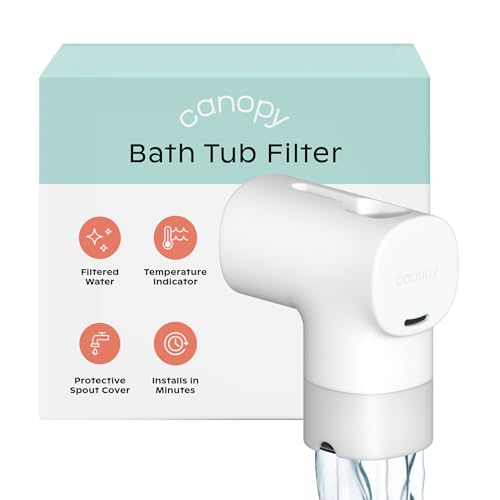 Canopy Baby Bath Tub FilterThe only bath filter here that mounts ON the tub spout rather than dangling under it, and one of two that names its media — granular activated carbon, copper-zinc and calcium sulfite. Read its certification line exactly as written: "Tested to ANSI/NSF-177 standards" names a standard and no certifying body, which is the weakest construction on this site's ladder.Three media: granular activated carbon (coco… | Mounting on the spout, with its media named | None | |
| 3 |  Crystal Quest Bath Ball Bathtub FilterPublishes by far the longest life in this category — 2,500 gallons and 12 to 18 months — and backs it with named proprietary media. It also makes the broadest contaminant claim on this entire site in one sentence, and contradicts its own capacity figure two paragraphs apart, so take the breadth of the list as marketing rather than as data.ERA 6500 and ERA 9500 proprietary media; the… | The longest published capacity, if you accept the claim list | None | |
| 4 |  Santevia Organic Cotton Bath Faucet FilterThe only product in this registry whose maker names the independent laboratory that tested it — ALS Environmental, ISO/IEC 17025:2017 accredited. Two caveats carry equal weight: the testing was to NSF/ANSI 42, the aesthetic-effects standard, not NSF/ANSI 177, the shower filter standard; and the same page gives the chlorine result four different ways."High efficacy granulated media" targeting c… | A named accredited lab, and the cheapest way in | None |
Every figure in this table links to the page it came from in the write-ups below. Units we claim to have tested: 0.
Sprite Pure Bath Filter (BB-WH)
The only bath filter with independent test data
The one bath filter somebody outside the company has actually measured, and the numbers are the most useful thing in this category: 50% chlorine reduction at 2.53 GPM, and chlorine down to undetectable at 1.01 GPM — same unit, same water, different tap position. It also moved chloroform by under 1%, so disinfection byproducts are untouched.
Published specifications
- Filter media
- Chlorgon — Sprite's proprietary blend, independently described as copper, zinc and calcium sulfiteThe same media family as Sprite's shower filters, which is the strongest thing about it. Sprite does not publish a composition itself; the blend description is WaterFilterGuru's.Source: WaterFilterGuru, "Sprite Bath Filter Review" — independent testing at two measured flow rates, credited to them (retrieved 2026-10-17)
- Stated flow rate
- Not publishedSprite publishes no flow rating. Independent testing ran it at 1.01 GPM and 2.53 GPM and found the chlorine result differed by half between them, which makes the missing figure the most consequential omission in the category.
- Rated cartridge life
- Approximately 25 to 30 baths (Sprite's estimate); about 900 gallons by independent reckoningThe shortest service life of any product in this registry when expressed per fill. The consumable, not the housing, is the purchase.Source: WaterFilterGuru, "Sprite Bath Filter Review" — independent testing at two measured flow rates, credited to them (retrieved 2026-10-17)
- Chloramine
- Not publishedNothing is published about chloramine, and the independent chloroform result suggests nothing should be assumed. Calcium sulfite and KDF do not break the chlorine-ammonia bond; catalytic carbon and vitamin C are the media that do.
- Format
- Bath ball — hangs under the tub spout on a universal detachable harness, no toolsIt sits in the falling water rather than in the plumbing, which is why no threads are needed and why contact time is so short.Source: Sprite Showers BB-WH Pure Bath Filter, White — listing on Amazon.com (retrieved 2026-10-17)
- Housing
- Not publishedSprite publishes no housing material or dimensions for the BB-WH.
What it does well
- Independently measured at two flow rates, which nothing else in this category has
- Chlorine to undetectable levels at 1.01 GPM — a genuine result, honestly bounded
- The same Chlorgon and KDF media family as Sprite's certified shower filters
- Universal detachable harness, no tools, fits most bathtub spouts
- The cheapest entry into the category from a brand with a real certification record elsewhere
- Replacement cartridge (BBC) is stocked separately and cheaply
Where it falls short
- Chlorine reduction falls to 50% at 2.53 GPM — the rate a tub actually fills at
- Measured to overflow at moderate flow
- No reduction of disinfection byproducts worth reporting
- Approximately 25 to 30 baths per cartridge is the shortest effective life here
- Tested to NSF/ANSI 177 by Sprite's account, but holds no certification listing of its own
- Sprite publishes no dimensions, no capacity in gallons and no flow rating for the unit
What it does not do
- It does not reduce disinfection byproducts. Independent testing measured chloroform down by less than 1% — the trihalomethanes are what free chlorine turns into, and this does not touch them. What a filter actually removes.
- It does not hold a certification. Sprite's shower filters do, from IAPMO R&T; this bath unit does not appear in any listing we could search.
- It does not soften water. Chlorgon performs no ion exchange. Why no shower or bath filter softens.
- It does not deliver its headline chlorine result at a normal fill rate — only at about 1 GPM.
- It does not last long. Sprite's own estimate is approximately 25 to 30 baths.
Who it is for
Anyone who wants a bath filter whose performance is a measured figure rather than a marketing adjective, and who is willing to run the tap slower to get the result.
Skip it if
You need the tub filled fast. The same testing found it overflows at moderate flow, and the chlorine figure halves as the flow rises.
#ad · how we are funded · price as of October 17, 2026
Canopy Baby Bath Tub Filter
Mounting on the spout, with its media named
The only bath filter here that mounts ON the tub spout rather than dangling under it, and one of two that names its media — granular activated carbon, copper-zinc and calcium sulfite. Read its certification line exactly as written: "Tested to ANSI/NSF-177 standards" names a standard and no certifying body, which is the weakest construction on this site's ladder.
Published specifications
- Filter media
- Three media: granular activated carbon (coconut shell), copper-zinc, calcium sulfiteCanopy describes the carbon as absorbing impurities, the copper-zinc as chemically reducing contaminants and the calcium sulfite as trapping suspended particles — note that last one, because calcium sulfite's established job in this category is dechlorination, not particle capture.Source: Canopy — Baby Bath Tub Filter product page (retrieved 2026-10-17)
- Stated flow rate
- Not publishedNo flow rate is stated. For a spout-mounted filter this is the figure that decides whether it works, because a tub spout runs far faster than a shower head and contact time is the mechanism.
- Rated cartridge life
- Replace every 90 daysA calendar interval with no volume behind it. Nothing here tells a household that fills two baths a day from one that fills two a week.Source: Canopy — Baby Bath Tub Filter product page (retrieved 2026-10-17)
- Chloramine
- Not publishedCanopy's own page claims only "chlorine, contaminants and other impurities" for this product. Retail listings elsewhere add chloramine, iron, manganese and zinc to the list; the maker's page does not.
- Format
- Spout-mounted, 3 in W x 7 in H x 7 in L, 1.5 lbs, with an attachment band and spout cover in two band sizesCanopy states it is "Designed for bath tubs only". The page also lists a variant weight of 1,361 g, which is roughly double the stated 1.5 lbs — the two figures do not reconcile.Source: Canopy — Baby Bath Tub Filter product page (retrieved 2026-10-17)
- Housing
- BPA-free siliconeSource: Canopy — Baby Bath Tub Filter product page (retrieved 2026-10-17)
What it does well
- Three media named outright: coconut-shell granular activated carbon, copper-zinc, calcium sulfite
- Mounts on the spout with an attachment band and a spout cover, so the filter is not sitting in the bath water
- Two band sizes supplied, which is a real fitment answer rather than a universal claim
- BPA-free silicone body, and a color-changing temperature indicator included
- A 90-day cartridge interval with a subscription path at a lower per-cartridge price
- One-year warranty and a 60-day return window
Where it falls short
- "Tested to ANSI/NSF-177 standards" with no certifying body named and no listing to check
- No chlorine reduction percentage, no flow rate, no gallon capacity published
- Its own page gives two different weights — 1.5 lb in the specs, 1,361 g (about 3 lb) in the variant data
- The most expensive bath filter here by a wide margin
- Skin benefits rest on a 42-parent perception survey, not on filtration testing
- Cartridges are not interchangeable with any other Canopy product
What it does not do
- It does not hold a certification we could verify. "Tested to ANSI/NSF-177 standards" names no body, and NSF's own shower-filter listing contains no Canopy product. How to read a certification claim.
- It does not publish a capacity in gallons — only "replace every 90 days", which tells you nothing about how much water passed through.
- It does not fit a shower or a sink. Canopy states it is "Designed for bath tubs only".
- It does not share cartridges with the rest of Canopy's range: "the Replacement Cartridge is not compatible with the Canopy Showerheads or the Canopy Faucet Filter".
- It does not evidence its skin claims with filtration data. The 88% figure comes from a consumer perception survey of 42 parents over 30 days, which is opinion collection, not chlorine measurement.
Who it is for
A parent filling a baby bath who wants the filter out of the water and fixed to the spout, and who values a named media list over a reduction percentage nobody will stand behind.
Skip it if
You want a number. Canopy publishes no chlorine reduction percentage, no flow rate and no gallon capacity — only a 90-day calendar interval.
#ad · how we are funded · price as of October 17, 2026
Crystal Quest Bath Ball Bathtub Filter
The longest published capacity, if you accept the claim list
Publishes by far the longest life in this category — 2,500 gallons and 12 to 18 months — and backs it with named proprietary media. It also makes the broadest contaminant claim on this entire site in one sentence, and contradicts its own capacity figure two paragraphs apart, so take the breadth of the list as marketing rather than as data.
Published specifications
- Filter media
- ERA 6500 and ERA 9500 proprietary media; the media chart describes coconut-shell carbon, two redox media and ceramic spheresA proprietary name over a described composition. Redox media is the KDF family; ceramic spheres are a filler stage with no dechlorination mechanism.Source: Crystal Quest — Bath Ball and replacement filter cartridge bundle (retrieved 2026-10-17)
- Stated flow rate
- Recommended flow rate 4-5 gallons per minutePublished as a recommendation, which reads as a fill-rate allowance rather than a performance condition. It is roughly double the 2.53 GPM at which the one independently measured bath filter in this category lost half its chlorine reduction.Source: Crystal Quest — Bath Ball and replacement filter cartridge bundle (retrieved 2026-10-17)
- Rated cartridge life
- 2,500 gallons, or 12 to 18 monthsStated inconsistently on one page: the description gives "2,500 gallons of filtration lifespan", the specification list gives "2,000 to 2,500 gallons of filtration" and "12 to 18 months".Source: Crystal Quest — Bath Ball and replacement filter cartridge bundle (retrieved 2026-10-17)
- Chloramine
- Chloramines named in the contaminant claim listNamed without a percentage, a standard or a stated mechanism. Chloramine needs catalytic carbon or vitamin C at shower and bath contact times, and the page does not say which stage is supposed to do it.Source: Crystal Quest — Bath Ball and replacement filter cartridge bundle (retrieved 2026-10-17)
- Format
- Bath ball, 5 in x 5 in, 2 lbs, fits standard bathtub faucets with two handle types, no tools requiredSource: Crystal Quest — Bath Ball and replacement filter cartridge bundle (retrieved 2026-10-17)
- Housing
- ABS plastic, stated BPA free; rated for hot and cold waterSource: Crystal Quest — Bath Ball and replacement filter cartridge bundle (retrieved 2026-10-17)
What it does well
- 2,500 gallons and 12 to 18 months — an order of magnitude more than the Sprite bath filter's 25 to 30 baths
- Names its media, even if proprietarily: ERA 6500 and ERA 9500, described as coconut-shell carbon, two redox media and ceramic spheres
- Explicitly addresses hydrogen sulfide and iron oxides, which matters on a private well
- Fits "all standard bathtub faucets" with two handle types, standard and flexible, no tools
- ABS housing stated BPA-free, rated for hot and cold water
- A publishing brand we already track — its shower filter is reviewed here too
Where it falls short
- The broadest contaminant claim on this site, with no percentage attached to any item in it
- Capacity stated two different ways on the same page
- ISO 9001 cited where a product certification would belong
- Recommended flow of 4 to 5 GPM is faster than the rate at which the only measured bath filter in this category held its chlorine result
- Maker warns its own chrome finish is damaged by hard water
- Dimensions and weight come from retailer pages, and the model numbers disagree between them
What it does not do
- It does not hold a product certification. The page cites ISO 9001, which certifies the company's quality management system, not this filter's performance. The difference, and why it is used this way.
- It does not publish a single reduction percentage for anything on its long claim list.
- It does not reconcile its own capacity: the description says 2,500 gallons, the specification block says 2,000 to 2,500 gallons and 12 to 18 months.
- It does not do what "removes" implies for most of that list — no shower or bath filter removes everything.
- It does not survive hard water cosmetically in chrome: the maker warns hard water can damage the chrome coating and recommends white instead.
Who it is for
Someone who wants to buy a bath filter once a year rather than every month, and who is buying on published capacity rather than on a certification.
Skip it if
The claim list is what persuaded you. Nothing on the page is a measured figure, and a medium that genuinely did all of that would be a water treatment plant.
#ad · how we are funded · price as of October 17, 2026
Santevia Organic Cotton Bath Faucet Filter
A named accredited lab, and the cheapest way in
The only product in this registry whose maker names the independent laboratory that tested it — ALS Environmental, ISO/IEC 17025:2017 accredited. Two caveats carry equal weight: the testing was to NSF/ANSI 42, the aesthetic-effects standard, not NSF/ANSI 177, the shower filter standard; and the same page gives the chlorine result four different ways.
Published specifications
- Filter media
- "High efficacy granulated media" targeting chlorine, plus a "Nature-Inspired Mineral Blend"; organic cotton bag over a polyethylene loofahThe media is named by function rather than composition. The mineral blend is an addition rather than a filtration stage — it puts magnesium and zinc in, it does not take anything out.Source: Santevia — Bath Filter product page (retrieved 2026-10-17)
- Stated flow rate
- Not publishedNo flow rate is published, and for a filter that hangs in the falling stream the fill rate is the variable that decides contact time.
- Rated cartridge life
- 2 monthsNo gallon capacity and no bath count. The whole unit is replaced rather than a cartridge inside it.Source: Santevia — Bath Filter product page (retrieved 2026-10-17)
- Chloramine
- Not publishedNothing is published about chloramine. The page claims chlorine reduction and mineral addition, and lists no other contaminant.
- Format
- Hangs on the bath faucet on an anti-slip velcro strap with a silicone grip; 10.5 x 10.5 x 17 in assembledSantevia states it "does not fit onto vertical faucets with a long neck" — an unusually specific fitment disclosure for this category.Source: Santevia — Bath Filter product page (retrieved 2026-10-17)
- Housing
- Organic cotton bag, stated 100% cotton, over a BPS/BPA-free polyethylene loofahSource: Santevia — Bath Filter product page (retrieved 2026-10-17)
What it does well
- Names the testing laboratory — ALS Environmental, ISO/IEC 17025:2017 accredited — which almost nothing in this category does
- The cheapest entry into bath filtration by a clear margin
- Organic cotton bag over a BPA/BPS-free polyethylene loofah, with no plastic housing at all
- Hangs on the faucet with an anti-slip velcro strap and silicone grip; nothing to plumb
- Honest about fitment: it says plainly which faucets it will not fit
- Made in North America, with filter-change reminders offered by email or text
Where it falls short
- Tested to NSF/ANSI 42, not to NSF/ANSI 177, and holds no certification either way
- Four different chlorine reduction figures on a single product page
- Two-month life with no volume figure, the second-shortest here
- Will not fit long-neck vertical faucets
- Mineral-addition and eczema claims are made without any cited data
- The media is described only as "high efficacy granulated media" — no composition
What it does not do
- It does not hold a certification. Testing by an accredited lab to a standard is not certification by a body against that standard. The four constructions, graded.
- It was not tested to the shower-filter standard. NSF/ANSI 42 covers aesthetic effects such as taste, odour and chlorine; NSF/ANSI 177 is the standard written for this application.
- It does not state its chlorine result consistently: 99%, "99.9% Reduction", "up to 99.9%" and "Avg. reduction >99.9%" all appear on the same page.
- It does not treat eczema. "Calms redness associated with eczema" is an unsupported claim about a skin condition, and the page cites no study for it. What the eczema trials actually found.
- It does not last. Two months is the stated life, with no gallon or bath-count figure behind it.
Who it is for
Someone who wants the cheapest real bath filter, who prefers a named lab to an unnamed standard, and who is filtering for chlorine and nothing else.
Skip it if
Your tub has a tall vertical faucet. Santevia states it "does not fit onto vertical faucets with a long neck", and a cotton bag that cannot hang is not a filter.
#ad · how we are funded · price as of October 17, 2026
The full Santevia Organic Cotton Bath Faucet Filter write-up
Published service life, bath filters
4 of 4 publish this figure. Every number below links to where it came from.
Compiled from the manufacturers’ own published material on 2026-09-01. We have measured none of it ourselves — see how we rank. Found an error? Tell us and we will correct it.
That table is the clearest practical difference between these four. Sprite's 25 to 30 baths against Crystal Quest's 2,500 gallons is a hundredfold spread in how often you are buying a consumable — and it is a spread between a measured product with a short honest life and an unmeasured one with a long unverified claim. The twelve-month arithmetic.
The certification picture, honestly
Certifications held by the four bath filters
0 of 4 carry a certification we could trace to a certifying body.
What the makers claim about themselves
These are manufacturer statements, reported as manufacturer statements. A claim is not a certification, and separating the two is the whole point of this section.
Certification listings and manufacturer wording checked on 2026-09-01. What NSF/ANSI 177 actually covers.
Empty, and that is the finding rather than an omission on our part. What each maker offers instead is worth distinguishing, because the four are not equally weak:
All four are reported as the makers word them. How to check any of these yourself in about two minutes.
What we would skip, and why
Your existing shower filter
Not a product fault — a thread fault. An inline shower filter screws onto the half-inch male thread of a shower arm. A bath spout has no thread at all, and nothing sold as an adapter changes that. Do not buy a shower filter intending to move it to the tub.
Rainshow'r Bath Ball 3000
The best-known name in bath balls, and we are not linking it because it is not currently purchasable — the listing returns no stock. We only feature products a reader can actually buy today. Worth re-checking if it relists.
Generic eight-stage tub cartridges
Several in-stock listings advertise 8 stages and 2,500 gallons for about twenty dollars while naming no media at all and no brand with a documented position. A stage count is not a specification. Why stage counts are the category's emptiest number.
Anything sold as a bath water softener
Softening is ion exchange over a salt-regenerated resin bed. Nothing that hangs on a tap does it, and a bath is a one-shot fill with no regeneration cycle. Why no fixture filter softens water.
What about a baby's bath?
A lot of the demand here comes from new parents, and two of the four products are aimed squarely at it — Canopy's is branded a baby bath filter and includes a color-changing temperature indicator, which is a genuinely sensible piece of design for the use case.
We will be careful about what we claim on it. Reducing the chlorine in a baby's bath water is a reasonable thing to want and a defensible purchase. What we will not tell you is that it treats or prevents a skin condition. Canopy's 88% softer-skin figure comes from a consumer perception survey of 42 parents over 30 days — disclosed, to its credit, and still a record of what people noticed rather than a measurement of what the filter removed. Santevia's claim that its mineral blend "calms redness associated with eczema" has no cited study at all.
The strongest evidence in this area comes from the SWET and SOFTER randomized trials, which tested ion-exchange water softeners in children with eczema — a more aggressive intervention than any of these filters performs — and did not find a benefit in eczema severity. The evidence in full. Buy a bath filter to reduce chlorine, which it can do. Treat any skin-condition claim attached to it as marketing.
So which one
Most people: the Sprite Pure Bath Filter — the review. It is the only one with a measured figure, the figure is honestly bounded, and it is at the cheap end. Run the tap slowly.
Filling a baby bath and you want the filter fixed to the spout: Canopy — the review. The best-made object here, three media named, the temperature indicator earns its place, and it is the most expensive by a distance.
You want to forget about it for a year: Crystal Quest — the review. 2,500 gallons and 12 to 18 months is the category's best answer to its worst problem. Buy the white finish — the maker warns hard water damages the chrome — and read its eleven-contaminant claim as marketing.
Spending as little as possible: Santevia — the review. The only maker here that names its testing laboratory, at the lowest price, with the loosest contact geometry and a two-month life. Check your faucet is not a long vertical neck first — Santevia says plainly that it will not fit.
And if it turns out the shower is your real problem rather than the tub, that is the rest of this site: the flagship ranking orders everything we track, and how to choose one walks the decision in order.
Questions people actually ask
+ Can I use a shower filter in the bathtub?
No. A shower filter screws onto the half-inch thread of a shower arm, and a bath spout has no thread for it to attach to. No adapter solves this, because there is nothing on the spout for an adapter to grip. Bath filtration is a separate purchase with three different attachment methods.
+ Do bath filters actually work?
For free chlorine, yes, with a flow-rate condition. The only independently measured bath filter took chlorine to undetectable levels at 1.01 GPM but achieved only 50% reduction at 2.53 GPM. Since a tub spout fills faster than a shower head runs, the practical answer depends mostly on how fast you fill the bath.
+ What is the best bath water filter?
The Sprite Pure Bath Filter, because it is the only one in the category with independent bench data behind it and the data is honestly bounded. Canopy is the better-built object and mounts on the spout; Crystal Quest publishes by far the longest service life; Santevia is the cheapest and the only one that names its testing laboratory.
+ Do bath filters remove chlorine?
That is the one thing they are genuinely for. All four use dechlorinating media — calcium sulfite, copper-zinc redox media and activated carbon in various combinations. None of them reduced disinfection byproducts in the one case where that was measured.
+ Will a bath filter soften hard water?
No. Softening requires ion exchange over a salt-regenerated resin bed, and none of these products performs it. If your complaint is scale or limescale rather than chlorine, a bath filter is the wrong purchase.
+ Are bath filters NSF certified?
None of the four is. NSF's public shower-filter listing contains six products from five companies and not one of them is a bath filter. What the makers offer instead ranges from a named accredited laboratory testing to NSF/ANSI 42 (Santevia) down to an ISO 9001 company certification (Crystal Quest).
+ How long does a bath filter last?
The published range is extraordinary: Sprite estimates 25 to 30 baths, Santevia two months, Canopy 90 days, and Crystal Quest 2,500 gallons or 12 to 18 months. A bath uses 30 to 50 gallons per fill, which is why per-use life matters much more here than for a shower filter.
+ Is there a filter for a baby's bath specifically?
Canopy's is branded for baby baths and includes a color-changing temperature indicator. Reducing chlorine in a baby's bath is a reasonable thing to buy; claims that a filter treats or prevents a skin condition are not supported, and the strongest trials in that area tested water softeners and found no eczema benefit.
Sources
Everything on this page traces to one of these. Where a source is brand-owned we say so, because a filter maker explaining filter chemistry has an interest and you are entitled to weigh it.
- WaterFilterGuru, "Sprite Bath Filter Review" — independent testing at two measured flow rates, credited to them (retrieved 2026-10-17)
- Plumbing & Mechanical, "NSF/ANSI Standard 177: A Level Playing Field for Shower Filter Claims" (retrieved 2026-09-01)
- NSF — NSF/ANSI 177 shower filter certification program
- NSF — public listing database, Shower Filter product type (retrieved 2026-09-09)
- NSF — NSF/ANSI 42: drinking water treatment units, aesthetic effects
- Water Quality Association — product certification program
- US EPA WaterSense — showerheads and the 2.5 gpm federal maximum
- Minnesota Department of Health — Hydrogen Sulfide and Sulfur Bacteria in Well Water (retrieved 2026-10-17)
- Thomas KS et al. (2011). A multicentre randomized controlled trial and economic evaluation of ion-exchange water softeners for the treatment of eczema in children: the Softened Water Eczema Trial (SWET).