Canopy Baby Bath Tub Filter review
The only bath filter that mounts on the spout instead of dangling under it, with its media named and its certification line left deliberately short.
Disclosure — some links on this page go to Amazon, and we earn a commission if you buy through them. It costs you nothing extra and it does not change what we recommend or in what order. The full disclosure.
Buy it for the mount, not for the certification. Canopy is the only bath filter here that fixes to the tub spout rather than hanging in the water, and one of two that names its media — granular activated carbon, copper-zinc and calcium sulfite. Its certification line reads "Tested to ANSI/NSF-177 standards": a standard with no certifying body named, which is the weakest construction on this site's ladder. It publishes no chlorine percentage, no flow rate and no gallon capacity.
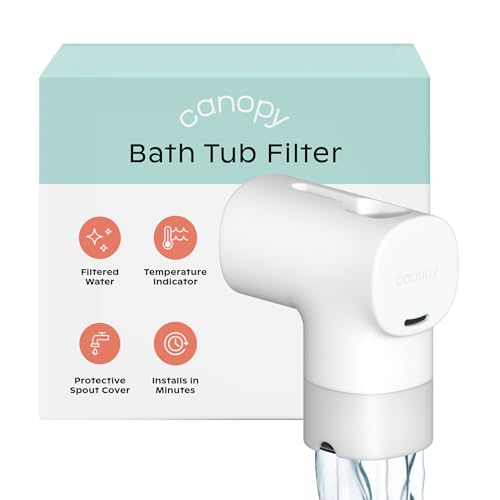
Canopy Baby Bath Tub Filter
Mounting on the spout, with its media named
The only bath filter here that mounts ON the tub spout rather than dangling under it, and one of two that names its media — granular activated carbon, copper-zinc and calcium sulfite. Read its certification line exactly as written: "Tested to ANSI/NSF-177 standards" names a standard and no certifying body, which is the weakest construction on this site's ladder.
Published specifications
- Filter media
- Three media: granular activated carbon (coconut shell), copper-zinc, calcium sulfiteCanopy describes the carbon as absorbing impurities, the copper-zinc as chemically reducing contaminants and the calcium sulfite as trapping suspended particles — note that last one, because calcium sulfite's established job in this category is dechlorination, not particle capture.Source: Canopy — Baby Bath Tub Filter product page (retrieved 2026-10-17)
- Stated flow rate
- Not publishedNo flow rate is stated. For a spout-mounted filter this is the figure that decides whether it works, because a tub spout runs far faster than a shower head and contact time is the mechanism.
- Rated cartridge life
- Replace every 90 daysA calendar interval with no volume behind it. Nothing here tells a household that fills two baths a day from one that fills two a week.Source: Canopy — Baby Bath Tub Filter product page (retrieved 2026-10-17)
- Chloramine
- Not publishedCanopy's own page claims only "chlorine, contaminants and other impurities" for this product. Retail listings elsewhere add chloramine, iron, manganese and zinc to the list; the maker's page does not.
- Format
- Spout-mounted, 3 in W x 7 in H x 7 in L, 1.5 lbs, with an attachment band and spout cover in two band sizesCanopy states it is "Designed for bath tubs only". The page also lists a variant weight of 1,361 g, which is roughly double the stated 1.5 lbs — the two figures do not reconcile.Source: Canopy — Baby Bath Tub Filter product page (retrieved 2026-10-17)
- Housing
- BPA-free siliconeSource: Canopy — Baby Bath Tub Filter product page (retrieved 2026-10-17)
What it does well
- Three media named outright: coconut-shell granular activated carbon, copper-zinc, calcium sulfite
- Mounts on the spout with an attachment band and a spout cover, so the filter is not sitting in the bath water
- Two band sizes supplied, which is a real fitment answer rather than a universal claim
- BPA-free silicone body, and a color-changing temperature indicator included
- A 90-day cartridge interval with a subscription path at a lower per-cartridge price
- One-year warranty and a 60-day return window
Where it falls short
- "Tested to ANSI/NSF-177 standards" with no certifying body named and no listing to check
- No chlorine reduction percentage, no flow rate, no gallon capacity published
- Its own page gives two different weights — 1.5 lb in the specs, 1,361 g (about 3 lb) in the variant data
- The most expensive bath filter here by a wide margin
- Skin benefits rest on a 42-parent perception survey, not on filtration testing
- Cartridges are not interchangeable with any other Canopy product
What it does not do
- It does not hold a certification we could verify. "Tested to ANSI/NSF-177 standards" names no body, and NSF's own shower-filter listing contains no Canopy product. How to read a certification claim.
- It does not publish a capacity in gallons — only "replace every 90 days", which tells you nothing about how much water passed through.
- It does not fit a shower or a sink. Canopy states it is "Designed for bath tubs only".
- It does not share cartridges with the rest of Canopy's range: "the Replacement Cartridge is not compatible with the Canopy Showerheads or the Canopy Faucet Filter".
- It does not evidence its skin claims with filtration data. The 88% figure comes from a consumer perception survey of 42 parents over 30 days, which is opinion collection, not chlorine measurement.
Who it is for
A parent filling a baby bath who wants the filter out of the water and fixed to the spout, and who values a named media list over a reduction percentage nobody will stand behind.
Skip it if
You want a number. Canopy publishes no chlorine reduction percentage, no flow rate and no gallon capacity — only a 90-day calendar interval.
#ad · how we are funded · price as of October 17, 2026
Certifications and claims
Two tables, deliberately. A certification names a standard and the body that issued it, and you can look it up. A claim is the maker describing itself. Both belong here; conflating them does not.
No third-party certification is published for this product. That is not evidence of poor performance and it is not evidence of good performance — it means there is nothing independent to check.
“"Tested to ANSI/NSF-177 standards" — the standard named, with no certifying body and no listing identifier”
Source: Canopy — Baby Bath Tub Filter product page (retrieved 2026-10-17)“Filtering media "is known to reduce chlorine, contaminants and other impurities from tap water" — no percentage given”
Source: Canopy — Baby Bath Tub Filter product page (retrieved 2026-10-17)“88% of users reported softer, more hydrated skin — from a consumer perception study of 42 parents after 30 days, with "individual experiences may vary" stated”
Source: Canopy — Baby Bath Tub Filter consumer perception study disclosure (retrieved 2026-10-17)
What Canopy gets right: the media is named
Most of this category sells a stage count. Canopy publishes a list: "3 types of filtering media: granular activated carbon, copper-zinc, calcium sulfite", with the carbon specified as coconut-shell. That is a real answer to the only question that determines whether a filter can work, and it puts Canopy ahead of the generic eight-stage cartridges that dominate the bath listings.
All three are defensible choices for free chlorine. Copper-zinc is the KDF family, a redox medium with a genuine record. Calcium sulfite is the dechlorinating workhorse of this category and the one medium that tolerates hot water well. Coconut-shell activated carbon adsorbs organics and improves odour. The media classes compared.
One detail in Canopy's own description is worth flagging, because it is the kind of error that reveals how copy gets written. Canopy describes the calcium sulfite as the component that "traps suspended particles." Calcium sulfite does not trap particles — it reduces chlorine chemically. That is the stage's actual, valuable job, and the page gives it credit for the wrong one.
The certification line, read exactly as written
Canopy's page says the cartridge is "Tested to ANSI/NSF-177 standards." Nine words, and every one of them has been chosen.
- "Tested to" is not "certified to". Testing is something a company can commission once; certification is an ongoing program with audits and retesting.
- No certifying body is named. The issuer is the part a buyer can check, and it is the part that is missing. A standard number without an issuer cannot be verified by anybody.
- "standards", plural, attached to a single standard number, which is a construction that reads as broader than the thing it describes.
- NSF's own public shower-filter listing contains no Canopy product. It returns six products from five companies — ATGENE, Coconutfilter, Seongill Chemical, UBS and Weddell Water.
So this product's certification table on this page reads empty, and the 177 line is filed as a claim. That is a statement about what we could verify, not an accusation that the testing never happened. The four products that hold a certification you can search, and how to check one yourself.
The figures that are missing, and why they matter here
Canopy publishes no chlorine reduction percentage, no flow rate and no capacity in gallons — only "replace every 90 days".
For a spout-mounted bath filter the flow rate is not a nice-to-have, it is the whole specification. Independent testing of the Sprite bath filter measured chlorine reduction halving between 1.01 and 2.53 GPM, and a tub spout runs faster than a shower head. Without a flow figure, Canopy's filtration claim has no conditions attached to it, and a claim with no conditions cannot be checked or relied on.
The 90-day interval has the same problem in a smaller way. A calendar tells a household that fills two baths a day the same thing it tells one that fills two a week. A gallon capacity would distinguish them. How cartridge intervals actually work.
The skin claim rests on 42 parents
Canopy's marketing cites 88% of users reporting softer, more hydrated skin. The source, stated on the page, is a consumer perception study of 42 parents over 30 days, with "individual experiences may vary" attached.
We want to be fair about this: disclosing the method and the sample size is better practice than most of this category manages, and Canopy deserves the credit for saying so. But a perception survey asks people what they noticed. It does not measure chlorine, it has no control arm, and 42 self-selected buyers over 30 days is a sample that cannot separate a filter's effect from a new-purchase effect. It is opinion collection, accurately labeled. What the actual water-and-skin evidence shows.
Fitment, and the cartridge that fits nothing else
It attaches to the tub spout with a band, and a silicone spout cover presses over the band. Two band sizes are supplied, which is a genuine fitment answer rather than a "universal fit" assertion — tub spouts vary much more than shower arms do, and Canopy has shipped two sizes because of it. A color-changing temperature indicator is included, which for the baby-bath use case is a sensible piece of design.
Canopy also states that it is "Designed for bath tubs only" and that "the Replacement Cartridge is not compatible with the Canopy Showerheads or the Canopy Faucet Filter." Both are honest, and the second one is a cost worth knowing about before you buy: a Canopy household running a showerhead and this filter keeps two separate cartridge subscriptions.
One inconsistency in the published specification: the page gives the weight as 1.5 lbs in the specs and 1,361 g — roughly 3 lbs — in the variant data. The two do not reconcile, and we report both rather than picking one.
Who should buy it
Buy it if you are filling a baby bath, you want the filter fixed to the spout and out of the water, and a named media list persuades you more than an unnamed percentage would. On those terms it is the best-designed object in this category and the temperature indicator earns its place.
Skip it if you want a figure to hold the product to, or if the price is doing work the specification does not support — it is comfortably the most expensive bath filter here, and the one independently measured product in the category costs a fraction of it. The four bath options, ranked.
Questions people actually ask
+ Is the Canopy bath filter NSF certified?
Not verifiably. Canopy says the cartridge is "Tested to ANSI/NSF-177 standards" and names no certifying body, and NSF's own public shower-filter listing contains no Canopy product. We record that as a manufacturer claim rather than a certification.
+ What media does the Canopy Baby Bath Tub Filter use?
Three, named on Canopy's page: granular activated carbon from coconut shells, copper-zinc, and calcium sulfite. All three are reasonable choices for free chlorine. Canopy describes the calcium sulfite as trapping suspended particles, which is not what it does — it reduces chlorine chemically.
+ How much chlorine does it remove?
Canopy does not say. The page states only that the media "is known to reduce chlorine, contaminants and other impurities from tap water", with no percentage and no flow rate. Since bath filter performance depends heavily on flow, a claim without a flow condition cannot be checked.
+ Can I use the Canopy bath cartridge in a Canopy showerhead?
No. Canopy states plainly that the replacement cartridge is not compatible with its showerheads or its faucet filter, so a household running both keeps two separate cartridge supplies.
+ Will it fit my bathtub?
It mounts on the tub spout with an attachment band and ships with two band sizes, which covers more spouts than a single-size fitting would. Canopy states it is designed for bath tubs only, not sinks or showers.
+ Is the 88% softer-skin figure reliable?
It is accurately labeled and weakly powered. Canopy discloses it as a consumer perception study of 42 parents over 30 days, which is a survey of what people noticed rather than a measurement of what the filter removed, with no control group.
Sources
Everything on this page traces to one of these. Where a source is brand-owned we say so, because a filter maker explaining filter chemistry has an interest and you are entitled to weigh it.
- Plumbing & Mechanical, "NSF/ANSI Standard 177: A Level Playing Field for Shower Filter Claims" (retrieved 2026-09-01)
- NSF — NSF/ANSI 177 shower filter certification program
- NSF — public listing database, Shower Filter product type (retrieved 2026-09-09)
- IAPMO R&T — product listing and certification directory
- Water Quality Association — product certification program