KDF, explained
The media inside most of this category, and the reason it works at all in a device with a tenth of a second to act.
Disclosure — some links on this page go to Amazon, and we earn a commission if you buy through them. It costs you nothing extra and it does not change what we recommend or in what order. The full disclosure.
KDF is a copper-zinc alloy that reduces free chlorine by oxidation-reduction: chlorine takes electrons from the alloy and becomes harmless chloride. It is fast, which is why it dominates this category, it inhibits bacterial growth inside the cartridge, and it does not break the chlorine-ammonia bond in chloramine.
The mechanism
KDF stands for Kinetic Degradation Fluxion, which is a grander name than the chemistry needs. A copper-zinc alloy in granular form sits in the water path. Free chlorine, being a strong oxidant, takes electrons from the zinc. The chlorine is reduced to chloride — a harmless dissolved ion that stays in the water — and the zinc is oxidized, gradually consuming the media.
The important property is speed. Redox is an electron transfer at a surface, and it does not require the water to linger the way adsorption does. That is the entire reason KDF is in most of this category: it is one of the few mechanisms that does useful work in the 0.10 to 0.14 seconds a shower head provides.
The secondary benefit nobody advertises
Copper and zinc surfaces inhibit bacterial growth. In a device that sits full of warm water between uses, that is a genuinely useful property, and it matters most where there is no residual disinfectant coming down the pipe — which is to say, on a private well. Culligan calls this out explicitly for its inline ISH-100, noting that KDF inhibits bacterial growth in a way standard carbon does not.
It is also part of why KDF is often paired with carbon rather than replaced by it. A carbon bed in a warm wet cartridge is an appealing environment for biofilm; a KDF stage upstream of it is doing more than chlorine reduction.
The limit: chloramine
Chloramine is chlorine bonded to ammonia, made deliberately more stable so that a disinfectant residual survives to the far end of a distribution network. KDF's redox reaction acts on free chlorine's readiness to accept electrons. The chlorine-nitrogen bond in monochloramine does not yield to that in the same way, so a KDF filter on chloraminated water is doing much less than the same filter on free chlorine.
Nothing on the box will tell you, because NSF/ANSI 177 does not evaluate performance in the presence of chloramines. A fully certified KDF filter can be close to inert on your supply, and the certification will still be genuine. Check your water report.
What it does to metals
The same redox chemistry acts on some dissolved metals, converting soluble species to insoluble ones that are retained in the cartridge or plated onto the media. That is a real property and it is why so many listings in this category mention heavy metals.
It is also entirely untested at the device level, because the shower filter standard does not cover metals. A real mechanism with no verification is a weaker claim than it sounds, and it is worth holding it that way.
Quick picks
Ranked on what can be verified: a traceable certification first, then media matched to your disinfectant. Tap a row to jump to the full write-up.
| # | Product | Best for | Certification | Price |
|---|---|---|---|---|
| 1 |  Sprite Slim-Line 2Certified to NSF/ANSI 177 by IAPMO, and the most instructive product in this set: when WaterFilterGuru measured it independently they got 42% chlorine reduction — a reminder that the certification floor is 50% of a controlled challenge, not a promise about your shower.KDF media with calcium sulfite, branded "Chl… | Certified media, honestly benchmarked | NSF/ANSI 177 | |
| 2 | 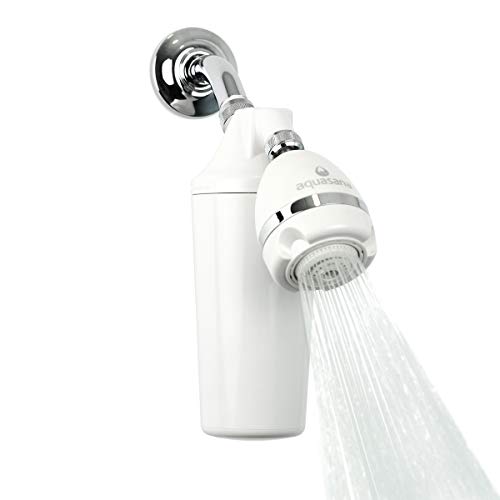 Aquasana AQ-4100One of the few units whose maker names the media outright — copper-zinc KDF plus coconut shell carbon — and one of the few that says anything at all about chloramine. Read its certification line carefully: it is tested to NSF/ANSI 177, not certified to it.Patented copper-zinc (KDF) plus coconut shel… | KDF plus carbon, with the media stated | None | |
| 3 |  Philips AWP1775CHWorth owning and worth studying. Its listing says "NSF-Certified KDF", which certifies the material inside the cartridge, not the finished device. That is a real certification of a real thing, and it is not the same as the filter being certified.Three-stage filtration with double mesh and … | Reading a certification claim correctly | NSF certification of the KDF filtration material | |
| 4 |  Culligan ISH-100The inline sibling of the HSH-C135, aimed squarely at sulfur odor and scale rather than at hair. It uses KDF media, which is the right mechanism for iron and hydrogen sulfide nuisance rather than for hardness.Kinetic Degradation Fluxion (KDF) media | Sulfur odor on well water | None |
Every figure in this table links to the page it came from in the write-ups below. Units we claim to have tested: 0.
Sprite Slim-Line 2
Certified media, honestly benchmarked
Certified to NSF/ANSI 177 by IAPMO, and the most instructive product in this set: when WaterFilterGuru measured it independently they got 42% chlorine reduction — a reminder that the certification floor is 50% of a controlled challenge, not a promise about your shower.
Published specifications
- Filter media
- KDF media with calcium sulfite, branded "Chlorgon"Source: WaterFilterGuru, "Sprite Slim-Line 2 Shower Filter: A Data-Driven Review" (retrieved 2026-09-01)
- Stated flow rate
- 1.8 GPM claimed; 1.65 GPM measured independentlyThe measured figure is WaterFilterGuru's, not ours.Source: WaterFilterGuru, "Sprite Slim-Line 2 Shower Filter: A Data-Driven Review" (retrieved 2026-09-01)
- Rated cartridge life
- 10,000 gallons, or 6 monthsSource: WaterFilterGuru, "Sprite Slim-Line 2 Shower Filter: A Data-Driven Review" (retrieved 2026-09-01)
- Chloramine
- Not publishedNo chloramine performance is published for this unit.
- Format
- Inline, fits between the arm and any shower headSource: Sprite Slim-Line 2 — listing on Amazon.com (retrieved 2026-09-01)
- Housing
- PlasticDescribed in the independent review as feeling flimsier than most of the filters tested alongside it.Source: WaterFilterGuru, "Sprite Slim-Line 2 Shower Filter: A Data-Driven Review" (retrieved 2026-09-01)
What it does well
- NSF/ANSI 177 certification from IAPMO, per the independent review that checked it
- KDF plus calcium sulfite, a media pairing with a real mechanism behind it
- 10,000 gallon / 6 month cartridge
- Low-profile inline body, roughly an inch and a half tall
Where it falls short
- Independently measured at 42% chlorine reduction, well below the marketing
- Plastic housing described by that reviewer as flimsier than most
- Measured flow of 1.65 GPM against a claimed 1.8
What it does not do
- It does not soften water. Independent measurement found hardness effectively unchanged at 128.19 PPM going in.
- It publishes no chloramine performance.
- Its certification does not mean 100% chlorine removal in your shower.
Who it is for
A reader who wants the certification and the caveat together, and who values a low-profile inline unit that does not change their shower head.
Skip it if
You want the highest measured chlorine reduction available. On the one independent measurement we could find, this was not it.
#ad · how we are funded · price as of October 16, 2026
Aquasana AQ-4100
KDF plus carbon, with the media stated
One of the few units whose maker names the media outright — copper-zinc KDF plus coconut shell carbon — and one of the few that says anything at all about chloramine. Read its certification line carefully: it is tested to NSF/ANSI 177, not certified to it.
Published specifications
- Filter media
- Patented copper-zinc (KDF) plus coconut shell carbonSource: Aquasana — shower filter with shower head (retrieved 2026-09-01)
- Stated flow rate
- 2.5 GPMStated as the optimum flow rate.Source: Aquasana — shower filter with shower head (retrieved 2026-09-01)
- Rated cartridge life
- 10,000 gallons, or up to 6 monthsSource: Aquasana — shower filter with shower head (retrieved 2026-09-01)
- Chloramine
- Chloramines listed among contaminants reduced; no percentage publishedSource: Aquasana — shower filter with shower head (retrieved 2026-09-01)
- Format
- Filter body with shower head; a head-free version (AQ-4100NSH) also existsSource: Aquasana AQ-4100 — listing on Amazon.com (retrieved 2026-09-01)
- Housing
- Not publishedAquasana does not state a housing material.
What it does well
- Names its media: patented copper-zinc (KDF) and coconut shell carbon
- Published capacity of 10,000 gallons or up to 6 months
- Publishes a chlorine reduction figure of over 90%
- Sold with a head or as a filter-only unit for an existing head
Where it falls short
- Tested to NSF/ANSI 177 rather than certified to it
- Chloramine is listed but not quantified
- 2.5 GPM is above the 1.8 GPM cap some states apply to new fixtures
What it does not do
- It does not soften water, and Aquasana makes no softening claim.
- It is not certified by NSF; the wording is "independently tested to NSF/ANSI Standard 177".
- It lists chloramines among what it reduces without publishing a reduction percentage for them.
Who it is for
Someone who wants a stated media list and a published capacity, and who cares more about what is inside than about the finish.
Skip it if
You need a certification mark rather than a testing claim. "Independently tested to" is a weaker statement than "certified by", and the difference matters.
#ad · how we are funded · price as of October 16, 2026
Philips AWP1775CH
Reading a certification claim correctly
Worth owning and worth studying. Its listing says "NSF-Certified KDF", which certifies the material inside the cartridge, not the finished device. That is a real certification of a real thing, and it is not the same as the filter being certified.
Published specifications
- Filter media
- Three-stage filtration with double mesh and NSF-certified KDF materialSource: Philips AWP1775CH/37 shower filter — listing on Amazon.com (retrieved 2026-09-01)
- Stated flow rate
- Not publishedNo flow rate is published on the US listing.
- Rated cartridge life
- Up to 50,000 L (about 13,208 gallons), replaced every 4-6 monthsPublished for the AWP1775 line; the figure is the manufacturer's, for the international model.Source: Philips AWP1775 in-line shower filter listing on Amazon.com (retrieved 2026-09-01)
- Chloramine
- Not publishedNot stated.
- Format
- Inline, fits handheld, rainfall or fixed headsSource: Philips AWP1775CH/37 shower filter — listing on Amazon.com (retrieved 2026-09-01)
- Housing
- Anti-scald material, chrome finishSource: Philips AWP1775CH/37 shower filter — listing on Amazon.com (retrieved 2026-09-01)
What it does well
- Three-stage filtration with double mesh and NSF-certified KDF material
- Large published capacity — the international version states up to 50,000 L, about 13,208 gallons
- Anti-scald housing rated for hot and cold
- Fits handheld, rainfall and fixed heads, tool-free
Where it falls short
- The certification applies to the media, not the device
- US listing publishes no flow rate
- Cartridge availability varies between the US and international model numbers
What it does not do
- It does not soften water.
- It is not stated to be a device certified to NSF/ANSI 177; the KDF material is what carries the NSF certification.
- It publishes no chloramine performance.
Who it is for
A reader who wants a large-capacity inline unit from a manufacturer with a plumbing division behind it.
Skip it if
You read "NSF-Certified" as meaning the unit passed NSF/ANSI 177. It does not say that.
#ad · how we are funded · price as of October 16, 2026
Culligan ISH-100
Sulfur odor on well water
The inline sibling of the HSH-C135, aimed squarely at sulfur odor and scale rather than at hair. It uses KDF media, which is the right mechanism for iron and hydrogen sulfide nuisance rather than for hardness.
Published specifications
- Filter media
- Kinetic Degradation Fluxion (KDF) mediaSource: Culligan ISH-100 inline shower filter — listing on Amazon.com (retrieved 2026-09-01)
- Stated flow rate
- Not publishedCulligan publishes no flow rate for the inline ISH-100.
- Rated cartridge life
- 10,000 gallons, or 6 monthsSource: Culligan ISH-100 inline shower filter — listing on Amazon.com (retrieved 2026-09-01)
- Chloramine
- Not publishedNot stated.
- Format
- Inline, fits between the arm and an existing shower headSource: Culligan ISH-100 inline shower filter — listing on Amazon.com (retrieved 2026-09-01)
What it does well
- KDF media, which inhibits bacterial growth inside the cartridge itself
- Published capacity of 10,000 gallons or 6 months
- Keeps your existing shower head
- Shares the WHR-140 cartridge family with other Culligan units
Where it falls short
- Aimed at odor and scale, not at hair and skin outcomes
- No published chloramine performance
- A serious well iron problem needs treatment upstream of the bathroom
What it does not do
- It does not disinfect. Nothing at the shower head addresses coliform bacteria.
- It does not soften water or reduce hardness.
- It does not replace a whole-house iron or sediment system on a heavily loaded well.
Who it is for
Private-well readers whose complaint is rotten-egg odor and staining, and who want to keep their existing shower head.
Skip it if
Your well has a bacteriological or nitrate problem. A shower filter is the wrong tool for that entirely, and so is any other point-of-use device at the shower.
#ad · how we are funded · price as of October 16, 2026
How KDF fails
- It is consumed. The zinc is oxidized over the cartridge's life, which is why gallon ratings exist and why a cartridge left in for two years is doing nothing.
- Flow rate matters. Faster flow means less contact even for a fast reaction. A unit rated at 2.5 GPM is doing the same chemistry in fewer milliseconds than one at 1.8.
- It does not filter. KDF is a reactive media, not a strainer. Every KDF cartridge pairs it with sediment stages, and those are what clog.
- Nothing it does touches hardness. The correction.
Questions people actually ask
+ What is KDF in a shower filter?
A copper-zinc alloy that reduces free chlorine to chloride by electron transfer. It is fast enough to work at shower contact times, which is why it dominates this category.
+ Does KDF remove chloramine?
Not on its own. Chloramine's chlorine-ammonia bond is deliberately more stable and does not yield to KDF's redox reaction.
+ Is KDF safe?
KDF media is manufactured to a specification and is NSF-certified as a material — which is what Philips means when its listing says NSF-certified KDF. That certifies the media, not the assembled filter.
+ What is the difference between KDF-55 and KDF-85?
KDF-55 is the high-zinc grade used for chlorine reduction and is what appears in shower filters. KDF-85 has more copper and is used for iron and hydrogen sulfide.
+ Does KDF remove heavy metals?
The redox chemistry acts on some dissolved metals. It is untested at the device level, because the shower filter standard does not cover metals.
Sources
Everything on this page traces to one of these. Where a source is brand-owned we say so, because a filter maker explaining filter chemistry has an interest and you are entitled to weigh it.
- AquaEarth, "KDF vs vitamin C vs carbon shower filter" — brand-owned explainer, cited with that stated (retrieved 2026-09-01)
- PICKI NIKI, "Filtered shower head technology explained" — brand-owned, cited for its published contact-time figures (retrieved 2026-09-01)
- Plumbing & Mechanical, "NSF/ANSI Standard 177: A Level Playing Field for Shower Filter Claims" (retrieved 2026-09-01)
- NSF — NSF/ANSI 177 shower filter certification program