Crystal Quest shower filter review
Catalytic carbon and a stated chloramine reduction at a budget price, with one of the longest published capacities in the category — and a certification line that names IAPMO in the role of a laboratory rather than a certifier.
Disclosure — some links on this page go to Amazon, and we earn a commission if you buy through them. It costs you nothing extra and it does not change what we recommend or in what order. The full disclosure.
Crystal Quest publishes a five-media stack including catalytic carbon, states reduction of chlorine, chloramines, VOCs and sulfur, and rates the cartridge at 10,000 to 15,000 gallons or 6 to 12 months at 2.0 GPM. Its testing line reads "independently tested by IAPMO labs in accordance to NSF/ANSI 177-2019" — testing, not certification.
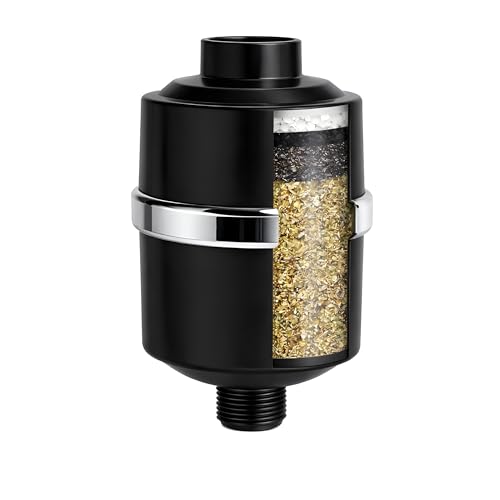
Crystal Quest Shower Filter
Catalytic carbon and a chloramine claim, cheaply
A five-media cartridge including catalytic carbon — the class with a real mechanism against chloramine — at the budget end of the category, with a 10,000 to 15,000 gallon capacity that is among the longest here. Its certification line needs careful reading: IAPMO tested it, which is not the same as IAPMO certifying it.
Published specifications
- Filter media
- Five-stage multi-media: coconut shell GAC, catalytic carbon, ERA 6500, ERA 9500 and ceramic spherical mediaCatalytic carbon is the reason this unit can credibly mention chloramine at all — it is one of two media classes with a real mechanism against it.Source: Crystal Quest — Premium Shower Filter (retrieved 2026-09-01)
- Stated flow rate
- 2.0 GPMSource: Crystal Quest — Premium Shower Filter (retrieved 2026-09-01)
- Rated cartridge life
- 10,000 to 15,000 gallons, a 6 to 12 month lifespan depending on water quality and usageThe replacement cartridge is the CQE-RC-04045. The upper end of that range is the longest published capacity in this registry.Source: Crystal Quest — Premium Shower Filter (retrieved 2026-09-01)
- Chloramine
- Stated to reduce chloramines, alongside chlorine, VOCs and sulfurNo percentage is published for chloramine specifically. The catalytic carbon in the stack is the mechanism that makes the claim plausible.Source: Crystal Quest — Premium Shower Filter (retrieved 2026-09-01)
- Format
- Inline shower filter; a version bundled with a shower head is sold separatelySource: Crystal Quest shower filter — listing on Amazon.com (retrieved 2026-09-01)
- Housing
- Not publishedCrystal Quest does not state a housing material.
What it does well
- Names all five media: coconut shell GAC, catalytic carbon, ERA 6500, ERA 9500 and ceramic spherical media
- Catalytic carbon is one of only two media classes with a real mechanism against chloramine
- States chloramine, VOC and sulfur reduction explicitly, which very little of this category does
- 10,000 to 15,000 gallons and a 6 to 12 month lifespan — among the longest published capacities we cover
- Publishes a flow rate of 2.0 GPM
Where it falls short
- "Independently tested by IAPMO labs" is a testing claim, not a certification — and the body named is one that also certifies, which makes it easy to misread
- No plain reduction percentage on the maker's own page
- The retail listing's "99% Chlorine" headline is not matched by the maker's own wording
- No independent bench measurement of this unit that we could find
What it does not do
- It does not hold a certification. IAPMO ran the testing; Crystal Quest does not state that IAPMO certified the product or that it appears in any listing.
- It does not soften water, and Crystal Quest makes no softening claim.
- Its own site publishes no single clean reduction percentage — the figure is expressed as performance relative to the standard's requirement, which is harder to check than a plain number.
- The Amazon listing title advertises "99% Chlorine", a figure that does not appear in that form on Crystal Quest's own product page.
Who it is for
Someone on chloraminated water who wants catalytic carbon without paying the premium the certified catalytic-carbon unit asks, and who will read the testing claim for what it says.
Skip it if
You want a certification you can look up. "Independently tested by IAPMO labs in accordance to NSF/ANSI 177-2019" describes a test, not a listing.
#ad · how we are funded · price as of October 16, 2026
Certifications and claims
Two tables, deliberately. A certification names a standard and the body that issued it, and you can look it up. A claim is the maker describing itself. Both belong here; conflating them does not.
No third-party certification is published for this product. That is not evidence of poor performance and it is not evidence of good performance — it means there is nothing independent to check.
“"Independently tested by IAPMO labs in accordance to NSF/ANSI 177-2019 standards/protocols"”
Source: Crystal Quest — Premium Shower Filter (retrieved 2026-09-01)“Reduces chlorine, chloramines, VOCs, sulfur and other common shower water contaminants”
Source: Crystal Quest — Premium Shower Filter (retrieved 2026-09-01)“"Removes 99% Chlorine, Chloramines & VOCs" — the retail listing title, a percentage the maker's own page does not state in that form”
Source: Crystal Quest shower filter — listing on Amazon.com (retrieved 2026-09-01)
The sentence that needs reading twice
Crystal Quest states its filter is "independently tested by IAPMO labs in accordance to NSF/ANSI 177-2019 standards/protocols". Every word of that is probably true and none of it is a certification.
IAPMO R&T is an accredited certifying body — it is the organization behind the marks on the Culligan, the Sprite and the WaterChef. So seeing "IAPMO" next to "NSF/ANSI 177" reads, at a glance, exactly like those products' certifications. The difference is the verb. Those three are certified by IAPMO R&T, which means an audited production line and a public listing. This one was tested by IAPMO's labs, which means a laboratory ran a protocol on samples somebody sent them.
We record Crystal Quest as uncertified, and we do not treat the wording as deceptive. It is more specific and more checkable than the "surpassing NSF-177" formulations used by the two highest-volume brands in the category. It simply is not a mark.
Catalytic carbon, and why that makes the chloramine claim credible
The media list is the reason this product is interesting: coconut shell GAC, catalytic carbon, ERA 6500, ERA 9500 and ceramic spherical media. The one that matters is catalytic carbon.
Most of this category runs KDF and calcium sulfite, which reduce free chlorine and do not break the chlorine-ammonia bond in chloramine. Catalytic carbon does — it and vitamin C are the only two media classes with a real mechanism against it. So when Crystal Quest states its filter reduces chloramines, the claim is at least mechanically coherent, which is more than can be said for the hard-water and chloramine claims made by several KDF products.
That puts it in unusual company. The only other catalytic-carbon unit we cover is the WaterChef SF-7C, which holds a real IAPMO certification and costs considerably more — and which, oddly, makes no chloramine claim at all. Crystal Quest claims chloramine without a certification; WaterChef holds a certification without claiming chloramine. Neither publishes a chloramine percentage, and NSF/ANSI 177 does not evaluate chloramine, so no certification would cover it anyway.
The longest capacity in the registry
10,000 to 15,000 gallons, a 6 to 12 month lifespan, on a 2.0 GPM rating, with the CQE-RC-04045 as the replacement. The top of that range is the longest published capacity of anything we cover — most of the category runs 10,000 gallons or six months, and several premium heads run 90 days.
Ranges have a cost, though: a figure that spans a factor of 1.5 on gallons and a factor of 2 on months is a figure you cannot budget precisely against. Crystal Quest attributes the spread to water quality and usage, which is honest and also means the low end is the one to plan for. Even so, on the low end it matches the category convention, and at this price the twelve-month arithmetic comes out well.
The percentage problem, in both directions
Crystal Quest's own page expresses performance as "up to 80% above the standard's performance requirement". NSF/ANSI 177 requires at least 50 percent free chlorine reduction across the rated life, so that phrasing points somewhere in the region of 90 percent — but it is a relative construction rather than a measured number, and we are not going to convert it into a percentage on the company's behalf.
The retail listing does convert it. The Amazon title reads "Removes 99% Chlorine, Chloramines & VOCs" — a flat 99 percent that does not appear in that form on Crystal Quest's own product page. We have seen this split before on the Delta Clarifi, where the retail title added a hard-water framing the maker's pages never use. Where a listing title and a manufacturer's own page disagree, the manufacturer's page is the one we record.
What it does not do
It does not hold a certification. It does not publish a clean reduction percentage of its own. There is no independent bench measurement of it that we could find, so nothing here has been checked by anyone outside the company except IAPMO's laboratory, on a test whose report is not published.
And it does not soften water — a claim Crystal Quest, to its credit, does not make. Sulfur and iron oxide appear in its contaminant list, which is the same territory the well-water roundup covers, and those are genuine redox-media jobs rather than softening.
What we would skip, and why
Questions people actually ask
+ Is the Crystal Quest shower filter NSF certified?
No. Crystal Quest states it is "independently tested by IAPMO labs in accordance to NSF/ANSI 177-2019". IAPMO is a certifying body, but testing by its laboratory is not the same as certification by it — there is no listing to check.
+ Does the Crystal Quest shower filter remove chloramine?
Crystal Quest states it reduces chloramines, and the stack includes catalytic carbon, which is one of only two media classes with a real mechanism against chloramine. No percentage is published for chloramine specifically.
+ How long does the Crystal Quest cartridge last?
10,000 to 15,000 gallons, or 6 to 12 months depending on water quality and usage. The top of that range is the longest published capacity of anything we cover; plan for the low end.
+ Why does Amazon say 99% chlorine when the maker does not?
The retail listing title says "Removes 99% Chlorine". Crystal Quest's own page expresses performance as up to 80 percent above the standard's requirement instead. When a listing title and a maker's page disagree, we record the maker's page.
+ Does it soften hard water?
No, and Crystal Quest does not claim it does. It lists sulfur, iron oxide and sediment, which are redox-media jobs. Softening requires ion exchange and no shower filter performs it.
Sources
Everything on this page traces to one of these. Where a source is brand-owned we say so, because a filter maker explaining filter chemistry has an interest and you are entitled to weigh it.
- Plumbing & Mechanical, "NSF/ANSI Standard 177: A Level Playing Field for Shower Filter Claims" (retrieved 2026-09-01)
- NSF — NSF/ANSI 177 shower filter certification program
- IAPMO R&T — product listing and certification directory
- WaterFilterGuru, "The Best Shower Head Filter" — independent lab testing, credited to them (retrieved 2026-09-01)
- US EPA — Consumer Confidence Reports (CCR) for drinking water