Shower filters for blonde hair
Blonde hair shows every water problem first. Two different things are turning it brassy, and a filter deals with exactly one of them.

Disclosure — some links on this page go to Amazon, and we earn a commission if you buy through them. It costs you nothing extra and it does not change what we recommend or in what order. The full disclosure.
Brassiness in blonde hair has two causes: oxidation from chlorine, which a shower filter genuinely reduces, and mineral or iron deposition from hard or well water, which it does not. Which one you have decides whether a filter helps. Green tints are usually copper; orange tints are usually iron.
Lightened hair is the most sensitive instrument in most bathrooms. The lifting process removes the cuticle's protection and the natural pigment that would otherwise mask deposits, so anything the water carries shows up on blonde before it shows up anywhere else. That sensitivity is why this is a real segment and not a marketing one — but it also means it is worth diagnosing the cause rather than buying the first filter that mentions color.
Cause one: oxidation
Chlorinated water is an oxidizing environment. Oxidation degrades the disulfide bonds that hold keratin's structure together, and it acts on deposited dye molecules as well as on the hair itself. This is the well-known mechanism behind what happens to swimmers' hair, and it is the one a shower filter interrupts directly. On a chlorinated municipal supply, this is a real and addressable cause.
How much chlorine your filter removes therefore matters more here than in most use cases, which is why this page ranks on measured reduction rather than on marketing. The independently-measured spread across the category ran from 42 percent to 100 percent — that is not a small difference when oxidation is your problem.
Cause two: deposition
Hard water leaves calcium and magnesium on the hair shaft, which dulls color and roughens texture. Well water can carry iron, which oxidizes and stains hair orange. Copper, usually from acidic water attacking pipes, produces the green tint that swimmers blame on chlorine and that is actually copper the whole time.
A shower filter does not remove hardness, as the measurements consistently show. Some media reduce dissolved metals to a degree, and KDF in particular has a real mechanism against some of them, but no shower filter is certified for metal reduction because the standard does not cover it. If your problem is deposition, the honest treatments are a softener, a chelating shampoo, and — for iron — treatment upstream of the bathroom.
Quick picks
Ranked on what can be verified: a traceable certification first, then media matched to your disinfectant. Tap a row to jump to the full write-up.
| # | Product | Best for | Certification | Price |
|---|---|---|---|---|
| 1 |  Weddell Duo Shower FilterThe only filter in this set whose maker publishes its NSF test dates and reduction ranges, and the one an independent lab measured at 100% chlorine removal. It also removed disinfection byproducts, which almost nothing else did.Dual cartridge: sediment filter plus activat… | Chlorine and disinfection byproducts | NSF/ANSI 177 +2 | |
| 2 |  Canopy Filtered ShowerheadCanopy publishes almost nothing you can check — no media, no flow rate, no capacity, no certification. What saves it is somebody else's number: WaterFilterGuru measured 97% chlorine reduction, from 2.7 PPM down to 0.06.Not published | Measured chlorine reduction | None | |
| 3 | 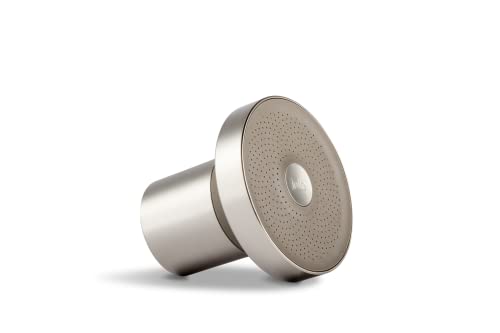 Jolie Filtered ShowerheadThe most searched shower filter in the United States, with a media pairing that makes sense and a certification line that does not. "Surpassing NSF-177 certifications" is a claim about exceeding a standard the product is not stated to hold.KDF-55 and calcium sulfite | The best-known name in the category | None | |
| 4 | 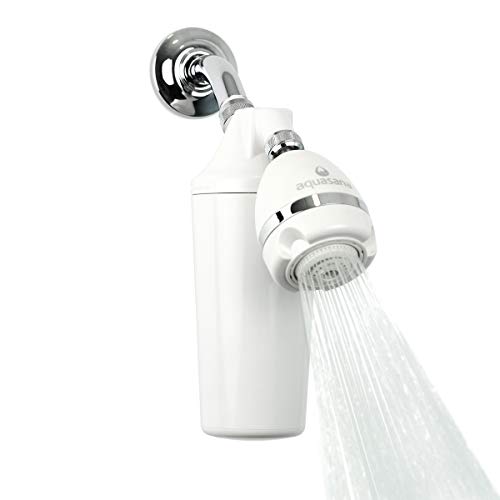 Aquasana AQ-4100One of the few units whose maker names the media outright — copper-zinc KDF plus coconut shell carbon — and one of the few that says anything at all about chloramine. Read its certification line carefully: it is tested to NSF/ANSI 177, not certified to it.Patented copper-zinc (KDF) plus coconut shel… | KDF plus carbon, with the media stated | None |
Every figure in this table links to the page it came from in the write-ups below. Units we claim to have tested: 0.
Weddell Duo Shower Filter
Chlorine and disinfection byproducts
The only filter in this set whose maker publishes its NSF test dates and reduction ranges, and the one an independent lab measured at 100% chlorine removal. It also removed disinfection byproducts, which almost nothing else did.
Published specifications
- Filter media
- Dual cartridge: sediment filter plus activated carbonThe maker states "Material: Activated carbon" for the black cartridge and a sediment stage for the white one.Source: Weddell Water — Weddell Duo Shower Filter (retrieved 2026-09-01)
- Stated flow rate
- 2.8 GPMSource: Weddell Water — Weddell Duo Shower Filter (retrieved 2026-09-01)
- Rated cartridge life
- 8,000 gallons, or 5-6 monthsRated capacity 8,000 gallons; the maker also gives a 5-6 month calendar prompt.Source: Weddell Water — Weddell Duo Shower Filter (retrieved 2026-09-01)
- Chloramine
- Not publishedWeddell publishes no chloramine figure. Absence of a claim is not evidence of failure, but it is also not evidence of performance.
- Format
- Inline, fits between the arm and any shower headTool-free; the maker states it fits fixed, rain and handheld heads.Source: Weddell Water — Weddell Duo Shower Filter (retrieved 2026-09-01)
- Housing
- Not publishedWeddell does not state a housing material.
What it does well
- NSF/ANSI 177 chlorine reduction with the test date published
- Also carries NSF/ANSI 53 PFAS reduction and NSF/ANSI 42 particulate reduction
- Independently measured at 100% chlorine reduction and confirmed to remove disinfection byproducts
- 2.8 GPM rating is the highest published flow in this set
- Clear cartridges let you see the sediment stage loading up
Where it falls short
- Publishes nothing about chloramine
- Two cartridges to replace instead of one
- Inline format adds length between the arm and the head
What it does not do
- It does not soften water. An independent lab measured hardness at 125.59 PPM after filtration — effectively unchanged.
- It publishes no chloramine performance data of any kind.
- It is an inline unit, so it does not replace or improve your shower head.
Who it is for
Anyone on chlorinated municipal water who wants the strongest published evidence rather than the strongest published adjectives.
Skip it if
Your utility uses chloramine. Weddell publishes nothing about chloramine performance, and an activated carbon block sized for shower flow is not the thing to bet on for it — see the chloramine guide.
#ad · how we are funded · price as of October 16, 2026
Canopy Filtered Showerhead
Measured chlorine reduction
Canopy publishes almost nothing you can check — no media, no flow rate, no capacity, no certification. What saves it is somebody else's number: WaterFilterGuru measured 97% chlorine reduction, from 2.7 PPM down to 0.06.
Published specifications
- Filter media
- Not publishedCanopy's own product page states no filter media. We checked it on 2026-09-01.
- Stated flow rate
- Not publishedNo flow rate is published on Canopy's product page.
- Rated cartridge life
- Not publishedNo gallon capacity or replacement interval is published on the product page.
- Chloramine
- Not publishedNot stated.
- Format
- Replacement shower head with integrated filter, three spray settingsSource: Canopy — Filtered Showerhead (retrieved 2026-09-01)
- Housing
- Not publishedNot stated.
What it does well
- Independently measured at 97% chlorine reduction, 2.7 PPM down to 0.06 PPM
- Three spray settings on a design-led head
- Widely stocked, so cartridges are easy to find
Where it falls short
- Publishes no media list, no flow rate, no capacity and no certification
- Was not one of the units shown to remove disinfection byproducts in that test
- Nothing published about chloramine
What it does not do
- It does not soften water. No filter in the independent test set reduced hardness, including this one.
- It publishes no filter media, flow rate, cartridge capacity or certification on its own product page.
- It removed chlorine in that test but was not among the two units that removed disinfection byproducts.
Who it is for
A reader who trusts an independent measurement more than a spec sheet, and who wants a design-led head rather than an inline puck.
Skip it if
You want to compare it on paper. There is no paper. Every figure we have for this product came from someone else's lab.
#ad · how we are funded · price as of October 16, 2026
Jolie Filtered Showerhead
The best-known name in the category
The most searched shower filter in the United States, with a media pairing that makes sense and a certification line that does not. "Surpassing NSF-177 certifications" is a claim about exceeding a standard the product is not stated to hold.
Published specifications
- Filter media
- KDF-55 and calcium sulfiteSource: Jolie — The Jolie Filtered Showerhead (retrieved 2026-09-01)
- Stated flow rate
- 1.8 GPMStated as compliant with California and New York water consumption standards.Source: Jolie — The Jolie Filtered Showerhead (retrieved 2026-09-01)
- Rated cartridge life
- Every 90 days on subscriptionNo gallon capacity is published.Source: Jolie — The Jolie Filtered Showerhead (retrieved 2026-09-01)
- Chloramine
- Not publishedJolie publishes no chloramine performance data.
- Format
- Replacement shower head with integrated filterSource: Jolie Filtered Showerhead — listing on Amazon.com (retrieved 2026-09-01)
- Housing
- Not publishedJolie lists finishes rather than a housing material.
What it does well
- Media named outright: KDF-55 and calcium sulfite
- 1.8 GPM, compliant with California and New York flow limits
- 90-day cartridge cadence on subscription, so replacement actually happens
- Replaces the shower head, so there is nothing extra hanging off the arm
Where it falls short
- "Surpassing NSF-177 certifications" is a claim, not a certification
- No gallon capacity published, so cost per gallon cannot be computed from its own data
- Nothing published about chloramine
What it does not do
- It does not soften water. KDF-55 and calcium sulfite do not remove calcium or magnesium.
- It does not hold a stated NSF/ANSI 177 certification; the published wording is that it surpasses NSF-177 certifications.
- It does not treat hair loss. Reduced shedding and reduced breakage are different claims from androgenetic hair loss — see the hair-loss evidence page.
Who it is for
A reader who wants the well-known unit, a 1.8 GPM head that meets state flow limits, and a subscription that removes the decision about when to change the cartridge.
Skip it if
You want a verifiable certification rather than a testing claim, or you want a published gallon capacity you can do arithmetic with.
#ad · how we are funded · price as of October 16, 2026
Aquasana AQ-4100
KDF plus carbon, with the media stated
One of the few units whose maker names the media outright — copper-zinc KDF plus coconut shell carbon — and one of the few that says anything at all about chloramine. Read its certification line carefully: it is tested to NSF/ANSI 177, not certified to it.
Published specifications
- Filter media
- Patented copper-zinc (KDF) plus coconut shell carbonSource: Aquasana — shower filter with shower head (retrieved 2026-09-01)
- Stated flow rate
- 2.5 GPMStated as the optimum flow rate.Source: Aquasana — shower filter with shower head (retrieved 2026-09-01)
- Rated cartridge life
- 10,000 gallons, or up to 6 monthsSource: Aquasana — shower filter with shower head (retrieved 2026-09-01)
- Chloramine
- Chloramines listed among contaminants reduced; no percentage publishedSource: Aquasana — shower filter with shower head (retrieved 2026-09-01)
- Format
- Filter body with shower head; a head-free version (AQ-4100NSH) also existsSource: Aquasana AQ-4100 — listing on Amazon.com (retrieved 2026-09-01)
- Housing
- Not publishedAquasana does not state a housing material.
What it does well
- Names its media: patented copper-zinc (KDF) and coconut shell carbon
- Published capacity of 10,000 gallons or up to 6 months
- Publishes a chlorine reduction figure of over 90%
- Sold with a head or as a filter-only unit for an existing head
Where it falls short
- Tested to NSF/ANSI 177 rather than certified to it
- Chloramine is listed but not quantified
- 2.5 GPM is above the 1.8 GPM cap some states apply to new fixtures
What it does not do
- It does not soften water, and Aquasana makes no softening claim.
- It is not certified by NSF; the wording is "independently tested to NSF/ANSI Standard 177".
- It lists chloramines among what it reduces without publishing a reduction percentage for them.
Who it is for
Someone who wants a stated media list and a published capacity, and who cares more about what is inside than about the finish.
Skip it if
You need a certification mark rather than a testing claim. "Independently tested to" is a weaker statement than "certified by", and the difference matters.
#ad · how we are funded · price as of October 16, 2026
What we would skip, and why
Any filter bought to fix brassiness caused by iron
Iron deposition is a well-water problem and it needs treatment upstream, not at the shower head. If your brass is orange rather than yellow, this is probably your cause.
Anything sold as a softener for color protection
The mineral half of the problem needs a softener. A product using the word without the mechanism will not deliver it — the correction.
The things that are free
- Rinse cooler. Hot water opens the cuticle and speeds both dye loss and deposition. This costs nothing and does more than most people expect.
- Use a chelating shampoo periodically, not daily. It binds and removes mineral deposits that a filter never prevented.
- Rinse before swimming. Hair saturated with clean water absorbs less pool water, and the copper in pools is what turns blonde green.
- Handle it less when wet. Wet hair is at its weakest, and hard water has already cost it measurable strength — the study.
Questions people actually ask
+ Do shower filters help blonde hair?
For chlorine-driven brassiness and dryness, yes. For mineral deposition and iron staining, no. Diagnosing which you have is most of the decision.
+ What is the best shower filter for color-treated hair?
The one with the strongest measured chlorine reduction, since oxidation is the mechanism a filter interrupts. On independent data that is the Weddell Duo.
+ Why does my blonde hair turn orange?
Usually iron in the water, most often on a private well. Iron is not something a shower filter removes reliably; it needs treatment upstream.
+ Why does blonde hair turn green in the pool?
Copper, not chlorine. Copper compounds in pool water bind to lightened hair. Rinsing with clean water before swimming reduces how much pool water the hair absorbs.
+ Will a shower filter make my color last longer?
It removes one of the two things fading it. That is worth something and it is not the whole story, and no honest page should claim it is.
Sources
Everything on this page traces to one of these. Where a source is brand-owned we say so, because a filter maker explaining filter chemistry has an interest and you are entitled to weigh it.
- WaterFilterGuru, "The Best Shower Head Filter" — independent lab testing, credited to them (retrieved 2026-09-01)
- Luqman MW et al. (2018). To evaluate and compare changes in baseline strength of hairs after treating them with deionized water and hard water and its role in hair breakage. International Journal of Trichology 10(3):113-117.
- Plumbing & Mechanical, "NSF/ANSI Standard 177: A Level Playing Field for Shower Filter Claims" (retrieved 2026-09-01)