Filter media compared
Four media classes, one constraint. Everything a shower filter can do is decided by what chemistry fits inside a tenth of a second.
Disclosure — some links on this page go to Amazon, and we earn a commission if you buy through them. It costs you nothing extra and it does not change what we recommend or in what order. The full disclosure.
KDF-55 reduces free chlorine by redox, fast enough for shower flow, and does not address chloramine. Calcium sulfite reduces chlorine chemically and tolerates heat. Activated carbon adsorbs, and needs 25 to 40 seconds it does not get. Vitamin C neutralizes both chlorine and chloramine chemically, and is consumed doing it.
Every claim in this category has to survive one number first. PICKI NIKI, a filter manufacturer, publishes a residence time of 0.10 to 0.14 seconds inside a shower head at 7.5 liters per minute, and states that standard activated carbon needs 25 to 40 seconds of empty-bed contact time for chlorine reduction. Once you have those two figures side by side, most of what follows is arithmetic.
The comparison table
Chemistry summarized from explainers published by AquaEarth and Second Shower, both of which sell filters. We cite them with that stated, because they are the clearest published accounts available and their interest is relevant to how you weigh them.
Why carbon is the interesting case
Carbon is the best media in water treatment and the worst fit for a shower head, and both are true for the same reason. Adsorption works by giving contaminants time and surface area to stick to. Given a slow flow and a big bed — a kitchen filter, a whole-house unit — it removes an enormous range of organics, including the disinfection byproducts that are the health-relevant part of chlorination.
Put it in a shower head at two gallons a minute and it has a tenth of a second and a few ounces of media. Heat makes it worse. This is why the units with genuine disinfection byproduct performance in independent testing — two out of a whole test group — are inline bodies with meaningful carbon-block volume, not shower heads.
Vitamin C is a different kind of media
Everything else here traps or converts contaminants while the media sits in the flow. Ascorbic acid reacts with them and is used up in the process. That changes two things about ownership.
First, contact time stops being the binding constraint, because a chemical reaction in solution does not need the water to linger against a surface. That is why vitamin C is the media class that works on chloramine at shower flow when carbon cannot. Second, cartridge life stops being a function of gallons and becomes a function of how much disinfectant your utility puts in the water — which is why vitamin C products publish a time range or nothing at all where carbon products publish a gallon rating.
What stage counts hide
Look back at the table's last row. Sediment media, stainless mesh and PP cotton do no chemistry at all — they strain particulates, which is useful and is why your flow eventually drops. Every one of them can be counted as a stage.
That is how a cartridge with three reactive media becomes a 15-stage or 33-stage product. There is no standard defining a stage and no body auditing the count. The AquaBliss SF220 names six media and calls itself three-stage; the iSpring SF2S names one media and calls itself 33-stage. Same class of product.
Quick picks
Ranked on what can be verified: a traceable certification first, then media matched to your disinfectant. Tap a row to jump to the full write-up.
| # | Product | Best for | Certification | Price |
|---|---|---|---|---|
| 1 |  Weddell Duo Shower FilterThe only filter in this set whose maker publishes its NSF test dates and reduction ranges, and the one an independent lab measured at 100% chlorine removal. It also removed disinfection byproducts, which almost nothing else did.Dual cartridge: sediment filter plus activat… | Chlorine and disinfection byproducts | NSF/ANSI 177 +2 | |
| 2 | 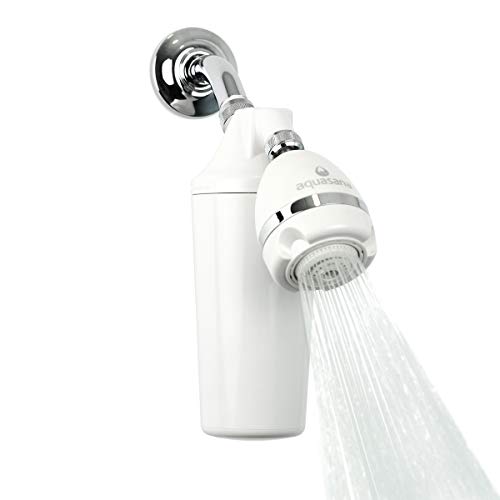 Aquasana AQ-4100One of the few units whose maker names the media outright — copper-zinc KDF plus coconut shell carbon — and one of the few that says anything at all about chloramine. Read its certification line carefully: it is tested to NSF/ANSI 177, not certified to it.Patented copper-zinc (KDF) plus coconut shel… | KDF plus carbon, with the media stated | None | |
| 3 |  AquaBliss SF100 Daily RevitalizeThe one product here whose maker states outright that it reduces chloramine as well as chlorine, and then backs that up by routing chloramine customers away from its own cheaper model. That is an unusually honest piece of product literature.Three stages: sand filter, stainless mesh an… | Chloramine, on the maker's own routing | None | |
| 4 |  Sprite Slim-Line 2Certified to NSF/ANSI 177 by IAPMO, and the most instructive product in this set: when WaterFilterGuru measured it independently they got 42% chlorine reduction — a reminder that the certification floor is 50% of a controlled challenge, not a promise about your shower.KDF media with calcium sulfite, branded "Chl… | Certified media, honestly benchmarked | NSF/ANSI 177 | |
| 5 | AquaYouth Vitamin C Handheld Shower HeadThe vitamin C head we could still buy. Ascorbic acid neutralizes chlorine and chloramine chemically rather than adsorbing them, which is why it does not need the contact time carbon does. The catch here is unusually explicit: the cartridge is refillable with loose vitamin C powder, and the maker says that refill comes round every two to four weeks.Vitamin C powder (ascorbic acid) with antimi… | Vitamin C as the primary media | None |
Every figure in this table links to the page it came from in the write-ups below. Units we claim to have tested: 0.
Weddell Duo Shower Filter
Chlorine and disinfection byproducts
The only filter in this set whose maker publishes its NSF test dates and reduction ranges, and the one an independent lab measured at 100% chlorine removal. It also removed disinfection byproducts, which almost nothing else did.
Published specifications
- Filter media
- Dual cartridge: sediment filter plus activated carbonThe maker states "Material: Activated carbon" for the black cartridge and a sediment stage for the white one.Source: Weddell Water — Weddell Duo Shower Filter (retrieved 2026-09-01)
- Stated flow rate
- 2.8 GPMSource: Weddell Water — Weddell Duo Shower Filter (retrieved 2026-09-01)
- Rated cartridge life
- 8,000 gallons, or 5-6 monthsRated capacity 8,000 gallons; the maker also gives a 5-6 month calendar prompt.Source: Weddell Water — Weddell Duo Shower Filter (retrieved 2026-09-01)
- Chloramine
- Not publishedWeddell publishes no chloramine figure. Absence of a claim is not evidence of failure, but it is also not evidence of performance.
- Format
- Inline, fits between the arm and any shower headTool-free; the maker states it fits fixed, rain and handheld heads.Source: Weddell Water — Weddell Duo Shower Filter (retrieved 2026-09-01)
- Housing
- Not publishedWeddell does not state a housing material.
What it does well
- NSF/ANSI 177 chlorine reduction with the test date published
- Also carries NSF/ANSI 53 PFAS reduction and NSF/ANSI 42 particulate reduction
- Independently measured at 100% chlorine reduction and confirmed to remove disinfection byproducts
- 2.8 GPM rating is the highest published flow in this set
- Clear cartridges let you see the sediment stage loading up
Where it falls short
- Publishes nothing about chloramine
- Two cartridges to replace instead of one
- Inline format adds length between the arm and the head
What it does not do
- It does not soften water. An independent lab measured hardness at 125.59 PPM after filtration — effectively unchanged.
- It publishes no chloramine performance data of any kind.
- It is an inline unit, so it does not replace or improve your shower head.
Who it is for
Anyone on chlorinated municipal water who wants the strongest published evidence rather than the strongest published adjectives.
Skip it if
Your utility uses chloramine. Weddell publishes nothing about chloramine performance, and an activated carbon block sized for shower flow is not the thing to bet on for it — see the chloramine guide.
#ad · how we are funded · price as of October 16, 2026
Aquasana AQ-4100
KDF plus carbon, with the media stated
One of the few units whose maker names the media outright — copper-zinc KDF plus coconut shell carbon — and one of the few that says anything at all about chloramine. Read its certification line carefully: it is tested to NSF/ANSI 177, not certified to it.
Published specifications
- Filter media
- Patented copper-zinc (KDF) plus coconut shell carbonSource: Aquasana — shower filter with shower head (retrieved 2026-09-01)
- Stated flow rate
- 2.5 GPMStated as the optimum flow rate.Source: Aquasana — shower filter with shower head (retrieved 2026-09-01)
- Rated cartridge life
- 10,000 gallons, or up to 6 monthsSource: Aquasana — shower filter with shower head (retrieved 2026-09-01)
- Chloramine
- Chloramines listed among contaminants reduced; no percentage publishedSource: Aquasana — shower filter with shower head (retrieved 2026-09-01)
- Format
- Filter body with shower head; a head-free version (AQ-4100NSH) also existsSource: Aquasana AQ-4100 — listing on Amazon.com (retrieved 2026-09-01)
- Housing
- Not publishedAquasana does not state a housing material.
What it does well
- Names its media: patented copper-zinc (KDF) and coconut shell carbon
- Published capacity of 10,000 gallons or up to 6 months
- Publishes a chlorine reduction figure of over 90%
- Sold with a head or as a filter-only unit for an existing head
Where it falls short
- Tested to NSF/ANSI 177 rather than certified to it
- Chloramine is listed but not quantified
- 2.5 GPM is above the 1.8 GPM cap some states apply to new fixtures
What it does not do
- It does not soften water, and Aquasana makes no softening claim.
- It is not certified by NSF; the wording is "independently tested to NSF/ANSI Standard 177".
- It lists chloramines among what it reduces without publishing a reduction percentage for them.
Who it is for
Someone who wants a stated media list and a published capacity, and who cares more about what is inside than about the finish.
Skip it if
You need a certification mark rather than a testing claim. "Independently tested to" is a weaker statement than "certified by", and the difference matters.
#ad · how we are funded · price as of October 16, 2026
AquaBliss SF100 Daily Revitalize
Chloramine, on the maker's own routing
The one product here whose maker states outright that it reduces chloramine as well as chlorine, and then backs that up by routing chloramine customers away from its own cheaper model. That is an unusually honest piece of product literature.
Published specifications
- Filter media
- Three stages: sand filter, stainless mesh and PP cotton; then calcium sulfite, redox media and activated carbon; then a PP cotton and mesh barrier. Cartridge infused with vitamin C, minerals and tourmaline.Source: AquaBliss — SF100 Daily Revitalize shower filter (retrieved 2026-09-01)
- Stated flow rate
- Not publishedAquaBliss publishes no flow rate for the SF100.
- Rated cartridge life
- Every 3-6 monthsAquaBliss adds "sooner if you're in a high-chlorine or high-sediment area" and publishes no gallon rating.Source: AquaBliss — SF100 Daily Revitalize shower filter (retrieved 2026-09-01)
- Chloramine
- Stated to reduce chloramine as well as chlorine and sedimentAquaBliss routes chloramine customers to this model rather than to its cheaper SF220, which is a claim it makes against its own interest.Source: AquaBliss — SF100 Daily Revitalize shower filter (retrieved 2026-09-01)
- Format
- Inline, standard half-inch connection, five finishesSource: AquaBliss — SF100 Daily Revitalize shower filter (retrieved 2026-09-01)
- Housing
- Not publishedFinish options are listed; the underlying material is not.
What it does well
- States chloramine reduction explicitly, which almost nothing else in this set does
- Full three-stage media list published, including calcium sulfite, redox media and activated carbon
- Vitamin C infusion in the cartridge, which is the media class that actually addresses chloramine
- Inline body fits fixed, rain and handheld heads on a standard half-inch connection
Where it falls short
- No published NSF/ANSI certification
- No published flow rate and no gallon capacity
- Cartridge cadence given only as a 3-6 month range
What it does not do
- It does not soften water; AquaBliss makes no softening claim for it.
- It carries no NSF/ANSI certification that AquaBliss publishes.
- It publishes no flow rate and no gallon capacity, so you cannot compute cost per gallon from its own data.
Who it is for
Readers whose water report says chloramine rather than free chlorine, and who want a stated media list at the low end of the price range.
Skip it if
You want a certification. AquaBliss publishes no NSF/ANSI certification for this unit, and a stated media list is not the same as a verified result.
#ad · how we are funded · price as of October 16, 2026
Sprite Slim-Line 2
Certified media, honestly benchmarked
Certified to NSF/ANSI 177 by IAPMO, and the most instructive product in this set: when WaterFilterGuru measured it independently they got 42% chlorine reduction — a reminder that the certification floor is 50% of a controlled challenge, not a promise about your shower.
Published specifications
- Filter media
- KDF media with calcium sulfite, branded "Chlorgon"Source: WaterFilterGuru, "Sprite Slim-Line 2 Shower Filter: A Data-Driven Review" (retrieved 2026-09-01)
- Stated flow rate
- 1.8 GPM claimed; 1.65 GPM measured independentlyThe measured figure is WaterFilterGuru's, not ours.Source: WaterFilterGuru, "Sprite Slim-Line 2 Shower Filter: A Data-Driven Review" (retrieved 2026-09-01)
- Rated cartridge life
- 10,000 gallons, or 6 monthsSource: WaterFilterGuru, "Sprite Slim-Line 2 Shower Filter: A Data-Driven Review" (retrieved 2026-09-01)
- Chloramine
- Not publishedNo chloramine performance is published for this unit.
- Format
- Inline, fits between the arm and any shower headSource: Sprite Slim-Line 2 — listing on Amazon.com (retrieved 2026-09-01)
- Housing
- PlasticDescribed in the independent review as feeling flimsier than most of the filters tested alongside it.Source: WaterFilterGuru, "Sprite Slim-Line 2 Shower Filter: A Data-Driven Review" (retrieved 2026-09-01)
What it does well
- NSF/ANSI 177 certification from IAPMO, per the independent review that checked it
- KDF plus calcium sulfite, a media pairing with a real mechanism behind it
- 10,000 gallon / 6 month cartridge
- Low-profile inline body, roughly an inch and a half tall
Where it falls short
- Independently measured at 42% chlorine reduction, well below the marketing
- Plastic housing described by that reviewer as flimsier than most
- Measured flow of 1.65 GPM against a claimed 1.8
What it does not do
- It does not soften water. Independent measurement found hardness effectively unchanged at 128.19 PPM going in.
- It publishes no chloramine performance.
- Its certification does not mean 100% chlorine removal in your shower.
Who it is for
A reader who wants the certification and the caveat together, and who values a low-profile inline unit that does not change their shower head.
Skip it if
You want the highest measured chlorine reduction available. On the one independent measurement we could find, this was not it.
#ad · how we are funded · price as of October 16, 2026
AquaYouth Vitamin C Handheld Shower Head
Vitamin C as the primary media
The vitamin C head we could still buy. Ascorbic acid neutralizes chlorine and chloramine chemically rather than adsorbing them, which is why it does not need the contact time carbon does. The catch here is unusually explicit: the cartridge is refillable with loose vitamin C powder, and the maker says that refill comes round every two to four weeks.
Published specifications
- Filter media
- Vitamin C powder (ascorbic acid) with antimicrobial ceramic ballsThe ceramic balls are stated to inhibit bacterial growth inside the filter, not to treat the water.Source: AquaYouth — Vitamin C Shower Head (retrieved 2026-09-01)
- Stated flow rate
- Not publishedAquaYouth publishes no flow rate for this head.
- Rated cartridge life
- Refillable; the maker states the vitamin C powder typically needs refilling every 2 to 4 weeksShort by the standards of this category, and a direct consequence of the chemistry: ascorbic acid is consumed by the reaction rather than loaded up like carbon.Source: AquaYouth — Vitamin C Shower Head (retrieved 2026-09-01)
- Chloramine
- Stated to neutralize chloramine as well as free chlorineNo reduction percentage is published. The mechanism is general to ascorbic acid rather than specific to this product.Source: AquaYouth — Vitamin C Shower Head (retrieved 2026-09-01)
- Format
- Handheld shower head with a refillable vitamin C cartridgeSource: AquaYouth vitamin C handheld shower head — listing on Amazon.com (retrieved 2026-09-01)
- Housing
- Not publishedAquaYouth does not state a housing material.
What it does well
- Vitamin C is the primary media rather than one name in a long stage count
- Neutralizes rather than adsorbs, so a tenth-of-a-second contact time is much less of a problem
- The cartridge is refillable with plain ascorbic acid, which is cheap and widely sold
- The maker states the chloramine mechanism plainly instead of implying it
Where it falls short
- A two-to-four-week refill interval is short, and it is the maker's own figure
- No published flow rate at all
- No certification on this model, while a sibling product in the same range does carry one
- No published reduction percentage to check the claim against
What it does not do
- It does not soften water. No shower filter does.
- It carries no published NSF/ANSI certification of its own. AquaYouth publishes an NSF/ANSI 177 and 372 certification for a DIFFERENT product in its range, the 2.0 Carbon filter — that certification does not transfer to this head.
- It publishes no flow rate, so you cannot check it against a state fixture cap.
- It publishes no reduction percentage for either chlorine or chloramine.
Who it is for
Readers on chloraminated water who want the media class that has a mechanism against it, and who would rather top up a cartridge than replace one.
Skip it if
You want a certification, a published flow rate, or a cartridge you can forget about for six months. This unit offers none of the three.
#ad · how we are funded · price as of October 16, 2026
Matching media to your water, in one list
- Free chlorine — KDF-55 with calcium sulfite. Fast, cheap, well understood, and what the certification actually tests.
- Chloramine — vitamin C, or catalytic carbon with real volume. The chloramine guide.
- Disinfection byproducts — a carbon-block inline unit with published DBP data. Very few qualify.
- Sulfur odor and some iron on a well — KDF, which also inhibits bacterial growth in the cartridge. Well water.
- Hardness — none of the above. A softener.
Questions people actually ask
+ What is the best shower filter media?
It depends on your disinfectant. KDF-55 with calcium sulfite for free chlorine; vitamin C for chloramine; a carbon block with real volume for disinfection byproducts.
+ Is KDF or vitamin C better?
On free chlorine, KDF is cheaper and lasts more predictably. On chloramine, vitamin C is the one with the right mechanism and KDF alone does not work.
+ Does activated carbon work in a shower filter?
Poorly, on its own. It needs 25 to 40 seconds of contact and a shower head gives about a tenth of a second. It works in inline bodies with real media volume.
+ What is calcium sulfite in a shower filter?
A chemical reducing agent for free chlorine that tolerates hot water better than carbon does. It is usually paired with KDF in filtered shower heads.
+ Do more filtration stages mean better filtration?
No. There is no standard defining a stage, and mesh screens count. Ask what the media is instead.
Sources
Everything on this page traces to one of these. Where a source is brand-owned we say so, because a filter maker explaining filter chemistry has an interest and you are entitled to weigh it.
- PICKI NIKI, "Filtered shower head technology explained" — brand-owned, cited for its published contact-time figures (retrieved 2026-09-01)
- AquaEarth, "KDF vs vitamin C vs carbon shower filter" — brand-owned explainer, cited with that stated (retrieved 2026-09-01)
- Second Shower, "Vitamin C shower filter chlorine science" — brand-owned explainer, cited with that stated (retrieved 2026-09-01)
- WaterFilterGuru, "The Best Shower Head Filter" — independent lab testing, credited to them (retrieved 2026-09-01)
- Plumbing & Mechanical, "NSF/ANSI Standard 177: A Level Playing Field for Shower Filter Claims" (retrieved 2026-09-01)