High pressure filtered shower heads
You cannot buy more water than the law lets a shower head pass. What you can do is stop replacing the head — so we ranked this on the only pressure-related figure anyone in the category publishes.

Disclosure — some links on this page go to Amazon, and we earn a commission if you buy through them. It costs you nothing extra and it does not change what we recommend or in what order. The full disclosure.
Federal law caps a shower head at 2.5 GPM, and California and New York cap new fixtures at 1.8 GPM. So no filtered head can deliver more water than an unfiltered one. If your current head has the spray force you want, the way to keep it is an inline filter upstream — and the highest published flow in this category, 2.8 GPM, belongs to one.
Why "high pressure" is a shower head question, not a filter question
Searches for a high pressure filtered shower head almost always come from the same place: someone has read that a filter will weaken their shower, or has already fitted one and felt the difference. Both concerns are reasonable. The answer is just not the one the phrase implies, because the ceiling here is set by law rather than by engineering.
The US federal maximum for a shower head is 2.5 gallons per minute. California and New York go further and cap new fixtures at 1.8 GPM. Every compliant filtered shower head sold in this country sits under those numbers, which means the whole category competes inside a band you cannot buy your way out of. A head advertised as high pressure is, at best, 2.5 GPM — the same as a plain head advertised as nothing in particular.
What does vary, and what people are actually responding to, is spray force: how hard the water hits at a given flow rate. That is a function of how the head divides and accelerates the water, since fewer and narrower nozzles produce a firmer jet from the same gallons per minute. It is a real effect. It is also engineered entirely into the head, which is why the most reliable way to keep a shower you already like is to not replace the head at all.
The three things that change what your shower feels like
- The flow cap on the fixture. 2.5 GPM federally, 1.8 in California and New York. This is the hard ceiling and no filter choice moves it. If you have just swapped a fifteen-year-old unregulated head for a modern one, a large part of what you are feeling is regulation — the four-cause diagnosis.
- The nozzle design of the head. The only lever that makes a capped flow feel stronger, and the only one WaterSense actually tests. Nothing in this category has been tested for it.
- Resistance in the water path. This is the part a filter adds, and the only part you still control after purchase — because the resistance rises as the cartridge loads. Replacing the cartridge recovers it; nothing else does.
How we ranked these
How we picked
Criteria first, products second. These are the things we ranked on, stated before anything is recommended.
- Whether the maker publishes a flow rate at all. Nineteen of the twenty-nine units we cover publish nothing. A filter sold on "high pressure" with no GPM figure anywhere on its own product page is an adjective, and adjectives are not ranked on this site.
- Whether the format lets you keep your shower head. Spray force is engineered into the head — nozzle count, nozzle diameter, pressure compensation. An inline filter sits upstream of all of it and leaves it alone. A replacement head hands you its own, whatever yours was doing.
- The published figure, read against the cap. 2.5 GPM is the federal maximum for a shower head and 1.8 GPM is the limit on new fixtures in California and New York. The useful question is therefore not "how high" but "how close to the ceiling, and is it legal where you live".
- Independent measurement where any exists, credited to whoever took it. Two figures on this page have been measured by somebody other than the manufacturer. We measured none of them, and we do not own any of these units.
- Explicitly NOT the phrase "high pressure" itself. No filtered shower head we cover carries a WaterSense label, which is the only independently certified definition of spray force in the US market. Nobody in this category has demonstrated it, so nobody gets credit for claiming it.
What we did not do: test any of these filters. We own none of them, we operate no lab, and nothing on this page is written as though we did. The full method.
One consequence of that order is worth stating before the picks, because it is the opposite of what the search term suggests: the top of this page is inline filters, not shower heads. That is not a dodge. It falls straight out of ranking on flow preservation — an inline body is not a shower head, so it is not bound by the head cap, and it leaves your existing nozzle design untouched. The replacement heads that do publish a figure are ranked below them, for readers whose current head is the thing they want to replace.
Quick picks
Ranked on what can be verified: a traceable certification first, then media matched to your disinfectant. Tap a row to jump to the full write-up.
| # | Product | Best for | Certification | Price |
|---|---|---|---|---|
| 1 |  Weddell Duo Shower FilterThe only filter in this set whose maker publishes its NSF test dates and reduction ranges, and the one an independent lab measured at 100% chlorine removal. It also removed disinfection byproducts, which almost nothing else did.Dual cartridge: sediment filter plus activat… | Chlorine and disinfection byproducts | NSF/ANSI 177 +2 | |
| 2 |  Delta Clarifi Standard (7SF100)Delta is the first major faucet brand in this registry, and its own claim is refreshingly narrow: chlorine, sediment and odor. It publishes a flow rate and a 10,000-gallon cadence, and it does not claim to soften water on its own product pages — even though the retail title on its pricier Premium tier says "Hard Water Shower Filter". It publishes no media list and holds no certification.Not published | A mainstream plumbing brand's narrow, accurate claim | None | |
| 3 | 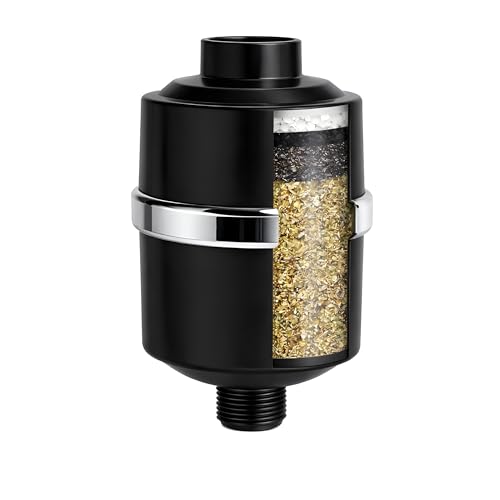 Crystal Quest Shower FilterA five-media cartridge including catalytic carbon — the class with a real mechanism against chloramine — at the budget end of the category, with a 10,000 to 15,000 gallon capacity that is among the longest here. Its certification line needs careful reading: IAPMO tested it, which is not the same as IAPMO certifying it.Five-stage multi-media: coconut shell GAC, c… | Catalytic carbon and a chloramine claim, cheaply | None | |
| 4 | WaterChef SF-7CThe only unit in this registry that pairs a traceable NSF/ANSI 177 certification with catalytic carbon — the media class that has a mechanism against chloramine. WaterChef publishes a 96.6 percent chlorine figure and, notably, makes no chloramine claim at all despite using the media that could support one.Two-stage system built on "Advanced ThermalG… | Catalytic carbon with a certification attached | NSF/ANSI 177 | |
| 5 | 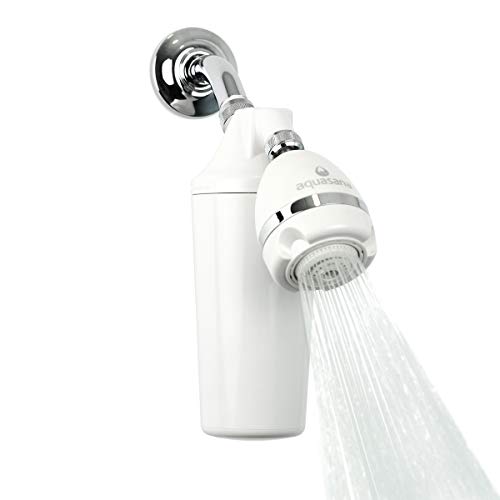 Aquasana AQ-4100One of the few units whose maker names the media outright — copper-zinc KDF plus coconut shell carbon — and one of the few that says anything at all about chloramine. Read its certification line carefully: it is tested to NSF/ANSI 177, not certified to it.Patented copper-zinc (KDF) plus coconut shel… | KDF plus carbon, with the media stated | None | |
| 6 |  Afina Filtered Shower HeadThe best chlorine number independently recorded for any filtered shower head — just under 99 percent. The same test found it reduced no hardness at all and that disinfection byproducts rose rather than fell, which is why it does not top our ranking.KDF-55 with calcium sulfite and activated ca… | The highest measured chlorine reduction | None |
Every figure in this table links to the page it came from in the write-ups below. Units we claim to have tested: 0.
Weddell Duo Shower Filter
Chlorine and disinfection byproducts
The only filter in this set whose maker publishes its NSF test dates and reduction ranges, and the one an independent lab measured at 100% chlorine removal. It also removed disinfection byproducts, which almost nothing else did.
Published specifications
- Filter media
- Dual cartridge: sediment filter plus activated carbonThe maker states "Material: Activated carbon" for the black cartridge and a sediment stage for the white one.Source: Weddell Water — Weddell Duo Shower Filter (retrieved 2026-09-01)
- Stated flow rate
- 2.8 GPMSource: Weddell Water — Weddell Duo Shower Filter (retrieved 2026-09-01)
- Rated cartridge life
- 8,000 gallons, or 5-6 monthsRated capacity 8,000 gallons; the maker also gives a 5-6 month calendar prompt.Source: Weddell Water — Weddell Duo Shower Filter (retrieved 2026-09-01)
- Chloramine
- Not publishedWeddell publishes no chloramine figure. Absence of a claim is not evidence of failure, but it is also not evidence of performance.
- Format
- Inline, fits between the arm and any shower headTool-free; the maker states it fits fixed, rain and handheld heads.Source: Weddell Water — Weddell Duo Shower Filter (retrieved 2026-09-01)
- Housing
- Not publishedWeddell does not state a housing material.
What it does well
- NSF/ANSI 177 chlorine reduction with the test date published
- Also carries NSF/ANSI 53 PFAS reduction and NSF/ANSI 42 particulate reduction
- Independently measured at 100% chlorine reduction and confirmed to remove disinfection byproducts
- 2.8 GPM rating is the highest published flow in this set
- Clear cartridges let you see the sediment stage loading up
Where it falls short
- Publishes nothing about chloramine
- Two cartridges to replace instead of one
- Inline format adds length between the arm and the head
What it does not do
- It does not soften water. An independent lab measured hardness at 125.59 PPM after filtration — effectively unchanged.
- It publishes no chloramine performance data of any kind.
- It is an inline unit, so it does not replace or improve your shower head.
Who it is for
Anyone on chlorinated municipal water who wants the strongest published evidence rather than the strongest published adjectives.
Skip it if
Your utility uses chloramine. Weddell publishes nothing about chloramine performance, and an activated carbon block sized for shower flow is not the thing to bet on for it — see the chloramine guide.
#ad · how we are funded · price as of October 16, 2026
Delta Clarifi Standard (7SF100)
A mainstream plumbing brand's narrow, accurate claim
Delta is the first major faucet brand in this registry, and its own claim is refreshingly narrow: chlorine, sediment and odor. It publishes a flow rate and a 10,000-gallon cadence, and it does not claim to soften water on its own product pages — even though the retail title on its pricier Premium tier says "Hard Water Shower Filter". It publishes no media list and holds no certification.
Published specifications
- Filter media
- Not publishedDelta publishes what the cartridge reduces and not what is inside it. Third-party sellers of compatible cartridges describe KDF and calcium sulfite, but that is their claim about their part rather than Delta's about its own.
- Stated flow rate
- 2.1 GPMDelta publishes this as the basis for its filter-life arithmetic rather than as a headline figure. It sits under the 2.5 GPM federal cap and above the 1.8 GPM several states require on new fixtures.Source: Delta Faucet — Standard Shower Filter Attachment 7SF100 (retrieved 2026-09-01)
- Rated cartridge life
- 10,000 gallons or 6 months, whichever comes firstThe cartridge is the 7RC100 singly or the 5RC100 in a two-pack. Delta's spec sheet states it fits both the 5SF1XX and 7SF1XX attachments, so the two Clarifi tiers share one part.Source: Delta Faucet — Clarifi replacement shower filter spec sheet (5RC100 / 7RC100) (retrieved 2026-09-01)
- Chloramine
- Not publishedDelta publishes nothing about chloramine for the Clarifi line.
- Format
- Inline attachment that fits between the shower arm and your existing headThe Standard tier uses non-metallic housings. Delta states the Premium tier differs only in the shape of that housing.Source: Delta Faucet — Standard Shower Filter Attachment 7SF100 (retrieved 2026-09-01)
- Housing
- Non-metallic, chrome finish on this variantSource: Delta Faucet — Standard Shower Filter Attachment 7SF100 (retrieved 2026-09-01)
What it does well
- Publishes a flow rate — 2.1 GPM — which several premium brands here do not
- 10,000 gallons or six months on a named cartridge, the 7RC100, which fits both Clarifi tiers
- Delta's own claim is narrow and checkable: chlorine, sediment and odor, with no softening claim on its product pages
- Five-year warranty on the housing from a plumbing brand with mainstream distribution
- Inline attachment, so your existing shower head stays where it is
Where it falls short
- No media list published at all
- "3rd-party tested" with no certifying body, no standard and no published percentage
- Cartridge warranty is only 30 days against five years on the housing
- No chloramine statement
- The pricier Premium tier differs only in housing shape, yet its retail listing title adds a hard-water framing Delta's own pages do not use
What it does not do
- It does not soften water. Delta's own product pages claim only chlorine and sediment, and no shower filter of any brand performs ion exchange.
- It does not state what media is inside. Delta publishes what the cartridge removes, not what does the removing.
- It says nothing about chloramine.
- It carries no NSF/ANSI certification that Delta publishes. "3rd-party tested" is a testing claim, not a certification.
Who it is for
Someone who wants a filter from a plumbing brand they already trust, with a five-year housing warranty and a cartridge stocked through mainstream retail, and who is buying for chlorine rather than hardness.
Skip it if
You want to know what is in the cartridge, or you want a certification. Delta publishes neither, and "3rd-party tested" names no body and no standard.
#ad · how we are funded · price as of October 16, 2026
Crystal Quest Shower Filter
Catalytic carbon and a chloramine claim, cheaply
A five-media cartridge including catalytic carbon — the class with a real mechanism against chloramine — at the budget end of the category, with a 10,000 to 15,000 gallon capacity that is among the longest here. Its certification line needs careful reading: IAPMO tested it, which is not the same as IAPMO certifying it.
Published specifications
- Filter media
- Five-stage multi-media: coconut shell GAC, catalytic carbon, ERA 6500, ERA 9500 and ceramic spherical mediaCatalytic carbon is the reason this unit can credibly mention chloramine at all — it is one of two media classes with a real mechanism against it.Source: Crystal Quest — Premium Shower Filter (retrieved 2026-09-01)
- Stated flow rate
- 2.0 GPMSource: Crystal Quest — Premium Shower Filter (retrieved 2026-09-01)
- Rated cartridge life
- 10,000 to 15,000 gallons, a 6 to 12 month lifespan depending on water quality and usageThe replacement cartridge is the CQE-RC-04045. The upper end of that range is the longest published capacity in this registry.Source: Crystal Quest — Premium Shower Filter (retrieved 2026-09-01)
- Chloramine
- Stated to reduce chloramines, alongside chlorine, VOCs and sulfurNo percentage is published for chloramine specifically. The catalytic carbon in the stack is the mechanism that makes the claim plausible.Source: Crystal Quest — Premium Shower Filter (retrieved 2026-09-01)
- Format
- Inline shower filter; a version bundled with a shower head is sold separatelySource: Crystal Quest shower filter — listing on Amazon.com (retrieved 2026-09-01)
- Housing
- Not publishedCrystal Quest does not state a housing material.
What it does well
- Names all five media: coconut shell GAC, catalytic carbon, ERA 6500, ERA 9500 and ceramic spherical media
- Catalytic carbon is one of only two media classes with a real mechanism against chloramine
- States chloramine, VOC and sulfur reduction explicitly, which very little of this category does
- 10,000 to 15,000 gallons and a 6 to 12 month lifespan — among the longest published capacities we cover
- Publishes a flow rate of 2.0 GPM
Where it falls short
- "Independently tested by IAPMO labs" is a testing claim, not a certification — and the body named is one that also certifies, which makes it easy to misread
- No plain reduction percentage on the maker's own page
- The retail listing's "99% Chlorine" headline is not matched by the maker's own wording
- No independent bench measurement of this unit that we could find
What it does not do
- It does not hold a certification. IAPMO ran the testing; Crystal Quest does not state that IAPMO certified the product or that it appears in any listing.
- It does not soften water, and Crystal Quest makes no softening claim.
- Its own site publishes no single clean reduction percentage — the figure is expressed as performance relative to the standard's requirement, which is harder to check than a plain number.
- The Amazon listing title advertises "99% Chlorine", a figure that does not appear in that form on Crystal Quest's own product page.
Who it is for
Someone on chloraminated water who wants catalytic carbon without paying the premium the certified catalytic-carbon unit asks, and who will read the testing claim for what it says.
Skip it if
You want a certification you can look up. "Independently tested by IAPMO labs in accordance to NSF/ANSI 177-2019" describes a test, not a listing.
#ad · how we are funded · price as of October 16, 2026
WaterChef SF-7C
Catalytic carbon with a certification attached
The only unit in this registry that pairs a traceable NSF/ANSI 177 certification with catalytic carbon — the media class that has a mechanism against chloramine. WaterChef publishes a 96.6 percent chlorine figure and, notably, makes no chloramine claim at all despite using the media that could support one.
Published specifications
- Filter media
- Two-stage system built on "Advanced ThermalGuard" catalytic carbonCatalytic carbon is the media class that chemically addresses chloramine as well as free chlorine — though WaterChef publishes no chloramine performance figure.Source: WaterChef — SF-7C shower filter system (retrieved 2026-09-01)
- Stated flow rate
- 2.5 GPM on the standard modelA separate SF-7C-ECO version is sold for states that require 1.8 GPM fixtures. The two are different SKUs, not a restrictor swap.Source: WaterChef — SF-7C shower filter system (retrieved 2026-09-01)
- Rated cartridge life
- Up to 10,000 gallons, or about 6 monthsThe replacement part is the RCSF-7, sold singly and in a two-pack.Source: WaterChef — SF-7C shower filter system (retrieved 2026-09-01)
- Chloramine
- Not publishedWaterChef publishes nothing about chloramine. Catalytic carbon is the media class with a real mechanism against it, which makes the silence notable rather than damning — but an absent claim is not evidence of performance, and NSF/ANSI 177 does not evaluate chloramine either.
- Format
- Shower system with an adjustable handheld wand, five spray settings and a stainless steel hoseSource: WaterChef Premium Shower Filter System SF-7C, chrome — listing on Amazon.com (retrieved 2026-09-01)
- Housing
- Not publishedWaterChef does not state a housing material.
What it does well
- Certified to NSF/ANSI 177 by IAPMO R&T, with the certifying body named
- Built on catalytic carbon rather than KDF — a media class with a broader mechanism
- Published chlorine reduction of 96.6% across the rated cartridge life, not just when new
- 10,000 gallons or six months on a named replacement cartridge, the RCSF-7
- Makes no softening claim, which in this category is a mark of care
Where it falls short
- No chloramine claim at all, despite using the media class that addresses it
- No published housing material
- The 2.5 GPM standard model is not compliant in states capping fixtures at 1.8 GPM — that is a separate SKU
- Priced well above the cheapest certified option, which is an inline body
What it does not do
- It does not claim to reduce chloramine. Catalytic carbon is the media class with the right mechanism, but WaterChef publishes no chloramine figure and NSF/ANSI 177 does not evaluate chloramine performance, so nothing here is verified for it.
- It does not soften water, and WaterChef does not claim it does.
- It does not publish a housing material.
- The standard model is a 2.5 GPM system. Households in states that cap fixtures at 1.8 GPM need the separate SF-7C-ECO version instead.
Who it is for
Someone who wants a certification they can trace to a named body, on a media class that does more than KDF, and who wants a handheld wand as part of the deal.
Skip it if
You want a slim inline body or the cheapest certified option. This is a full shower system with a wand and a hose, and it is priced accordingly.
#ad · how we are funded · price as of October 16, 2026
Aquasana AQ-4100
KDF plus carbon, with the media stated
One of the few units whose maker names the media outright — copper-zinc KDF plus coconut shell carbon — and one of the few that says anything at all about chloramine. Read its certification line carefully: it is tested to NSF/ANSI 177, not certified to it.
Published specifications
- Filter media
- Patented copper-zinc (KDF) plus coconut shell carbonSource: Aquasana — shower filter with shower head (retrieved 2026-09-01)
- Stated flow rate
- 2.5 GPMStated as the optimum flow rate.Source: Aquasana — shower filter with shower head (retrieved 2026-09-01)
- Rated cartridge life
- 10,000 gallons, or up to 6 monthsSource: Aquasana — shower filter with shower head (retrieved 2026-09-01)
- Chloramine
- Chloramines listed among contaminants reduced; no percentage publishedSource: Aquasana — shower filter with shower head (retrieved 2026-09-01)
- Format
- Filter body with shower head; a head-free version (AQ-4100NSH) also existsSource: Aquasana AQ-4100 — listing on Amazon.com (retrieved 2026-09-01)
- Housing
- Not publishedAquasana does not state a housing material.
What it does well
- Names its media: patented copper-zinc (KDF) and coconut shell carbon
- Published capacity of 10,000 gallons or up to 6 months
- Publishes a chlorine reduction figure of over 90%
- Sold with a head or as a filter-only unit for an existing head
Where it falls short
- Tested to NSF/ANSI 177 rather than certified to it
- Chloramine is listed but not quantified
- 2.5 GPM is above the 1.8 GPM cap some states apply to new fixtures
What it does not do
- It does not soften water, and Aquasana makes no softening claim.
- It is not certified by NSF; the wording is "independently tested to NSF/ANSI Standard 177".
- It lists chloramines among what it reduces without publishing a reduction percentage for them.
Who it is for
Someone who wants a stated media list and a published capacity, and who cares more about what is inside than about the finish.
Skip it if
You need a certification mark rather than a testing claim. "Independently tested to" is a weaker statement than "certified by", and the difference matters.
#ad · how we are funded · price as of October 16, 2026
Afina Filtered Shower Head
The highest measured chlorine reduction
The best chlorine number independently recorded for any filtered shower head — just under 99 percent. The same test found it reduced no hardness at all and that disinfection byproducts rose rather than fell, which is why it does not top our ranking.
Published specifications
- Filter media
- KDF-55 with calcium sulfite and activated carbonSource: Afina filtered shower head, chrome — listing on Amazon.com (retrieved 2026-09-01)
- Stated flow rate
- 2.5 GPM with a 1.8 GPM restrictor supplied; 1.85 GPM measured independentlyThe measured figure is WaterFilterGuru's, not ours. A separate 1.8 GPM variant is sold for California and New York.Source: WaterFilterGuru, "Afina Shower Head Review" — independent lab testing, credited to them (retrieved 2026-09-06)
- Rated cartridge life
- 90 days on the shower head listing; the replacement-filter listing says every 2 monthsAfina's own two listings disagree. We report both rather than picking the flattering one; the independent reviewer recorded 2 months.Source: Afina filtered shower head, chrome — listing on Amazon.com (retrieved 2026-09-01)
- Chloramine
- Not publishedAfina publishes no chloramine performance figure.
- Format
- Replacement shower head with integrated filterSource: Afina filtered shower head, chrome — listing on Amazon.com (retrieved 2026-09-01)
- Housing
- Not publishedFinishes are listed — chrome, brushed nickel, matte black — but no housing material is stated.
What it does well
- Independently measured at just under 99% chlorine reduction, 1.68 PPM down to 0.02 PPM
- Media named outright: KDF-55 with calcium sulfite and activated carbon
- Measured flow of 1.85 GPM, which the reviewer recorded as retaining 100% of baseline
- Sold in several finishes, and in a 1.8 GPM variant for California and New York
Where it falls short
- No certification of any kind
- Disinfection byproducts rose in independent testing
- Marketed for hard water while reducing no hardness
- Short cartridge interval, and the maker's own figures disagree on what it is
What it does not do
- It does not soften water. An independent lab measured hardness going in at roughly 250 PPM and coming out at 251 — despite the hard-water marketing.
- It did not reduce disinfection byproducts in that test. All three measured DBPs increased after filtration rather than falling.
- It holds no certification. The independent reviewer recorded it as neither performance certified nor design certified.
Who it is for
Someone on chlorinated municipal water who wants the strongest measured chlorine result in a replacement head and is buying for that specifically.
Skip it if
Your report shows disinfection byproducts near their limits, or you want a certification. Neither is this product's strength — the DBP discussion.
#ad · how we are funded · price as of October 16, 2026
Who publishes a flow rate, and who does not
This is the table the page is built on: every unit we cover, the flow figure its maker publishes, and a link to where we read it. The blanks are the finding, not a gap in our research.
Published flow rate across every filter we cover
10 of 29 publish this figure. Every number below links to where it came from.
Compiled from the manufacturers’ own published material on 2026-09-01. We have measured none of it ourselves — see how we rank. Found an error? Tell us and we will correct it.
Ten of twenty-nine publish a number. Nineteen publish nothing at all — including several premium replacement heads whose listings describe the shower experience at length. That ratio is the most useful thing on this page: in a category where more than half the makers will not state the flow rate of a fixture that has to be rated to be legal, "high pressure" is not a specification you can shop on.
It also explains why the ranking above is short. We have not ranked those nineteen as bad on flow. We excluded them, because there is nothing to rank — and a page that estimated their GPM to fill the column would be inventing the one figure the reader came for.
The published figures, read against the cap
Every figure is the manufacturer's own published number except the two marked measured, which are WaterFilterGuru's independent measurements and are credited to them on each product's own page. The nineteen units absent from this table publish no flow rate, and we did not estimate one for them.
What an inline filter actually costs you in flow
Less than the category's reputation suggests, and there is a standard that puts a floor under it. NSF/ANSI 177 requires a certified filter to maintain at least 1 GPM at 80 psi of initial dynamic pressure throughout testing, across its whole rated life — so a certified unit has demonstrated that it does not choke the flow to nothing as it ages.
The two independent measurements in the table are the closest thing to a real-world answer anyone has published, and they point the same way. WaterFilterGuru measured the Sprite Slim-Line 2 at 1.65 GPM against a claimed 1.8 — a shortfall of under 10 percent, which is smaller than the gap between a 2.5 GPM head and a 1.8 GPM one. They measured the Afina head at 1.85 GPM and recorded it as retaining 100 percent of their baseline flow: no measurable loss at all.
One caveat on that second figure, because it matters more than the number. Afina rates the head at 2.5 GPM and supplies a 1.8 GPM restrictor in the box, and WaterFilterGuru did not state which configuration they measured. So 1.85 GPM is a real measured figure, and we cannot tell you what it was measured against. What it does establish is the useful part: a filtered head at this flow took nothing off that reviewer's baseline.
If you live in California or New York
Your ceiling is 1.8 GPM on any new fixture, which takes most of this page's upper half out of consideration as a head. It does not take out the inline options, because an inline filter is not a fixture replacement — you keep your existing compliant head and its nozzle design, and the filter sits behind it.
Two makers here sell a genuinely compliant variant rather than asking you to modify the standard one: WaterChef's SF-7C-ECO and Afina's separate 1.8 GPM version. Those are different part numbers with their own ratings. Buying the 2.5 GPM model and taking the restrictor out is the one approach we will not recommend, because it defeats the rating the fixture was sold under.
What twelve months of these costs
Flow is not the only recurring consequence of this choice. Every unit above is a cartridge on a schedule, and the inline filters that preserve your shower head are also the ones you keep re-cartridging.
Twelve-month cost of the picks on this page
Purchase price + (cartridges per year x cartridge price). Cadence comes from published specifications; the money comes from the live price layer or is left blank.
Prices as of October 16, 2026, from the live retailer feed. Cartridge prices are not included in the year-one figure above because they are a separate purchase with a separate live price. The full method.
Which of these to buy
- You like your shower head and want to keep exactly how it feels → the [Weddell Duo](/reviews/weddell-duo). The highest published flow in the category at 2.8 GPM, inline, and separately the strongest chlorine evidence here — NSF/ANSI 177 with the test date published, and 100 percent chlorine removal measured independently. Honest cons: it publishes nothing about chloramine, it is two cartridges rather than one, and the inline body adds length between the arm and the head.
- The same idea from a plumbing brand, for less → the [Delta Clarifi](/reviews/delta-clarifi-shower-filter). 2.1 GPM published as the basis of Delta's own cartridge arithmetic, an inline attachment that leaves your head alone, and a cartridge stocked through mainstream retail. Honest cons: Delta publishes no media list and holds no certification, and its "3rd-party tested" line names neither a body nor a standard.
- The cheapest unit in the category that will tell you its flow rate → the [Crystal Quest](/reviews/crystal-quest-shower-filter). 2.0 GPM, inline, with five named media including catalytic carbon. Honest cons: "independently tested by IAPMO labs" describes a test and not a listing, and its Amazon title headlines a percentage its own product page does not state.
- You want the certification more than the ceiling → the [WaterChef SF-7C](/reviews/waterchef-sf-7c). 2.5 GPM, certified to NSF/ANSI 177 by IAPMO R&T, built on catalytic carbon. Honest cons: it is a full system with a wand and a hose rather than a slim body, it is priced accordingly, and California and New York households need the SF-7C-ECO part number instead.
- You want the ceiling with the media actually named → the [Aquasana AQ-4100](/reviews/aquasana-aq-4100). 2.5 GPM stated as the optimum flow, copper-zinc KDF plus coconut shell carbon, 10,000 gallons. Honest cons: it is tested to NSF/ANSI 177 rather than certified to it, and it lists chloramines without publishing a reduction figure for them.
- You are replacing the head anyway and want a measured number → the [Afina](/reviews/afina-filtered-showerhead). The only replacement head in this category whose flow rate somebody independent has measured — 1.85 GPM, recorded as retaining 100 percent of the reviewer's baseline flow. Honest cons: it is one of the most expensive heads we cover, the same independent test found it reduced no hardness at all despite the hard-water marketing, and its own listings disagree about the cartridge interval — 90 days on the head listing, every two months on the replacement filter.
- You are in California or New York and want it settled → an inline filter behind the head you already own. Your head is already rated at 1.8 GPM and nothing in this category will improve on that, so the only question left is which filter, and the inline ranking answers it on certification rather than on flow.
What we would skip, and why
Any filtered head advertised as "high pressure" with no flow rate published
This is the most common shape in the category and it is the easiest to check. A flow rate costs a manufacturer nothing to publish — the fixture has to be rated to be legal in the first place. A company that prints "high pressure" on the box and omits the GPM figure from its own product page has chosen which number you get to see. The table above lists every maker that will tell you.
A 2.5 GPM model, if you live in California or New York
Both states cap new shower fixtures at 1.8 GPM, so a 2.5 GPM head is not a legal fixture there. Two makers on this page sell a compliant alternative as a separate part number rather than as a restrictor swap — WaterChef's SF-7C-ECO and Afina's 1.8 GPM variant. Buying the standard model and removing a restrictor is not a fix; an inline filter behind your existing compliant head is.
Any filter claiming it will increase your water pressure
A filter is resistance added to the water path. It can subtract from your flow and it cannot add to it, and none of the filters on this page claims otherwise. A shower head can make a weaker flow feel stronger by narrowing its nozzles, which is a real effect and a different mechanism entirely — but that is the head doing it, not the filter.
Questions people actually ask
+ What is the highest flow rate a filtered shower head can have?
2.5 GPM. That is the US federal maximum for any shower head, filtered or not, and California and New York cap new fixtures at 1.8 GPM. No filtered head legally sold in the US exceeds those figures, which is why "high pressure" cannot mean more water than a plain head delivers.
+ Do filtered shower heads reduce water pressure?
A little when new, and progressively more as the sediment stages load with use. NSF/ANSI 177 requires a certified filter to hold at least 1 GPM at 80 psi across its whole rated life. The two independent measurements we could find were modest: WaterFilterGuru measured the Sprite Slim-Line 2 at 1.65 GPM against a claimed 1.8, and recorded the Afina head's 1.85 GPM as retaining 100 percent of their baseline flow.
+ Can a shower filter increase water pressure?
No. A filter is resistance added to the water path, so it can only subtract. A shower head can make a capped flow feel stronger by narrowing its nozzles, which is a genuine effect — but that is the head doing it, and swapping your head for a filtered one means inheriting whatever nozzle design the filtered head came with.
+ What is the best high pressure filtered shower head?
The honest answer is to keep your head and fit an inline filter behind it, because spray force is engineered into the head and no filter can add any. If you want a number, the highest published flow in this category is the Weddell Duo's 2.8 GPM, and it is an inline unit rather than a head.
+ Which filtered shower heads are WaterSense labeled?
None that we cover. WaterSense is the only program that independently certifies spray force, spray coverage and pressure compensation, at no more than 2.0 GPM. No filtered shower head in our registry publishes a WaterSense label, so every pressure claim in this category rests on the manufacturer's own description.
+ Will an inline filter work with a rain shower head?
Usually yes. An inline filter fits between the shower arm and the head, so the head's own mounting is unaffected. A wide rain head spreads the same capped flow over a larger area, which is why it feels gentler before any filter is involved.
Sources
Everything on this page traces to one of these. Where a source is brand-owned we say so, because a filter maker explaining filter chemistry has an interest and you are entitled to weigh it.
- US EPA WaterSense — showerheads and the 2.5 gpm federal maximum
- Plumbing & Mechanical, "NSF/ANSI Standard 177: A Level Playing Field for Shower Filter Claims" (retrieved 2026-09-01)
- WaterFilterGuru, "The Best Shower Head Filter" — independent lab testing, credited to them (retrieved 2026-09-01)
- WaterFilterGuru, "Sprite Slim-Line 2 Shower Filter: A Data-Driven Review" (retrieved 2026-09-01)